Tag: writing

  • Re: Re: ‘A Woman’s Issue’ by Margaret Atwood [with notes].

    Persecution saturates the neck of young women. This damp exterior, crushed between jagged ribs and the unbecoming ill-remains of fat, will become explicit, R-rated, subverted to a perversion of this body, her body. Forget about the care we show intent — it is now stretched, disjointed; an awkward veil of femininty (lace and all.)

    [I could be remarkable, and prudish.]

    Should I talk upon the juvenile nature of flexibility? Where, the extension of ones hips [the landscape for childbirth] & career & jaw, remains sexual. Deceptiveley delicate ‘the woman’ is.

    Either way, the post / pre / birth of modern misogyny aligns a women to be knowledgeable in its ‘devices’ — that which shocks, suffocates, pricks, invades, redefines. That of a collar or hand, of personal persuasion to bind the stomach, the fat under the arms, the placement of the toes upon the feet — how they should curve until the bones snap.

    Then, there is the awful codification of ‘muse’, which could have been disastrous, but remained ill-defined as women began to carve space into art and music and fashion (still posing, hooked on devices, drugged to calm the eyes). Atwood was familiar with such inflexibility of women in art, or their use for it, and therefore made her own exhibit.


    Space: Part I

    Space: the three feet between their sunken back in line and your purse (controlled by stickers glued to the pavement and an awkward placement of your hands); the lack-there-of between a shared hug (how we create an allowance for the possibility of a greeting); an interval (the bell on a microwave, the minutes between contractions); the cycles of sleep (how religion was formed from hours of REM); a uterus (childbirth, cysts, IUDs’); the gap between breaths, cells, neurons, eyebrows.

    Briefly, I want you, the reader, to remove yourself from any understanding that you are about to read a poem (and any notion that it may be life changing). Rid yourself of excitement, pride, humility, or historical insight you may feel is relevant to the female body. Now, this intangibility of your intelligence should be caressed — held with enough care that dislocation from the physical body is nurturing, yet necessary.

    Here, I urge you simply, to consume.

    “The woman in the spiked device

    that locks around the waist and between

    the legs, which holds in it like a tea strainer

    is Exhibit A

    We must start with ‘The’, whose practical use in the sentence must provide a body, a root, for the further construction of a ‘woman’. Yet, Atwood extends past simple grammatical structures to dictate a tone of culpability, where name is unknown, and whose consciousness holds no weight in her description.  The ‘woman’ is dismissed – nameless, muted, and withheld. By the first sentence alone, Atwood introduces the present, systemic, pornographic reality of women (who endure sexual slavery, prostitution, brutish desires and ferocious kinks). She is silenced, and more importantly, spoken for.   

    Even further, the frequent sexual strangulation present in pornography and sexual encounters, is leaving women with irreparable brain damage. Therefore, suggestions of ‘the woman’ being implicated as ‘brain dead’ are probable, and often passively initiated when a ‘spiked device’ strains upon the neck and legs. It is then, that the omniscient voice must dictate her despair.  

    What are we to then make of ‘Exhibit A?’ Are the readers meant to watch, loosely, abhorrently, decisively like one does in an art exhibit? (Never too closely, or even somewhat thoughtfully, limited to opening hours and release dates, constrained by the attention span of the viewers). Is it possible Atwood is referring to an article, doused in symmetrical red circles and frilly skirts as the women try to cover their face? Do we place the symbolism past the women to inspect her constraints, (i.e the collar, the sunken waist, the immobility of mouth and body) and leave the connotations of ‘Exhibit A’ to schoolboys’ magazine as they move the image side to side.  

    By the end of the first stanza, the removal of the subject is dualistic. Atwood respects the privacy of ‘the woman’ enough to soften her features, deconstructing the hard contours of breasts or a demeanour that must be conquered, while being unable to free her body from the sexual, sociological constraints – that which ‘holds [here] like a tea strainer’. A tool, designed to grasp and clench; while also actively releasing parts of itself; the dilution of the women is uncanny to modern, female autonomy.  

    What pleasures have I given away?


    Space: Part II

    “The woman in black with a net window

    to see through and a four-inch

    wooden peg jammed up

    between her legs, so she can’t be raped

    is Exhibit B

    Let us assume that Exhibit B is a photograph, which was displayed on National Geographic for the features of her face (how the world could not fathom such beauty enduring starvation, or genocide, maybe sexual abuse, and modern slavery). Let us hide the wooden peg, claim that the object was in the way of the shot, (a mental disturbance at best for the viewer) and rather focus on how the pattern of the net reflecting amongst her skin. Please do not entertain the background (the refugee camp, the perished mountains and dry soil, those rushing toward flour or the individual surrounded by bottles) rather focus on the eyes.

    Who is violent, then?

    Exhibit B builds upon the sexual strangulation of ‘the women’ in ‘devices’, while precisely eliminating her personal liberation of sexual security. The viewer must walk between the exhibits, aware of the struggle the soles of their feet encounter with the wet, marble floor to the persecution of ‘the women’s’ skin (& the unforgotten space of flesh between her legs), which to them, is all movement anyway.

    Insertion is not dictated, nor coerced, it is ‘jammed’, pummelled, immobilized within her uterus. The violation is personal, yes, but the removal of space between her legs furthers the offence that she must lose in ones translation of all we are meant to sacrifice.

    There was a window, (Atwood recalls), which is pliant for the man. ‘The woman’ is now a dominion, conquerable and contagious in here lack of exploitation. He is goverend by assumption, and therefore, once capable of interfence, his depravity of his violence will surpass the insertion of the wooden peg.

    What is Exhibit B?

    a) The women of Tigray, who after being forcefully raped, succumbing to the pain of nails, screws, plastic rubbish, sand, gravel, and letters jammed into their uterus.

    b) Rape being a tactic of war and interastate conflicts in Sudan, by the RSF (Rapid Support Forces) which forced women into sexual enslavement, gangrape, sexual assualt against children, and enacting violence which displaced women and their children in the Dafur region.

    c) The men and women in the Abu Ghraib prision in Iraq, that faced psychological torture, sexual humiliation, rape, confinement, and electrical shocks which were produced by “enhanced interrogation techniques” and what we know today as “The Hooded Man”.

    d) Women, boys, girls, dogs, and animals in Palestine, Ukraine, Sudan, Congo, Vietnam, Afghantistan, Iraq, Ethipia, Mali, Nigeria, Somalia, Syria, Bosnia & Herzegovina (…) who become paramount staistics in reports a decade later, yet have succumbed to their injuries years prior.

    e) Annihilation.    

    16.10.25

    It was Denial in my throat. All of this.
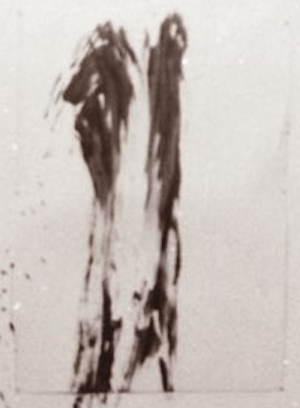
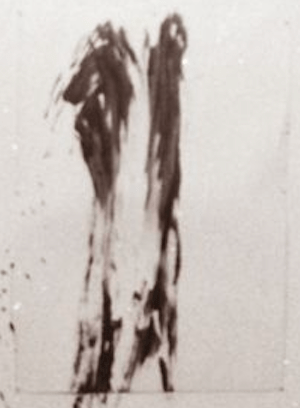
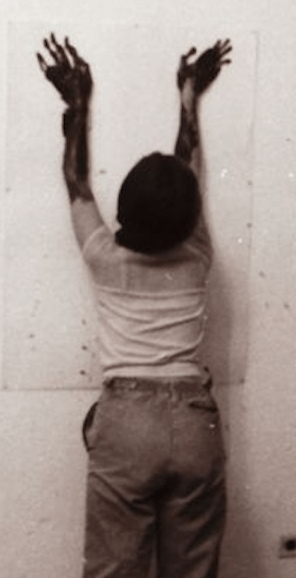
    Tania Bruguera, Title: Tribute to Ana Mendieta (1985)

    I was a petulant child, smothered by my own two hands — hands that were recognized, and therefore clenched.

    There was little articulation amongst the imposing stature of the self, maybe it was the balancing part I struggled amongst confrontation. This ‘self’ must be considerate enough to bruise it once in a while, alongside proving the subtlety of the act alone.

    Much of these days, intention is of that same false decree we hang religion from. Space (a tribute to oxymorons) must be weighed, sifted, and if appeased, saturated in front of ones mirror suitable for child-like identification. Our eyes no longer belong to the face of our mother, neither will these ‘petulant hands’, and what do I make of my righteous ability?

    I have already learned how to breath.

    A manuscript for greed, the breath is. Delicate and horrifyingly immeshed with a voice for death.

    What else have I known?


  • (no title)

    Sometimes, briefly or as though I know what it means to dream, the leaves begin to shift each time I am near, as if the tree could fathom the soul of my name. There was time spent defining energy (the soul gliding amongst tissues and muscles and nerve endings as my mouth once did on the rim of a wine glass; purely intentional in the mark I left behind). A familiar tug of war, as death mechanically hovers over the ankles (and family corners the home of the soul), that one’s eyes, saturated in hunger, blink toward their rife separation. A dilemma which begins at a curve, disjointed by laws in physics and treehouses, till the breath begs to touch the calcium of carved bone.

    I suppose my chatter toward energy is valued at the notion that it cannot be destroyed; therefore, the remnants of my smile could be altered, but not erased. So, my laugh should follow alongside the crooked shape of my eyes with each wink… (and I am finding it hard to believe in an afterlife, when your smile still exists). Maybe, it is the wind I mentioned previously?

    Anyway, I can tell you that the light, which arguably reflected off the leaves at 5 PM last Tuesday, was proof enough.

    Fuck the wind. Let’s share this fantasy together?

    Please.

    Three days ago, a surface-level cavity had to be filled, yet when they drilled away such brief remains of bone and decay, I wondered if you would see my smile clearly in the trees. Should we let this hope extend amongst the row of ants captivated by the rich, dense roots of this oak tree we buried our catastrophic fingerprints upon?

    What should we do about the winter due to arrive soon?

    Where will your smile go then?

  • A Greek Mimesis of Persian Tragedy

    Grade: 65, 2:1; Drama, Term 4 (2500 words)

    *Paper has not been altered after feedback has been given.

    Tragedy is socially dramatized and linguistically undefined, positioning the polis1 toward ‘arbitrary and sterile2’ definitions, with little effect. The contextualisation of human suffering is mimetically presented within Aeschylus Persians, as Greek interpretation strives to imitate Persian political atrophy and civic decimation within a framework of the Persian – Greco War. Herein, Steiners’ definition of ‘Tragedy’ presents a dualistic argument able to sustain the dialogic expressions of the characters, as grief is constructed within the narrative: “The intentional focus can be narrow and specific, as in ‘a tragic accident’ or undefinably spacious, as in the shopworn phrase ‘a tragic sense of life’3”. I aim to expand upon choral identity within a narrative framework alongside a corporeality present in lamentations to explicate a reconstruction of human suffering of Persians’ through a mimetic, Greek, tragedian perspective.  

    Choral Identity and Vocalization 

    Participation of the chorus in Aeschylus Persians is strategically abnormal. Vocal and dominant within the dialogue, the group of women defy a traditional placement that is commonly mollified by moral ideology or a modest collective commentary, seen within Euripides Medea or even, Aeschylus Agamemnon. The presentation of the choral identity begins within Aeschylus temporal, theatrical depiction, as his “[…] display of an Athenian chorus dressed as Persian males right at the opening of his 472 BCE play was a daring and, as far as we know, unparalleled gesture4”. Aeschylus challenge toward the presentation of a female-dominant role, negates an ancient theatrical structure, submerged in gender presentation, social power, and vocality. This (‘daring’) act exemplifies the bold nature of the tragedian, whose decisive linguistic conventions, posit his work outside social convention — as I later argue, to utilize as means to further potent representations of human suffering.  Additionally, it’s “fundamentally chora medium5” rejects enforced civic displays of public mourning, that which was “permitted, although in a controlled form6” and could not be re-enacted by “women under the age of sixty, other than close relations, [who] could enter the chamber of the deceased or follow the procession to the tomb7”. Aeschylus’ intent surpasses a Greek, social presentation of mourning, to depict a Persian pathos existing outside Athenian civic obligation, elucidating the dramatic within a cacophony of chants, wails, laments, and lacerations.  

    To begin, I aim to construct a timeline of the Persian chorus to facilitate their progressive, polyphonic voice as it encounters a tragic framework of war. Before receiving word from the messenger, the Queen converses with the chorus on an omen she received with fear. The routine role of moral guidance is sustained within the response of the chorus, as they reply:  

    Mother, we do not wish to say what would make you wither unduly fearful or unduly optimistic. You should approach the gods with supplications and ask them, if there is anything sinister in what you saw8

    Yet, as the chorus immerses their voice within the Persian politic, “moments of ‘self-referentiality9” deconstruct their role within mediation, opting to dialogically employ pathea10 as means to draw the audience into the familiar condition of grief – an ‘integrated experience’ outlined by Carter. As the socio-political and economic life in the Persian city, Susa, bears transitional tension, the mimetic dramatized upon conditionally relies on Aeschylus knowledge on the Greek politic and legislation, to correctly divide the public and private sphere of potential suffering. The body of the chorus unflinchingly condemns Xerxes fatal actions, as the young king went to war with the Greeks: “Otototoi, you are saying / that the dead bodies of our loved ones / are floating, soaked and constantly buffeted by salt water, / shrouded in mantles that drift in the waves11”, reconstructing a new temperament of the chorus, through the sheer evaluation of Persian bodies floating amongst the sea. Steiner’s broad sense of tragedy captures dream-filled omens and spacious declaration – “and < in every house / the woman left behind > howls for her young husband12” – while also targeting the dead bodies of (‘loved ones), (‘buffeted), (‘shrouded) and (‘floating’) amongst the sea thousands of miles away. The intentional narration, vocality, and tonality immersed in accusation the chorus fosters their eventual barbaric action within laments and public bouts of mourning. This vocality of anguish slightly shifts in its accommodation from the internal to external justification, as the chorus directs their speech to the public space before them: “O you god who has caused such toil and grief, how very heavily you have leaped and trampled on the entire Persian race!13” The act, formerly confined to dialogue of the Queen, Messenger, and Chorus, is unconsciously torn as the women turn their attention to the metaphysical, to a God with capability to proctor death fit for immense human suffering. Placating, questioning, blaming, and sadness, the liminal atmosphere of the chorus’ bargaining eventually commences full-bodied laments that harbor a collective anguish, turmoil, and anger of the (‘Persian race’).  

    Furthermore, the mimetic performance rests upon an historic reality, which eliminates the prepotent of the mythic, until it becomes a“[…] kind of lamentation more shocking, for the audience is encouraged to compare what they see with their own funerary practices14”. The funerary procession is noncorporal, the bodies of the soldiers cannot be returned to Susa, leaving Xerxes in worn out attire, and a weeping chorus to fulfill a memorial of the lost men. Specifically, the function of the chorus as a collective, capable of anguished re-enactment, yet fundamentally immersed in Greek mimicry to feasibly represent the Persian individual concurrently encountering a personal, vivid suffering.  

    In comparison, Alice Oswald’s, Memorial, captures the similar literary essence of dedication amongst a funerary procession, developing an oral cemetery for the lost bodies: 

    DEMUCHUS 

    LAOGONUS 

    DARDANUS 

    TROS 

    MULIUS 

    RHIGMOS 

    LYCAON 

    MYDON15 

    Aeschylus’ Persian eulogy exacerbates the role of the chorus – their demands target the power dynamic between citizen and King, dismissing civic hierarchy to emphasize the suffering the women unconsciously feel. Language becomes a weapon of distrust, commencing verbal accusations against Xerxes through the use of (‘you’), while also suggest the young king is neither (‘brave’) and (‘nobly-born) due to his fatal actions. Before the lamentations proceed, the chorus bemoans stanzas of notable soldiers lost from this encounter, crying out: “Where did you leave Pharnuchus, / yes, and the brave Ariomardus? / Where is the lord Seuacles / or the nobly-born lilaeus, / Memphis, Tharybis and Masistras, / Artembares and Hystaechmas?/ I ask you this again16”. Mirroring Oswald’s declaration, the constructed voice of the once mediating chorus is left to return the dead amongst Persian lands by a verbal eulogy, leaving the group of women to unconsciously redefine their capabilities to a role of mourners.  

    Corporeality and Lamentations 

    Correspondingly, the two distinguished laments of the chorus, (l.255-59) and (l.908-1077) redefine characteristic responses to suffering, as Aeschylus shifts from the internal (private) to the external (public), within his displays of anguish. Yet, this shift into a public sphere, orients the mourning into the political, defining the act of laments indecent, unqualifiable, or unnecessary through representative measures of class, gender, and age. Paul Kottman expands upon the mimetic within a philosophical framework, denoting the theatrics to hold political qualities, allowing for the expansion into the role of the chorus: “[…] like the praxis it imitates – is also pre-political, for it is precisely the interaction that adheres in speaking and action among a plurality that opens the space for the polis17”. The Persian (‘polis’) is intertextual and heavily reliant on Aeschylus interpretation of the Greeks socio-economic, politic, and literary convention, simply due to the representative nature of mimesis. Therefore, Greek tragedies like The Fall of Miletus18 contrive anecdotes of tragic pathos Athenians experienced, whose substantially vivid baseline of grief, becomes a unification of meaning and significance, that would be pertinent to its application in Persian suffering19.  

    Within the tragedy, I aim to touch upon the severity of the laments exercised by the Chorus and the furthered incitement of verbal encouragement of the young king, Xerxes. Aeschylus’ stage directions signal a shift within the vocality of the chorus, alluding to an exacerbated tonal shift of anguish: “[They shift from chant to song] / The land laments its native youth / killed by Xerxes, who crammed Hades with Persians20”. The accusatory tone is projected within a unified, collective manner, yet a polyphonic21 structure surrounds the notion of ‘chant’ (i.e it necessitates a crowd to project in a unison manner) and produces a vivid spectacle of voice to demonstrate public suffering. Even further, the utilization of the body to endure laceration and physical punishment within a lamentation, is mimetic – representative of women in Greek processions of mourning: “[…] women displayed their mourning […] by beating, and sometimes baring, their chests, by loosening and tearing their hair, by crying and wailing, by tearing their robes and by scratching their cheeks22”. Persian suffering, therefore, rest upon the intertextual conceptions and assumption of character, alongside Aeschylus framework and personal encounter of war. 

    Ultimately, the expansion of corporal identity within the chorus expands to adjust to the demands of Xerxes, and crucially the lack of recovery toward the bodies of the soldiers:   

    Xerxes 

    and Chorus 

    Ototototoi! 

    Chorus 

    And mixed in with my groans will be – 

    oi! – black, violent blows. 

    Xerxes 

    Beat your breasts too, and accompany the action with a 

    Mysian cry. 

    Chorus 

    Painful, painful! 

    Xerxes 

    Now, please, ravage the white hairs of your beard23

    The (‘black, violent blows’) composed alongside the beating of the breast, produce a gendered, physical, and an aggressive tone defined by (‘groans’) and the (‘Mysian cry’). The suffering surpasses the emotional, liminal boundary to reassign the chorus as a witness and a narrator to their own grief. The collective identity of the chorus merges the private individual of the women to an uncontrollable entity, encouraged to experience the (‘painful’), fatal disposition of the Persian soldiers. Aeschylus continuation of mimetic narratives within a Greek understanding, situates Persian suffering past individual fatality to a unified, collective identity of civic collapse.  

    Thus, the ‘living memory24’ of Aeschylus and Athenians alike, constitute a relation to a ‘mimetic performance25’ that can support, characterize, and develop a theatrical performance of human suffering outside a cultural context. Aeschylus’ Persians interacts within a theoretical framework of polyphonic and mimetic analysis, expanding Steiners’ dichotomy of tragedy to a vivid corporeality and unique narration of a Persian chorus.  

    —–

    Footnotes:

    [1] See, The Oxford Classical Dictionary, definition of polis. In this paper, I will be referring to Oswyn Murray’s definition listed: The polis is the characteristic form of Greek urban life; its main features are small size, political autonomy, social homogeneity, sense of community and respect for law.

    [2] Steiner 2004: 2.

    [3] Steiner 2004: 1

    [4] Hopman: 58.

    [5] Hopman: 59.

    [6] Foley 2003: 25.

    [7] Foley 2003: 23.

    [8] Aeschylus 2008: l. 215-17.

    [9] Carter 2011: 247.

    [10] Utilized within a plural sense of pathos.

    [11] Aeschylus 2008: l. 274-77.

    [12] Aeschylus 2008: l. 12-13.

    [13] Aeschylus 2008: l. 515-6.

    [14] Swift 2010.

    [15] Oswald 2012: 12.

    [16] Aeschylus 2008: l. 967-73.

    [17] Kottman 2003: 82.

    [18] Kottman produces the account of Athenians watching the performance of The Fall of Miletus within the writing of Herodotus. I have taken an excerpt for reference of suggest claims above to articulate a baseline for Greek suffering. “The audience in the theater burst into tears, and the author was fined a thousand drachmae for reminding them of a disaster which touched them so closely. A law was subsequently passed forbidding anybody ever to put the lay on stage again” (Kottman 2003: 83.)

    [19] Further information is sourced from Steinby 2013: 2. Excerpt follows as such: “The unit of the world in aesthetic seeing is not a unity of meaning or sense – not a systematic unity, but a unity is concretely architectonic”

    [20] Aeschylus 2008: l. 923-26.

    [21] Polyphony in this context is was derived from Steinby 213: 10. The definition used is ‘polyphony’ arises from persons with different world views encountering each other in the concrete events of life”.

    [22] Hurschmann 2006: Brill.

    [23] Aeschylus 2008: l. 1052-56.

    [4] Kottman 2003: 97.

    [25] Ibid.

    Citations: 

    Αἰσχύλος., et al. Aeschylus. Edited by Alan H. Sommerstein, Harvard University Press, 2008. 

    Carter, D. M. Why Athens?: A Reappraisal of Tragic Politics. Oxford University Press, 2011. 

    Hurschmann, R. (. (2006). Mourning. In Brill’s New Pauly Online. Brill. https://doi-org.bris.idm.oclc.org/10.1163/1574-9347_bnp_e1219110  

    Kottman, P. A. (2003). Memory, “Mimesis,” Tragedy: The Scene before Philosophy. Theatre Journal, 55(1), 81–97. http://www.jstor.org/stable/25069181 

    Murray, O. (2012). polis. In The Oxford Classical Dictionary.: Oxford University Press. Retrieved 25 Mar. 2025,  

    https://www.oxfordreference.com/view/10.1093/acref/9780199545568.001.0001/acref-9780199545568-e-5162.

    Oswald, Alice. Memorial: An Excavation of the Iliad. Faber and Faber, 2011. 

    Steinby L. Bakhtin and Lukács: Subjectivity, Signifying Form and Temporality in the Novel. In: Steinby L, Tintti T, eds. Bakhtin and His Others: (Inter)Subjectivity, Chronotope, Dialogism. Anthem Press; 2013:1-18. 

    Steiner, G. (2004). “Tragedy,” Reconsidered. New Literary History, 35(1), 1–15. http://www.jstor.org/stable/20057818&nbsp;

    Swift, L. A., ‘7 Thrēnos and Ritual Lament’, The Hidden Chorus: Echoes of Genre in Tragic Lyric, Oxford Classical Monographs (Oxford, 2010; online edn, Oxford Academic, 1 May 2010), https://doi.org/10.1093/acprof:oso/9780199577842.003.0008, accessed 25 Mar. 2025.  

  • Crisis, Intellects & Love.

    Editor

    to Me

    Re: ‘Crisis’

    Amanda,

    Carry the child-like wonder of possibility on your left hip, graze fingertips upon a melting, egregious split your lips are capable of — that which holds back weathered teeth and a home to hold laughter.

    Imitate the dictionary upon your dresser — be malleable and forget the definition of a monster and the act of surrendering; become corrosive or generous, watch how the sun falls first, then decide. Capture a big word, then use it, like a header or a new name. Don’t carry it in your sodden wallet, let the syllables shatter amongst the[ir] cheeks. Smother. Recollect. Strategize. Become abbrasive.

    Then, define “‘Crisis’”.

    Trace the freckles, drowsy in winter sun, until an opening gives. Fit the body between the slim carving of wasting vessels, seep between the bone, re-define oxygen, carbon, the blood from your mother. Sleep deliciously, past noon, till dinner must hold the stomach accountable, breath then, I suppose.

    Return back to your arbitrary question. Simmer, dwell, practice hand gestures and whimsical movements of your hips, align your back, breath, send an email to your therapist.

    Leave the answer for tomorrow morning.

    Best,

    Editor

    I contemplated the subjection of my mind / my teenage years / the pressure behind my eyes / the swell of my stomach / the political atrophy of global governments / starvation and homeless populations / the plummeting of human rights / coral reefs succumbing to bleaching / the metal detectors at the school entrances / my first period / the right to love / carry the fetus / hold the blood in your hands / eighteen with five credit cards / tasers, rape whistles, pepper spray, the word fire / how expensive plan B is / productivity to guilt to profit to neglect to capitalism / modern slavery and child labour / rampant ecological devastation / food deserts / carbon emissions / therapy cost / the wealth divide / femicide / death.

    The skin has stretched from the crushed liquid of my spine to the gruesome perspiration upon fingertips — I had no control, the weather was harsh, annual blood test have become far to weekly. [I could not exist without crisis, or disaster and the far too many lists that developed from anxiety-riddled midnight catastrophes. Here would be the proper time to imagine, dedicate a paragraph, the journal four years old and barely reputable in terms of cohesiveness. I did this to spare your imagination and my blood pressure levels, but might you read this and insert your own crises, laid bare, as you remember to unclench your hands.]

    Your crisis will continue through flying spaceships, snow-covered summers, a ferocious PMC, the awkward conversations of paper straws, an incarcerated womb, everyone starving – furiously, desperately, unconsciously. Crises cannot be wretched from you — for this, you must make this a positive, generous, even holy belief.

    Doubt. Become your own religion. Demand crisis to submit to your uncertainty. Re-name the holy practice of ‘Crisis’, to begin with.

    Breath.

    “We are here and we have to do something nurturing, that we respect before we go. We must. It is more interesting. More complicated. More intellectually demanding and more morally demanding to love somebody. To take care of somebody. To make one other person feel good. Now the dangers of that are the dangers of setting up as a marytr or as you know the one who without whom it would not be done. That is the problem of the human mind and the soul but we have to try that. We have to try that. We have to do that, and not doing it is so poor for the self. It’s so poor for the mind. It’s so uninteresting to live without that and it has no risk. There’s no risk involved, and that just seems to make life not just livable but a gallant, gallant event. If you want to hang onto your sanity or hang onto yourself, don’t live anything, it’ll hurt… It’s so risky. People don’t want to get hurt, they don’t want to be left out, they don’t want to be abandoned, you see? It’s though love is always some present you’re giving somebody else and it’s really a present you’re giving yourself.”

    Toni Morrison


    It felt realistic, at least once the morning meditation, coffee, teeth-brushing, mind-numbing warmth of a second-hand turtleneck — would provoke a decency among me, should I have forgotten it the night before, slumped upon wilted sheets and questionable philosophies toward lust. I became attracted to the possibility of love without the necessary lesion of trauma. It was intellectually stimulating to demand more, to perform heartbreak ritually (each six-month job, friendships constructed around an hour each week, forgetting the take the trash out before Friday morning), to be unrealistic.

    There is the prosperity of fantasy, the out-of-date requests copied over by generations, the odd cliché of brushing your teeth each morning lest you both stare into the mirror at the same time(?). I could use love to explain my failures, dilemmas, sorrows, pleasures, lack of writing in my journal (as Ha Jin wrote best…)

    My notebook has remained blank for months
    thanks to the light you shower
    around me. I have no use
    for my pen, which lies
    languorously without grief.

    Nothing is better than to live
    a storyless life that needs
    no writing for meaning --
    when I am gone, let other say
    they lost a happy man,
    though no one can tell how happy I was.

    Ha Jin, Missed Time

    Yet, yet, yet. […]

    I should become the easy assurance produced by love. (I could) Submit to the individuality the connection offers, allow it to re-define its bruising meaning, and as (I)/you turn to arbitrary paths of drugs and lust, might someone provide sufficient evidence (I)/you can one day embroider on a pillow or smoother across your lips.

    DEBTS AND LESSONS: (taken from Zadie Smith’s Intimations, Six Essays)

    CONTIGENCY:

    “That my mother had no hatred for her own skin, hair, nose. backside, nor any part of her… That I was considered ‘ugly’ young and ‘beautiful’ later. That by the time the external opinion changed it was too late to create any real change in me… That I met a human whose love has allowed me not to apply got love too often through my work — even when we’ve hurt each other desperately”

    Within these parts of Zadie Smith, I wish to reconcile love with crisis and love with stimulation — that of the present and future events. A brief moment where the application of style, in which this reference is subjected to the style of ones existence, their youth, the presentation which is of ‘little protection against catastrophe’ and therefore can wilt if caressed enough. Such style works through the mechanisms of love, the defiance birthed from mechanical list of attributes and baby names, a vacuum of desperation, of despair, with the hopeful nature that your crisis of a lover is synonymous with a crisis amongst yourself, your intellect. Now, realistically, I am using the same language of ‘Crisis’ I mention later, yet it is valuable when you are also situated in this vacuum of society, and so, I prefer to be liminal and harsh.

    So, here must I must lay out some ground rules if you are to love amongst crisis.

    1. Redefine desperation to a characteristically holy adventure rather than the submission of despair.
    2. Respect the ability to nurture, and only nurture. Love does not need to follow this sentiment. It is simply okay to hold.
    3. Present yourself to risk (and while you are at it, redefine the cautious nature of this word, or someone else will do it for you.)

    Carrying multiple conversations between intellects alike, The Voices: Writers and Politics offer differing opinions to establish a multi-perspective narrative, as the fluid line of questioning sparks debates on the many central crises arising socio-economically and politically. I aim to include four brilliant writers in this segment: Umberto Eco, Stuart Hall, Nadine Gordimer, Susan Sontag.

    Crisis no longer cuts the hands or bruises the shins. It became fluid, capable of a literary construction, and a necessity that must punish the blood that hides under your fingertips. It matched your breath, and therefore it must be here, in text, on paper, carried upon the skin as it pushes the air around you. It is “biologically, physically, culturally speaking, a permanent state”. By such details, you might want to conclude your own sovereignty, barren of complex governments and contesting relationships, but what if the acceptance one arguably grasps is necessary. What if this grey, liminal space, where the detriment of such definitions, does not need to solve, coddle, simmer as brilliantly as you deem it to be worth?

    “And that is what I mean by crisis, the incapability of a society to recognise the real historical process and movement. My interpretation doesn’t solve your problem.”

    I appreciate the candour, how inflexible the mouth can be when you expand upon personal uncertainty — (a constriction a father imposed on your sixth birthday). Is it a problem then? If we relinquish our crisis of identity, of belief, of love, to satisfy a rectification on its our own language? Then malleability must rest upon tone, mood, to the proper insert for quotations, instead. It is no longer a crisis nor a division of circumstances, but character with enough weight for enunciation and storytelling.

    “Something is dying, and what we’re seeing is that something, the new that we hoped for, doesn’t seem to be being born”

    It is a dying act. Reconstructing, trusting, forgetting. Historically, the alteration of language was made to be simplistic, louder, held. Yet, its lack of success birthed our own crisis to be heard. Our own genesis, an origin of longing, a consequences of urges — we become creators with enough sustenance to breath life into movements with enough action, that reaction is our plight. Should this revelation spark empathic urges to nurture your words, learn to reinforce, to modify your sensibilities, to enlarge your sympathies. The stretch you fear, (of doubt, of forceable expansion) does not render the lung deficient. The skin will fold, the bones will shift, what has crisis ever shaped between your breastbone?

    “[…] but I realize that my writing comes out of a deep pessimism and I think that we do live in a time that we all experience in some way as a time of crisis, as a time in which much has been destroyed and much has been lost and much more is going to be lost”

    I am not fond of conclusions, nor summaries. My expansions are sacrificial enough and I prefer to not situation such meaning to broad, social understandings. I believe I have bared enough words for now.

    Allow your poor mind to re-define crisis, quickly enough, that sleep does not have to keep waiting.


    References:

    Zadie Smith, Imitations: Six Essays (2020)

    Channel 4 Series, The Voices: Writers and Politics

    Toni Morrison, On Love and Writing: Bill Moyers Interview (1990)

    Ha Jin, Missed Time

  • Temptation and Excess in ‘Goblin Market

    Temptation and Excess in ‘Goblin Market

    Preface: This essay stirred self-doubt and questionable career paths due to its final grade. While I have made a few tweaks to this paper, I felt it was necessary to release a piece that invoked excitement and curiosity within my work at university. My relationship with criticsm has mirrored a complexity of my love for literature in general, so as a way of letting go, i felt it was necessary to uplift a voice not understood, or markedly seen as wrong.


    “The evil of [her] self-indulgence, the fraudulence of sensuous beauty, and the supreme duty of renunciation[1],” delivers Rossetti‘s conflicting dispositions in her fairy-tale world of the “sensuous, […] ascetic[2],” and religious. On reading Christina Rossetti’s ‘Goblin Market,’ sexual desire permeates the text of the fairy-tale world of the poem yet, I argue, we should go further and examine the eroticism of the mouth in maidenhood, to capture consumption through a lense of temptation and excess, eventually altering the body.

    Christina Rossetti’s brother, Dante and his painting, The Annunciation, cited as Image A, composed the Virgin Mary, cowering in the corner of the bed, leaning away from archangel, Gabriel, to capture inciting fear of an approaching holy figure. Yet, the psychological realism confronts the young maiden through a forceful motherhood. Hilda Koe’s painting, referenced as Image B, introduces similar implications as Dante’s piece, of white gowns, biblical references from golden circles to tempting apples, fearful eyes as the man imposes into female spaces. The condition of the women merges here, as she is now tempted by possibility, of the taste of fruit or the holy summoning, yet unaddressed by the sexual nature of the offering, that which is the social insistence of motherhood.

    Laura approaches the Goblin men, by “stretch[ing] her gleaming neck[3]” like a ‘poplar branch,’ an gesture of intrigue, until “[her] last restraint is gone[4].” Desire is initiated by the maiden until the temptation compels her to cut a lock of golden hair; “’Buy from us with a golden curl’ / She clipped a precious golden lock[5].” Her virgin maidenhood shifts to female eroticism, transactional is relingquishing a piece of herself, notably her youth, until the emodiment of seductress follows the expanse of her mouth. Eventually a physical rupture of Laura’s virginity hungrily commences when, “She dropped a tear more rare than pearl / Then sucked the fruit globes fair or red[6],” till the “mouth-watering urgency[7]” she trembles with, incites a realm of perversion. It is through this desirable loss of innocence, her mouth becomes a sexual orifice, filled with, “hunger and satiation[8]” and as a result, temptation becomes animalisitc as her oral state is transfixed on consumption for, “She sucked and sucked and sucked the more / … / She sucked until her lips were sore[9].” Must she bite into the fruit, a mirror of Eve who held the red apple, the ‘fruits that thy soul lusted after[10]’ leave the maiden to be consumed by an erotic madness, which now sustains her body. A hunger which can no longer be satiated by the forbidden fruit “sweeter than honey[11].” The temptation in now embedded within the lining of her stomach and the taste lingering in her mouth, until she must return for more, utilizing such a mouth to speak, kiss, and desire: “’Nay hush, my sister: / I ate and ate my fill, / Yet my mouth water still: / To-morrow night I will / Buy more,’ and kissed her[12].”

                Noted in religious text as the “Fall of Man” with Eve’s temptation of the apple, to the “Fallen Woman” during the pre-Raphaelite era, biblical interpreations begin to center the sexual corruption of women. Sharon Smulders’s, Christina Rossetti Revisited, reimagines Laura’s actions toward that of Eve writing, “Indeed, while the sisters’ temptations double on Eve’s temptation, the fruits multiply outrageously. If the first fruit of the goblin as well as Satanic temptation is the allusive apple, the second fruit (the quince) and the twenty-first (the pear) belong to the apple genus.[13]” Precisely, the relationship between the mouth of a biblical, virginal, or maiden women consume a ‘sinful’ fruit, prescribes her ‘fallen’ stature and immoral standing with God, until the hunger which riddles temptation can only be led by the mouth of a man.

    From this moment, the decay of Laura unfolds. She becomes an “all-giving, all receiving womb[14],” yearning to embrace the taste and the sensuality to suck upon the fruit which fills her mouth, dependent on the pleasure she is to receive. Marsh conceives this phenomena arguing, “This is also the essence of desire: once attained, it ceases to satisfy, vainly driving the sensual urge to repetition, seeking to regain the first, orgasmic joy[15].” As a result, the animalization of Laura recenters the mouth to hold her forbidden carnality, while also supplying bestial gestures as eroticism reconstructs her previous maiden identity: “She gnashed her teeth for balked desire, and wept / As if her heart would break[16].” 

    Correspondingly, Victorian history alongside prostitution produced conversations on venereal dieases, leaving women to become the center of another social illness. Eager to consume only the body of women,[AS1]  their mouths produced the sexual desire, the necessary tempation, to leave the women are their “…hair grew thin and gray: / […] dwindled, as the fair full moon doth turn / To swift decay , and burn / Her fire away[17].” The mouth now rids her of vitality, sprititually depleting the maiden, and a site once fit for eroticism fades swiftly as, “Her tree of life drooped from the root[18]:” until she can no longer serve, nor consume eagerly as a biblical woman.

    As I divulge into ‘excess’ in ‘Goblin Market,’ the maiden’s peverse actions are analyzed through the lens of, “violence of passion[s]; extravagant or rapturous feeling; [and] unrestrained manifestations of grief[19].” Arthur Rackham’s illustration as Image C, drowns Lizzie in the “Cat-like and rat-like, Ratel- and wombat-like[20]” creatures, tearing at her white dress, as their hands force sinful fruit into the maiden’s face. Otto Greiner’s sketches seen as Image D, attracts a desirable comparison between the poised women: the body is malleable, desirable, corporeal as its skin holds the hands of those below them, each head turned purposefully, the mouth shut and unwilling to concede, skin wrapped with pure intention. Sap-filled pastures, blooming lilies, to the maiden’s milking the cows, the intersection of nature within Rossetti’s poem expands Dijkstra’s thoughts, “Thus, the eroticized body of woman became the late nineteenth-century male’s universal symbol of nature and of all natural phenomena. She sat, a flower among flowers, a warm, receiving womb and body, waiting patiently for man, the very incarnation of the spirit of the rose[21].”

    The development of Lizzie from a cautious, untouched maiden insistent of the deviant sexual nature the goblins present to excessively urging her sister to lick upon her face, is no coincidence. A rational, modest maiden who “churned butter, whipped up cream, / Fed their poultry, sat and sewed[22]” to:

    “Come and kiss me.

    Never mind my bruises

    Hug me, kiss me, suck my juices

    Squeezed from goblin fruits for you

    Goblin pulp and goblin dew.

    Eat me, drink me, love me[23]; “

    captures the sexual sacrifice explored by Rossetti, through an excessive, ‘unrestrained manifestations of grief” of Laura’s declining state. A transitionary moment for both sisters, the exploration of excess expands with the rape of Lizzie as the goblins forcefully invade her body with the forbidden fruit. Moreover, Freud’s construction of hysteria, the breach of the mind can develop from, “[…] any pains, whatever their cause, reach maximum intensity and that any afflictions are ‘terrible’ and ‘unbearable’[24]” accompanies the demanding, desperate tone to present her face covered in the ejaculation of the goblin men. Even further, Dijkstra argues alongside Albert Von Keller painting as Image E, of feminine submission as “[…] sadistic pleasure [is felt from] the representation of a vulnerable, naked woman tied to a cross[25].” Mirrored alongside Image C, the subjection of Lizzie as the goblins constrain her body against the tree, in possession of her vulnerable nature, displays the carnality she exhibits as the poem ends.

    As a result, the self-sacrifice must become transactional – Lizzie “put[s] a silver penny in her purse, / Kiss’d Laura” while the carnal desires of the goblins were “unrestrained[AS2] , erotic”, and held that penny to exhibitionism of her now hyper-sexualized body[26]:

    “Tho’ the goblins cuffed and caught her,

    Coaxed and fought her,

    Bullied and besought her

    Scratched her, pinched her black as ink.

    Kicked and knocked her,

    Mauled and mocked her[27]

    It is in the rape of Lizzie, that her new role is to indulge in Laura’s lasting sexual temptations, and most notably, the desperation that inhabits her dying sister’s eroticized mouth, as excess constructs her body to a palatable feast. In the midst of her assault, Lizzie sealed the opening of her mouth, a distant allusion to the virginal qualities that can be physically penetrated, and specifically, Rossetti emphasizes the sacrificial nature of the maiden to relinquish her body instead, “Lizzie uttered not a word; / Would not open lip from lip / … / But laughed in heart to feel the drip / Of juice which syruped her face[28].” An offering, a face covered in forbidden juices, delievers her skin, ripe in sexual pleasure to her sister, until she allows herself to be ruined, perfect for her starving mouth: “Kissed and kissed and kissed her: / Tears once again / Refreshed her shrunken eyes, / Dropping like rain / … / She kissed and kissed her with a hungry mouth[29].” Thus, a promiscious mouth, riddled in ‘raptuous feelings’ of her self-sacrifice, Lizzie transforms her body to capture the erotic desires of Laura’s previously penetrated mouth, until the latter knows of hunger again.

                Altogether, an examination of the mouth is pertinent to grasping the inclusion of eroticism within the poem, and more specifically, in the realm of temptation and excess. Returning to Image D of Greiner’s ‘Gaia,’ the supporting quote, ‘The woman is the man’s root in the earth[30],’ illustrates the sensual relationship between Laura and Lizzie, as each supply their bodies – and more specifically their mouths – to confront maidenhood.


    Bibliography

    Bram Dijkstra (1986). Idols of Perversity. Oxford University Press, USA.

    Breuer, J. and Freud, S. (2013). Studies in hysteria. Digireads.com Publishing.

    Marsh, J. (2012). Christina Rossetti : a literary biography. London: Faber Finds.

    Mermin, D. (1983). Heroic Sisterhood in ‘Goblin Market’. Victorian Poetry, [online] 21(2), pp.107–118. doi:https://doi.org/10.2307/40002024.

    Oxford English Dictionary, s.v. “excess (n.), sense 9,” June 2024, https://doi.org/10.1093/OED/4381276791.

    Rossetti, C. (1862). Goblin Market. [online] Santa Clara University. https://webpages.scu.edu/ftp/lgarber/courses/eng67F10texts/RossettiGoblinMarket.pdf [Accessed 1 Nov. 2024].

    Smulders, S. (1996). Christina Rossetti Revisited. Hall Reference Books.

    [Image A]: Rossetti, Dante. ‘The Annunciation’, 1849-50. https://www.tate.org.uk/art/artworks/rossetti-ecce-ancilla-domini-the-annunciation-n01210 [Accessed 20 November 2024].

    [Image B]: Koe, Hilda. ‘The Goblin Market’, 1895. < https://theharvestmaidsrevenge.com/2023/04/05/revisiting-christina-rossettis-goblin-market-an-early-folk-horror-classic/ [Accessed 19 November 2024].

    [Image C]: Rackman, Arthur. ‘Goblin Market,’ 1933. https://commons.wikimedia.org/wiki/File:Goblin_Market_032.jpg [Accessed 20 November 2024].

    [Image D]: Greiner, Otto. ‘Gaia’ [Mother Earth],’ 1912. http://www.symbolismus.com/ottogreinerg228a1912.html [Accessed 21 November 2024].

    [Image E]: Von Keller, Albert. ‘In the Moonlight,’ 1894. http://www.symbolismus.com/albertvonkeller2.html [Accessed 20 November 2024].


    [1] Mermin 1983: 107.

    [2] Ibid.

    [3] Rossetti 1862: l. 81.

    [4] Rossetti 1862: 86.

    [5] Rossetti 1862: 125-6.

    [6] Rossetti 1862 : 127-8.

    [7] Marsh 2012: 231.

    [8] Dijkstra 1986: 62.

    [9] Rossetti 1862: 134, 136.

    [10] Ibid.

    [11] Rossetti 1862: 129.

    [12] Rossetti 1862: 164-8.

    [13] Smulders 1996: 35.

    [14] Dijkstra 1986: 85.

    [15] Marsh 2012: 233.

    [16] Rossetti 1862: 267-8.

    [17] Rossetti 1862: 277-80.

    [18] Rossetti 1862: 260.

    [19] Oxford English Dictionary 2024.

    [20] Rossetti 1862: 340-1.

    [21] Dijkstra 1986: 87.

    [22] Rossetti 1862: 207-8.

    [23] Rossetti 1862: 466-71.

    [24] Breuer and Freud 2013: 241-42.

    [25] Dijkstra 1986: 34.

    [26] Rossetti 1862: 324-5.

    [27] Rossetti 1862: 424-29.

    [28] Rossetti 1862: 430-4.

    [29] Rossetti 1862: 486-9, 492.

    [30] Dijkstra 1986: 85.


     [AS1]come back to cite

     [AS2]“These images were expressive of men’s dreams of generous, unrestrained inclusion; of nature as simultaneously receptacle, fertile soil, and comforting breast” (85)