Tag: literature

  • Colonial Oppression, Resistance and Revenge in a South Asian Diaspora: The Role of English in Post Colonial Translations

    Introduction 

    The belly of the world1 relies on the inevitability of language. The concept of The Self, its material relations imposed upon the body, the limits and traditions aroused by a collective, sustained a moralizing, passionate, and tainted reliance on the voice. We have allocated a multiplicity of words to navigate our loudest quality: morphology, semantic, lexicon, linguistic, communicative. Yet, the present limitations of low literacy rates, linguistic assimilation, or lack of receptive multilingualism acknowledged a new form of social discourse, that of post-colonial studies.   

    Provided the tools and proper education, the fabrication of the voice is reliant on that of tones, nuances and paradigms, yet if the embodiment and articulation of the individual is compressed/forgotten/unacknowledged, how is the culture affected?  Sara Suleri and her text, The Rhetoric of English India, posits, “To tell the history of another is to be pressed against the limits of one’s own – thus culture learns that terror has a local habitation and name2”. Post-colonial studies became that catalyst of stretched limitations, by the recognition of subalternity and the tense ambivalence that dominates a diaspora. Moreover, my aim in this essay is to address how writers of South Asian heritage utilize the English language within cultural narratives to explicate a history of colonial oppression, resistance, and revenge amongst linguistic ‘Otherness’.  

    Colonial Oppression and Translation 

    Harish Trivedi and Susan Bassnett began to tackle the complexity of post-colonial translation as a literary phenomenon – that which disregards physical space or metaphoric, cultural ‘transportation’, for a literary field prescribed as an ‘interlingual translation provid[ing] an analogue for post-colonial writing3.’ Notably, the utilization of the prefix post- or pre-, upholds a function as linear identifiers, capable of separating a before, a beginning or an aftermath. Therefore, their actions are stationary, emblematic as a point of reference on a historical timeline or a previous state of existence. Yet, the prefix trans- disrupts a literary tradition with measurable outcomes; rather, it’s embraced as an ambiguous, stratified, social concept which must evaluate relevant discourse of personhood, identity and cultural subjugation to understand hierarchical systems of oppression. Plainly, it thrives on theoretical frameworks that become a necessary foreground for a ‘metatext of culture4.’   

    Namely, the ‘transcolonial’ or ‘translocation’ interacts with a complexity of geographical boundaries in conjunction to the morphological, the semantic, or the linguistic attitudes within a diasporic nation. The mitigation of ‘trans-’ must suffice as a competent descriptor of the transient identity the colonized subject is to retain. Rennhak attempts to tackle the marginal role of this dislocated pre-fix: 

    […] they [‘transnational’, ‘transcultural’] do not focus on the links between two given entities – nations, cultures – assuming that these entities essentially remain the same; they rather presuppose (personal emphasis) border transgressions and constitutive transformations to take place all along, and they explore the productive instabilities, fluidities and conflicts within such entities – nations, cultures – which render all political attempts to draw a rigid boundary around them questionable5 

    The conditions of a diasporic identity are innately cyclical. The persistence of the English Language is repetitive, brazen in nature, and reliant on practices of assimilation. As such, the linguistic paradigms and cultural integrity of Eurocentric nations, disrupt the social harmony and ability to regulate ‘intercultural’ relationship between the ‘trans-’, foreign tongue and Standard Written English6. Ania Loomba in ‘Colonialism / Postcolonialism’, enriches Spivak’s’ influential postulation of the subalterns’ agency in her essay, ‘Can the Subaltern Speak?’, by pressing a linguistic dimension of the colonial subject. She writes, “In what voices do the colonised speak – their own, or in the accent borrowed from their masters7?” The mitigation of ‘borrowed’ to be an action wilfully taken on by the colonized individual elucidates a prevailing history of assimilation – that of the subaltern carrying a voice not of their own yet incapable of cultural possession of the colonizer’s language. English bears the commonality of hegemony and expansion; Urdu/Hindi became the fragment of agency left to the South Asian writer. So, how does the South Asian writer speak?  

    Salman Rushdie knew well of the ‘translated man’, who knew English and could not reject its presence. The writer was not to engage in a cultural fusion of the Indo-European, but rather the “locational disrupture8that must decentre the writer’s native homeland, rendering the land ‘imaginary’ amidst memories. By default, the space for Indian work in English media is how loose the accent becomes, the timidity of a colonial replication, or the biting silence of conversations. Language exists in these tensions of subversion – the utilization of ‘Othering’ to argue their uncivilized authority (‘savage, brute, uncouth, unsophisticated, barbarian, […] primitive’) and the political action necessary to reject the British, colonial role within India. Rushdie explores the former concept of linguistic subversion through the act of creating a new language entirely: 

    English, no longer an English language, now grows from many roots; and those whom it once colonized are carving out large territories within the language for themselves. The Empire is striking back9 

    As I begin to carve out my argument on Resistance and Revenge writing, the individual must be positioned accordingly. Edward Said in his book Orientalism procures an academic, philosophical, and intimate depiction of the ‘Other’. A raw and passioned piece of text, Said narrates a poli-cultural exposition to shape the Orient amongst the linguistic paradigms of language, repetition, and mimicry. 

    It is an elaboration not only of a basic geographical distinction (the world is made up of two unequal halves, Orient and Occident) but also a whole series of ‘interests’ […] it not only creates, but also maintains; it is, rather than expresses, a certain will or intention to understand, in some cases to control, manipulate, even to incorporate, what is a manifestly different world10 

    Notably, the Orient succumbs to a duality of identity, ‘Orient and Occident’, while enforcing the maintenance, incorporation, or intention into a subjected alterity. These distinctions are disjointed and unregulated by linear conceptions of time, reliant on the colonial subject to execute with recognition of language. Post-colonial studies resist the dualism of identity through the conception of abrogation. It is then that the alterity of the voice can be heard.  

    Resistance: Allowing the Subaltern to Speak 

    “Something of the unwashed odour of the chamcha lingers around its cadences.” 

    Salman Rushdie, The Empire Writes Back with Vengeance 

    The political tradition of resistance within a colonial territory is unabashedly physical. The land becomes violated — seeped in blood or deficient in institutions, rendering the body of the land contaminated by the imposed, imperial command. Yet, a lingering dialect of the people resist the violence of this colonial policy, as a tactic recognized for Linguistic Imperialism. A conception that seeks to structurally, ideologically, and with exploitative intent, privilege a dominant language, in this instance English, over an ‘uncivilized’ language – that of the native, colonial dialect. Phillipson on Linguistic Imperialism, empirically investigates the characteristics of dominate and suppressed languages in common expansion practices, global trade, and the waves of post-colonial critique. An English Professor at the University of Copenhagen, Phillipson offers an analytic list of necessary qualities present within linguistic imperialism – for my argument, I will be listing a few critical points: “Linguistic imperialism is invariably contested and resisted,” [..] “The dominance is hegemonic: It is internalized and naturalized as being ‘normal,’” […] “Linguistic imperialism interlocks with a structure of imperialism in culture, education, the media, communication, the economy, politics, and military activities11” Yet, with a limited implementation of a native, colonial language, in this instance Hindi and Urdu, the writers, linguists, religious practices, teachers and individuals, connected to their native tongue, are unable to express the consumptive process of colonialization precisely within the English language. They are stuck amidst the boundaries of translation. The invariable resistance Phillipson mentions attaches Trivedi and Bassnet’s theoretical framework of an intra-personal conflict the South Asian writer encounters, writing: 

    [The Indian who writes] in spite of our ambiguity towards it, or because of that, perhaps because we find in that linguistic struggle a reflection of other struggles taking place in the real world, struggles between the cultures within ourselves and the influences at work upon our societies12 

    The genesis of linguistic resistance necessitates cultural reflection, their current ambiguity within society, or even further, the South Asian writer must begin to frame the discourse their language arouses within global conversations as their own. My attempt within this section is to display the expanse of linguistic dislocation and the corresponding response of the ‘Other’ — that when utilized by the oppressed, begins to critique, dismantle, and outright resist the structuralism of imperial languages13 (i.e English). To apply pressure at the root of my argument, an opposition of colonial rhetoric is essential, or precisely what Doering labels as ’counter-discourse’: 

    Such a process by which oppositional forces emerge from within established power structures and begin to redefine or re-employ their mechanisms, is usefully described as ‘counter-discourse’ […] Yet to fight this cause, the means are taken up in different, unconventional, unexpected ways and so, instead of endorsing the discursive structures, are now used to manipulate their elements, appropriate their signs and ultimately change them14 

    Present-day media has allowed for the unconventional, raw, or often violent to be globally recognized, or most importantly heard. But what of the South Asian writer who nurtures a philological attitude within their work? How does the rhyme match the tension of their native tongue? Does the translation they are engaging with accurately elucidate the words missing from their vocabulary, lost in colonial regimes and decades of linguistic hegemony? Is this all their voice would become known for? 

    Section II: Shame, Salman Rushdie 

    Salman Rushdie prepares a space amongst literature to produce a body of work on shame. The basis of power, that which surpasses royal status, political affiliations, marriage, or economic abundance rather commences at the welcoming of resistance. The opposition amongst these cultural notifiers, is decerned by their relational qualities, that of challenging authority, situation, dependency on movements/protest/action, and a social response. Within his novel, Shame, Rushdie’s pivotal reflection on the shamelessness of political corruption or of gendered persecution, actualizes the 1947 Partition of Pakistan and India as a space capable of satirization from a South Asian writer: 

    Wanting to write about shame, I was at first haunted by the imagined spectre of that dead body, its throat slit like a halal chicken, lying in a London night across a zebra crossing […] I thought of the crime as having been committed right there, publicly, ritually, white at the windows eyes.15 

    Intimacy permeates the mode of resistance for Rushdie. The personal implication of acknowledging shame, writing the complexity and qualities of the brash emotion, while reflecting the feeling in a narrative based on a post-partition Pakistan alludes to the rigid silence desirable by that linguistic imperialism. Rushdie utilizes English to write the South Asian experience tainted by a British, colonial upheaval; the grasp of shame is not a quality of the Oriental body, but a consequence of the Occident invasion. Crucially, the body is not forgotten, rather personified to hold the violent persecution of shame, leaving a ‘throat slit like a halal chicken’ and the remnant of the figure is left publicly for all to witness the crime. The metaphoric body is abruptly killed at night, laid in the street of blinking lights and zebra crossings, to carry an outline of a voice Rushdie cannot carry, but his text can. The acknowledgement, publication and enunciation of the by-product of shame upholds a space to question and observe the experience of the subject, while also examining the encounter the South Asian author witnessed to know such characteristics of shame. Salman Rushdie’s metaphoric examination of shame became a bite of resistance as he set out to write the Oriental struggle in a colonial language of English.  

    Revenge: The English Expansion 

    “Babu-English, chamcha-English, and turn it against  

    itself: the instrument of subservience became a weapon of liberation16” 

    Yet, what does revenge look like within one’s fight against linguistic imperialism? The British poet, Daljit Nagra, arguably performs within his notable works ‘British Museum’ and ‘Look We Have Coming to Dover!’ a channel for a counter-discourse, often challenging mainstream narratives within the complexity of post-colonial language itself.  In his piece, ‘For the Wealth of India17’, a disparate dialect leads the scene of Nagra’s ’ancestral homeland’ through the bazaar tracks and the ’brightly lit boutiques’, yet as the speaker begins to brandish the wealth through Sari-shopping, the diction aligns with British, formal expressions: ”That is the style mummy! / I need it now mummy!” while a few lines later, Nagra creates a linguistic space for the mother, as her Indian accent seeps through the dialogue: “[…] until mum / clears them with her finest English: / Vut is dis corruption? Vee need it fut-a-fut, or must vee / go to the clean nosed Hindu with cut-cut scissors, next door? / Daddy would applaud if he wasn’t slogging at the concrete factory18.” Nagra decisively disregards the aesthetic judgement, or embarrassment toward an accent untouched by British expression, but rather proceeds within a position of authority. Rather, the mothers accent becomes a state of great wealth, a symbol of power which can refuse the work of British tailors to go to the ’clean nosed Hindu next door.’ Doering comments on the phenomena of power and language stating,” […] ’power’ should not be understood as a matter of physical violence only (personal emphasis) but of language, of everyday practices […] but which all bear serious thinking and reconsideration because none of them are historically unchanging nor without alternative19.” Precisely, the British poet is critical of the framework of power present within language. The piece subverts the English voice, saturated in a British (colonial) accent, as inferior within the conversation; the tailors are silenced, contained to slight movements as they ’scratch their necks, snort / reversing some phlegm’. 

    Nagra employs a notable portmanteau, ‘Punglish20’, as a keynote to his work. A fusion of the British-Asian experience, the writers revenge begins at the concoction of a new lexicon, a merging of a voice oppressed for an ’uncivilized’ presence amongst an enforced colonial language. Rather, Nagra’s work becomes an antithesis to assimilation. In his piece, ’He Do the Foreign Voices’, the voice becomes disjointed, mixed with an extension of an occupying English dialect, yet ripe in the lyrical intonation of Punglish. The disruption is vital to sustain the control of language, whether it be a mesh of English-Hindi, or translations from Hindi to English. Nagra ends the piece as, “You drive away, yet somehow affirmed, / more in love with your pretty airs / that update the same old / that speak to power and fear, / whether they’re heard or not, they’ll say, head on, / before family and blood and wealth / our hoard of words must cleanse the world21” In defiance, the ’hoard of words’ utilized is no longer metaphorical, or lapsed through linguistic assimilation, rather Nagra punishes the English aesthetic with gaps, pauses and enough space to let his ’Punglish’ voice lament the history of Indian imperialism.  Eurocentrism is disrupted, in favour of the world which must be cleansed, before that of ’family and blood and wealth’ comes the distinction of the Punjab voice.  

    Section III: Partition Voices 

    BBC Radio 4 series on ‘Partition Voices’ interviewed British-Asians and militia in the British Colonial forces to cover the 1947 Partition between India and Pakistan. The migrations of millions, uneducated borders imposed by British officials resulting in border disputes, the dislocation of language between Hindi and Urdu, and the religious affiliations between Muslims and Sikhs/Hindu left last damage between the two countries over seven decades later. The broadcast titled ‘Legacy’ and ‘Inheritors of Partition’ assemble the consequence and tense aftermath of the Partition while also providing a voice for the generations of British-Asians who feel the effect years later.  o a greater extent, the coverage provided a concrete foundation for the South Asian voice to explicate, deconstruct, or just remain an active participant within the conversation. Amongst the first of the series, a Pakistani gentleman provides a metaphoric illustration of the Partition, stating: “[…] You know when a lady does an abortion, child has died, she bleeds. We Sikh community, we aborted from our home, but we were alive. She [homeland in Pakistan] must be bleeding22.” Recalling the instigation of power within post-colonial studies, the space carved by this podcast allows for a representation of South Asian identity, while also embracing the violence of resistance through verbal expression. Therefore, the mode of ’revenge’ is not a physical, aggressive display of power, but one found is reuniting a dislocated, transcolonial identity a platform to utilize a voice once repressed, disregarded, or linguistically altered.  

    Conclusion 

    Translation and the industry of literature are neoteric guides amongst post-colonial discourse. A bridge between the ‘Oriental’ voice and the hegemonic listener, the mode of morphology and interpretation deliver banished stories, untold narratives and forgotten dialects as foundational to the modern socio-cultural and political atmosphere. As post-colonial studies progress, my argument surrounded the colonial, diasporic voice and revenge may be acknowledged, but my theoretical framework posited through poetry, narratives, and alternative media expand upon a literary tradition of orality and interpretation. The South Asian writer, individual, speaker and experience do carry a voice capable of resistance amidst colonial oppression, but also with a strength to engage in revenge as well.  

    Footnotes:

    1 Referenced from Sadiya Hartman in her piece, The Belly of the World. Utilized in this instance to replace how the modern follows the conception of language, relying on its birth and future endeavours to establish identity. Therefore, language is a symbol of birth, which is inevitably once conceived, but also critical to modern development.  

    2 Suleri 1992: 2.  

    3 Bassnet, Trivedi 1999: 35. 

    4 Bassnett, Trivedi 1999: 3.  

    5 Doring 2019: 30. 

    6 The definition of SWE is utilized in the context of David Foster Wallace, ‘Democracy, English, and The Wars Over Usage’ referenced in Harper’s Magazine. (2001). Wallace makes considerable effort to indebt his work with abbreviations, where he makes racially charged statements elucidating a difference between SBE (Standard Black English) and SWE, (Standard White English). This is to be noted due to the clear erasure of accents, tones and phrases used within cultures, to where they are considered ‘Other’ and unconventional. Notably, this mindset settles in with the debate of language in South Asian Diasporas.  

    7 Loomba 1998: 229.  

    8 Trevidi 1998: 13. 

    9 Rushdie 1982. 

    10 Said 1978: 13.  

    11 Phillipson 2024.  

    12 Bassnett & Trivedi 1999: 58. 

    13 It is to be noted that given the nuances of language, English is represented within linguistic imperialism due to its histography within British, colonial rule in India, yet many other language like Spanish, French and German were utilized in a similar manner within colonization to inflict structural, linguistic impositions on the native subject. 

    14 Doering 2019: 26.  

    15 Rushdie 1983: 116. 

    16 Rushdie 1982.  

    17 Daljit Nagra, Look We Have Coming to Dover!  

    18 Nagra 2019: 9.  

    19 Doering 2019: 22

    20 A combination of Punjabi and English. 

    21 Nagra 2017: 19.  

    22 BBC Radio 2017: 00:43.  

    References:  

    Bassnett, Susan, and Harish Trivedi. 1999. Post-Colonial Translation: Theory and Practice (Milton Keynes: Lightning Source) 

    Döring, Tobias. 2011. Postcolonial Literatures in English (Stuttgart Klett Lernen Und Wissen) 

    Gallagher, Michael, Tim Smith, and Ant Adeane. 2017. ‘Legacy, Partition Voices’ (BBC Radio 4) 

    Loomba, Ania. 1998. Colonialism-Postcolonialism (London Etc.: Routledge) 

    Nagra, D. (2017). British Museum. Faber & Faber. 

    Nagra, D. (2019). Look We Have Coming to Dover! Faber & Faber.  

    Phillipson, Robert. 2024. ‘Linguistic Imperialism’, The Encyclopedia of Applied Linguistics (Wiley): 1–5 <https://doi.org/10.1002/9781405198431.wbeal0718.pub3>&nbsp;

    Rushdie, Salman. (1982) ‘The Empire writes back with a vengeance’, Times, 03 Jul, 8, available: https://link-gale-com.bris.idm.oclc.org/apps/doc/CS134843107/TTDA?u=univbri&sid=bookmark-TTDA&pg=8&xid=013e846f 

    Rushdie, Salman. 2010. Imaginary Homelands: Essays and Criticism 1981-1991 (London: Vintage Books) 

    Said, Edward W. 1978. Orientalism (New York: Pantheon Books) 

    Singh, K., Maheshwari, K. (2024). Primitivizing the Hindus: Hindus as Oppressive and Hierarchical. In: Colonial Discourse and the Suffering of Indian American Children. Palgrave Macmillan, Cham. https://doi.org/10.1007/978-3-031-57627-0_3 

    Suleri, Sara. 2011. The Rhetoric English India (Chicago ; London: The University Of Chicago Press) 
  • Is Violence Against Nature Superior to Human-On-Human Violence?


    Histories of Violence, Term 5

    Key words: Anthropocene, Climate Change, Environment, Violence, Ecocriticism 

    Lewis and Maslin, a pair of Professors in Geology at UCL, present a paper in MacMillian as ‘Defining the Anthropocene1’ aimed at consolidating the ‘possible Anthropocene-specific’ dates, alongside ‘evidence-based decisions’ which would elucidate the consequence of this Anthropocene Epoch. A scientific and social discourse barely half a century old, the ‘Anthropocene’ Era is reliant on the deconstruction and processing power of humanity to become a primary agent of environment change, often coined Climate Change. For further precision, the introduction of the Anthropocene by the pair above, define the term within its critical tensions:  

    The magnitude, variety and longevity of human-induced changes, including land surface transformation and changing the composition of the atmosphere, has led to the suggestion that we should refer to the present, not as within the Holocene Epoch (as it is currently referred to), but instead as within the Anthropocene Epoch2.  

    Utilizing evidence-based papers and scientific diagrams, I aim to position ecological violence enacted by individuals as superior to human-on-human violence by exploring industrial pollution of Roman antiquity and the occupation of military infrastructure which posits the natural world as incorporeal. 

    Industrial Pollution 

    Humanity has been consistent in exploiting industrial pollutants, namely carbon emission and sulphur compounds. By 400 BC, Hippocrates published, ‘On Airs, Waters, and Places’ which explored the critical role of an individual (and later collective) interacting with nature. The introduction offered a candid argument of the environment, space, and human interaction: “There was a rational element, which relied upon accurate observation and accumulated experience. This rationalism concluded that disease, and health depended on environment3.” By Hippocrates argument, the individual must surpass a co-dependent relation to the outright reliance onto the environment for overall survival. Correspondingly, the naturalist and naval commander of the early Roman Empire, Pliny the Elder, dedicated pieces to the ongoing mobilization and further urbanization of the Roman Empire. A mirror of Hippocrates four centuries later, the scientist writes, “We taint the rivers and the elements of natures, and the air itself, which is the main support of life, we turn into a medium for the destruction of life4.” 

    Susanne Knittel5, within the field of Memory Studies examines a ‘forgotten’ approach to environmental violence, one that does not pose the socio-cultural field as its primary application: “Often, the way ecological violence is framed as violence relies on repertoires, forms and conventions for representing and commemorating genocides and other acts of large-scale violence against humans… [we should explore] the turn towards the environment and the non-human6.” Knittel’s implication of broaching the incorporeal, that which is ‘non-human’, posits the metaphysical hierarchy, currently recognized as the Anthropocene7. Applying Knittel’s proposal to the groundwork of Industrial Pollution in the Roman Empire, we can begin to address the lineage of ecological violence, beginning with lead measurements in Greenland Ice.  

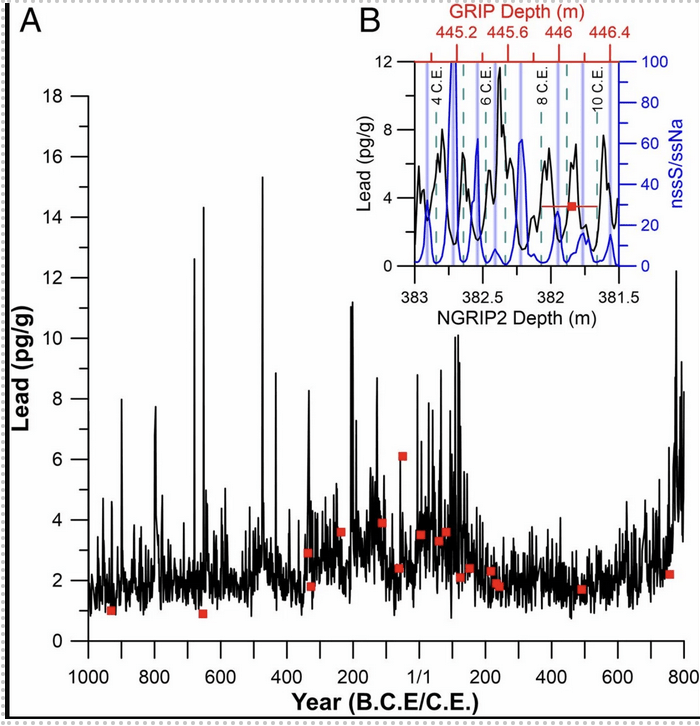
    In 2018, the multidisciplinary scientific journal PNAS8, delivered a research article within Environmental Sciences, known as, ‘Lead Pollution Recorded in Greenland ice Indicates European Emissions Tracked Plagues, Wars, and Imperial Expansion during Antiquity’, which provided evidence on Roman industrial pollution peaking at the start of its emerging empire. Referencing Figure 1, the chart provides data of fluctuating lead measurements in relation to critical centuries of human development, which is contextualized by the articles abstract:  

    Here we show, using precisely data records of estimated lead emissions between 1100 BCE and 800 CE derived from sub annually resolved measurements in Greenland ice and detailed atmospheric transport modelling, that annual European lead emissions closely varied with historical events, including imperial expansions, wars, and major plagues9

    Figure 1. Lead measurements in Greenland Ice derived from PNAS article.  

    Environmental exploitation in the Roman Empire lacked any legal mediation or government interference unless the natural resource was guarded for ‘indiscriminate exploitation10.’ Notably, the persistent exploitation of ‘high temperature smelting’, large scale extraction of conquered lands and valuable elements, deforestation to combat rapid expansion, and industrial-scale operations for mining for economic profit11, produced enough emissions to penetrate the integrity of the soil and land from 500 BCE. Moreover, the biological and microscopic structures of the ice utilized for this data collection showed immense morphological changed nearly two millennium later.  

    Section II: Current Industrial Pollution 

    Many of the present phenomena, field of studies, or terminology fall under Waring, Wood and Szathmarys’ procedure of ‘Group-level Environmental Management Traits12’. Precisely, larger groups will encounter more challenges to manage their environment as they lack consistent evolutionary qualities or solutions to the developing involutions (e.g extinct species). Correspondingly, we are unable to manage the scale of social organization to readjust, convene, or faithfully deconstruct previous systems of belief.  

    Macroecology, a subfield in ecological studies, focuses on ‘large-scale ecological patterns across broad spatial and temporal scales,’ and is only a present-day distinction. It was a side-effect without the precaution of mobility, in which, the development of a new ecological system was necessary and could not be removed without further dislocation from the original objective. Therefore, the structures of biological and environmental distinctions must be expanded to address, study, or report on the rapid shift in our present climate conditions.  

    Moreover, to establish violence in the context of industrial pollution, we must refer to Serene Jones explication of the ‘traumatized physical environment’- that which must witness the ‘integrity of the creation [become] violated13’. The ‘violation’ is eventually dualistic, as the physical degradation of plants, landscapes, and synchronic climates correspond to the conceptual, biological, and evolutionary framework we have once prescribed upon nature. This ‘twofold approach’ must present a concurrent discourse of the existing conditions of nature and all that is absent to consider the future. Correspondingly, the condition of the environment will become integral to daily interaction, allowing for the destabilization of an anthropogenic perspective, as human-on-human action becomes secondary to the foundation of landscape, matter and the self-regulating processes of the Earth. 

    Turning to Fig. 2., The University of Leeds produced linear graphs depicting the quality of air pollution between The United Kingdom and Pakistan, drawing upon the a ‘global disparity’ amongst pollutants. While the contrast of colours may produce a positive or negative attributes, the diversity of shades becomes a concerning ‘cocktail of pollutants14’. The agriculture, cars, forest fires, burning of oil, vehicle exhaust, power plants and the fossil fuel industry united as a primary cause to a degrading ozone layer, acid rain, bleached coral reefs, scorched landscapes, and a lack of biodiversity within plants. A rather careless violence stuck in a cycle too repair itself.  

    Fig 2. The United Kingdom, Global Air Quality Trends15 

    Fig. 2, Global Air Quality Trends16  

    Moreover, if we are to return to Hippocrates, the presence of dense air and floating sulphur pollutants is a familiar topic. Referencing his notable texts, On ‘Airs, Waters and Places’, the naturalist writes, “They are likely to have deep, hoarse voices, because of the atmosphere, since it is usually impure and unhealthy in such places17.” The individual’s innate reliance on oxygen produced by a stable, homeostatic body, will suffer a similar violation as the integrity of the body is compromised. So, if the co-dependency of humanity onto the expansive, biological function of the Earth, reduces the anthropocentric measures to a more equal baseline of existence between nature and humans, the violence upon the environment will be held to the severity, repercussions and justice that humans have awarded themselves.  

    Military Infrastructure 

    Roman Antiquity 

    […] argued that the emergence of modern bureaucratic, territorialized and centralized nation-states — marked by the monopolization of the means of violence […]  — was in large part the result of protracted wars and highly expensive military campaigns, a process of co-evolution whereby ‘war made the state and state made the war18’. 

    Roman, military grounds were littered with dead bodies. Their armour was weaponized, buried, or reused for the solider next in line. Deforestation become a building block for invasions, providing enough resources for fuel, materials for weapons, and the space for military sites. Yet, how was military infrastructure displayed in an active war? Josephus, Jewish War, presents the siege of Jotapata as the Roman army sought the Jewish stronghold for further power in their campaign to Galilee. As the campaign makes way, the distraction of military weapons and an erected stone wall is as much a Roman display of power as it is a forceful overtaking of integral landscape: 

    Vespasian now brought up his artillery engines — 160 in all — and set them in a semi-circle with order to fire on the defenders on the wall. In one concerted barrage the catapults sent their spears whistling through the air, the stone-throwers hurled hundredweight rocks, and both flaming and regular arrows flew in a hail19.  

    Eventually, the earth will begin to scream of thirst, the charred dirt will be forced to recover, the cement left behind from the battering ram will stand still as a trophy depicting their conquer. The city will continue, with or without the inhabitants, conquerors, or those in-between, but the landscape must reclaim a buried ecosystem once more.  

    Section II: The Present 

    […] where I, for a fraction of time, caused a security alert, because I violated this order by standing on a scrap of grass, next to a public highway, looking through a fence20.  

    This ‘scrap of grass’ — a space designed to hold up the fence, the shoes of her body, the cement that is to guide aircrafts, bustling bases, and artillery weapons is barely a register. The purpose has changed, unbeknownst to the grass covered in gravel or the roots pulled for concrete bases, the land lacks recognition. Nature became the first casualty, with the title of victim but lacking in the finality of justice. Thus, they are just a victim.  

    Fig. 3. Burning of Oil Wells in Kuwait during The Gulf War. Noted to be ‘one of the worse environmental disasters’ in recent history21.  

    Returning to the Anthropocene, the self-awareness of humankind becomes imperative to the assumptions one must accept for central power. An awareness catering to conditions, that of: 

    […] continental trade and transport networks, eradication policies for nuisance species and diseases, agricultural pollution fines, genetic modification, anti-extinction policies and the emergence of global environmental law22

    While armed forces sustained Weapons of Mass Destruction (WMD): 

    [..] from uranium mining and milling; through transport of ‘yellowcake’, MOX and other nuclear materials; fabrication of fuel rods; reprocessing and fast-breeder reactors; and the problems of storage of nuclear waste over millennia23

    Unsurprisingly, Nature will lack the corporeal rights, or rather the right to co-exist fairly, within a centrist collective. Even further, the environmental laws, annual summit meetings, prosecution by fines or trespassing warnings are in favour of the individual, not of the planet. They become exercises of free will, faux determinism, or ill-informed manuscripts delivered with enough enthusiasm to think moral implications are censored. We will continue to address future generations in decorated speeches, before questioning the soil degradation in Sudan. Reports of, “50 nuclear warheads and 11 nuclear reactors littering the ocean floor24” will be cleared an ‘accident’ yet the responsibility of the ocean to absorb the force of a nuclear weapon, must be rationalized as a the only ‘right’ Nature can afford.  

    Fig 3. is a makeshift military infrastructure. An active battlefield, with no soldiers as enemies, but rather the land as their final target. While the burning of oil wells in Kuwait were documented as a military tactic, or an economic loss for the country, the campground, uniforms, artillery shells, surveillance helicopters, and the bodies, traumatized that land. The burning fuel was violent, the weakening ground was silenced, and the smoke-filled air traumatized the natural, surrounding life. It would take over eleven months for the last oil well to be capped and the miles of ‘fire trenches25’ would be discovered.  

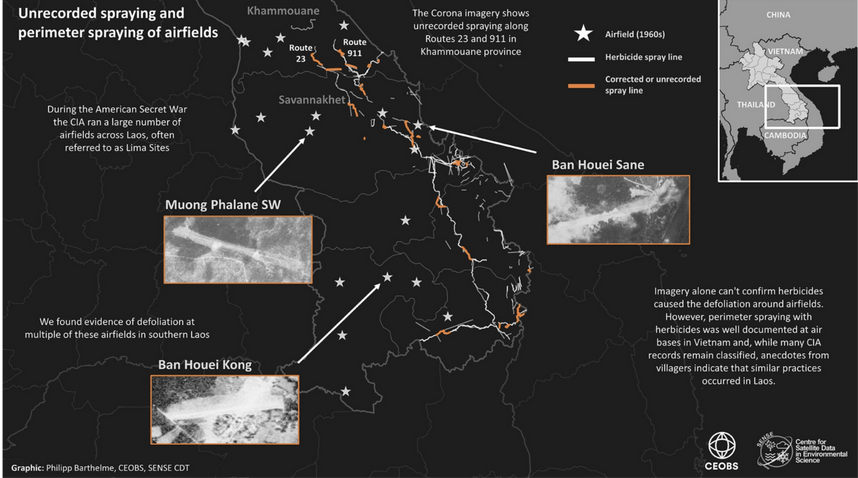
    Fig 4. Unrecorded spraying of Agent Orange in Vietnam War26.  

    Lastly, there are a few human disasters to touch upon. Captured in Fig. 4, the use of Agent Orange in the Vietnam War became a hidden ecological disaster, as released FBI files lack the extensive records of using chemical warfare. As the black-and-white photographs display, the thick, scar-like line amongst the tree is defoliation. A common tactic within war to uncover food, shelter and aid harvesting of the opposition. The chemical agent utilized biologically alters the structures and / or compounds of the plant, forcing them to de-shed, often permanently. The land cannot recover, and the herbicide will flourish in the soil of next year’s harvest. Put simply by Pearson, “the militarization of landscape is rarely complete or final27.” 

    Conclusion 

    My aim within this paper balanced loosely between a personal, corporeal discernment and sympathies toward the incorporeal. What rights, as an individual, have I willingly taken from the environment to further this violation? Could we, as a collective, repair the tension, brutality, and suffering we have posited to be correct, moral and justified? Either way, our violence is noticeable. It is then, imperative to start on the contrary to modern thought, to focus on the corporeality, the body of the environment, as a necessary right to life.  

    Bibliography: 

    Barthleme, Phillip. 2024. ‘New Data on Agent Orange Use during the US’s Secret War in Laos – CEOBS’, CEOBS <https://ceobs.org/new-data-on-agent-orange-use-during-the-uss-secret-war-in-laos/#6&gt; [accessed 2 December 2025] 

    Bostock, John, and Henry Riley. 2018. ‘The Project Gutenberg EBook of the Natural History of Pliny, Vol I., by Pliny the Elder.’, Gutenberg.org <https://www.gutenberg.org/files/57493/57493-h/57493-h.htm>&nbsp;

    Hay-Edie, David. 1991. THE MILITARY’S IMPACT on the ENVIRONMENT: A NEGLECTED ASPECT of the SUSTAINABLE DEVELOPMENT DEBATE a Briefing Paper for States and Non-Governmental Organisations (Sebastian) <https://www.ipb.org/wp-content/uploads/2017/03/briefing-paper.pdf&gt; [accessed 1 November 2025] 

    Jones, W.H.S , and Hippocrates. 2023. ‘On Airs, Waters, and Places [Attributed to Hippocrates (C. 460 – C. 370 B.C.)] : Hippocrates : Free Download, Borrow, and Streaming : Internet Archive’, Internet Archive <https://archive.org/details/hippocrates-airs-waters-places-l-147/page/XIII/mode/2up>&nbsp;

    Kersten, Jens. 2017. ‘Who Needs Rights of Nature?’, RCC Perspectives: 9–14 <https://www.jstor.org/stable/26268370>&nbsp;

    Knittel, Susanne C. 2023. ‘Ecologies of Violence: Cultural Memory (Studies) and the Genocide–Ecocide Nexus’, Memory Studies, 16.6 (SAGE Publishing): 1563–78 <https://doi.org/10.1177/17506980231202747>&nbsp;

    Leeds, University of. 2024. ‘New Images Reveal Global Air Quality Trends | University of Leeds’, Leeds.ac.uk <https://www.leeds.ac.uk/news-environment/news/article/5635/new-images-reveal-global-air-quality-trends>&nbsp;

    Lewis, Simon, and Mark Maslin. 2015. ‘(PDF) Defining the Anthropocene’, ResearchGate <https://www.researchgate.net/publication/273467448_Defining_the_Anthropocene>&nbsp;

    McConnell, Joseph R., Andrew I. Wilson, Andreas Stohl, Monica M. Arienzo, Nathan J. Chellman, and others. 2018. ‘Lead Pollution Recorded in Greenland Ice Indicates European Emissions Tracked Plagues, Wars, and Imperial Expansion during Antiquity’, Proceedings of the National Academy of Sciences, 115.22: 5726–31 <https://doi.org/10.1073/pnas.1721818115&gt;  

    McSorley, Kevin. 2014. ‘Towards an Embodied Sociology of War’, The Sociological Review, 62.2_suppl: 107–28 <https://doi.org/10.1111/1467-954x.12194>&nbsp;

    Pearson, Chris, Peter A Coates, and Tim Cole. 2010. Militarized Landscapes : From Gettysburg to Salisbury Plain (London ; New York: Continuum) 

    Salgado, Sebastiao. 2016. ‘When the Oil Fields Burned’, The New York Times <https://www.nytimes.com/interactive/2016/04/08/sunday-review/exposures-kuwait-salgado.html>&nbsp;

    Serene Jones. 2009. Trauma and Grace : Theology in a Ruptured World (Louisville, Ky.: Westminster John Knox) 

    Waring, Timothy M, Zachary T Wood, and Eörs Szathmáry. 2023. ‘Characteristic Processes of Human Evolution Caused the Anthropocene and May Obstruct Its Global Solutions’, Philosophical Transactions of the Royal Society B, 379.1893 (Royal Society) <https://doi.org/10.1098/rstb.2022.0259>&nbsp;

    Whiston, William. 1737. ‘Josephus: Of the War, Book III’, Penelope.uchicago.edu <https://penelope.uchicago.edu/josephus/war-3.html>&nbsp;

    Woodward, Rachel. 2004. Military Geographies (Malden, Ma: Blackwell Pub) 

    Zvereva, Elena L, Eija Toivonen, and Mikhail V Kozlov. 2008. ‘Changes in Species Richness of Vascular Plants under the Impact of Air Pollution: A Global Perspective’, Global Ecology and Biogeography, 17.3 (Wiley): 305–19 <https://doi.org/10.2307/30137862>&nbsp;

  • Space, Gender and Chastity: Domestic Space in The Rape of the Lock.

    Space, Gender and Chastity: Domestic Space in The Rape of the Lock.

    Literature 1550-1740, Term 2.

    Judith Butler in Gender Trouble (1989) develops the relationship between gender and space through a cultural discourse. An unprecedented work, Butler’s aim shifts the reflection of gender to the corporeal – the body, and by relation, the space in which the physical and mental are shaped by social intrusion. When addressing Alexander Pope’s, The Rape of the Lock, domestic space becomes a cultural and social inscription which is repressive toward women and an unexplored political playground roaming with the women’s plight toward sexual purity. Domestic space shapes the repressive nature spurred by class and patriarchal objectives until chastity defines the characteristics of a women.  

    Re-worked alongside theory, domestic space leans into dichotomies that allows for cultural inscription, a feat best represented by the Oxford Dictionary as they characterized the space to exist as, “The apartheid system dichotomized physical space into masculine and feminine categories, marginalizing the feminine1.” It is practical to notice the dualism, which must be addressed, where women’s domestic space caters to expansion, possibility, and subversive positions which warrants the growth of children, partners, and their developing passions, leaving the mother, daughter, or wife to cater excruciatingly to a force- fed oppression: “Women were relegated to the inferior physical and social space of the homelands where they were expected to farm, raise children, and care for the sick and elderly2.” In replicating the domestic space in The Rape of the Lock, Pope’s execution becomes fluid and satirical, relegating Beauty as a willingly, yet violent adornment alongside the female body, whose vain rituals profess an innocence not yet known to the woman.   

    Revisiting Butler, her suggestions of ‘cultural inscription’ and the body follows Pope’s domestic space of marriage and class, a notion summed up as,  

    “Space is never neutral but always discursively constructed, ideologically marked, and shaped by the dominant power structures and forms of knowledge… space is both created and articulated through cultural discourse, including gender discourse. Thus, we cannot grasp space outside a socially meditated perspective.3” 

    Pope drives the perception of wealth and space satirically in one excerpt, denoting the jewels and objects adorning the main character, Belinda, as a foolish desire the wealthy place on insignificant items. Class is seen as: 

      “Whether the Nymph shall break Diana’s law, / Or some frail China jar receive a Flaw, / Or stain her Honour, or her new Brocade, / Forget her Pray’rs, or miss a Masquerade, /Or lose her Heart, or Necklace, at a Ball;/ Or whether Heav’n has doom’d that Shock must fall.4” 

    Represented by ‘frail China,’ or her ‘new Brocade,’ the objects surrounding the female character shapes both a metaphysical and domestic space aligned with conforming to beauty practices upheld from a ‘socially meditated perspective,’ whose yearning for marriage is a presentation of ‘her Honour.’ In mock-epic fashion, Belinda’s description of wealth pervades human protection, as the Sylphs surround the embellished and objectifiable lady, leaving Pope to pursue the permeation of the body through the adornment of wealth and established performativity of gender roles: “Form a strong Line about the Silver Bound, / And guard the wide Circumference around.” (ii.121-122) The fixation on the ‘Necklace’ and a ‘Heart’ situate the body and the material in the same category of space – domestic, as Belinda unconsciously indulges the prospect of her situated repression – a decision by Pope, which posits her outside a space of volition and feeds into the class-act of marriage and wealth. The ‘circumference’ of Sylphs surrounding Belinda introduces the skin as a mode of space, a quality capable of permeation and personal condemnation, whose association to gender discourse, brings about the plights of the domestic space, as a limit to the female self:  

    “What constitutes the limit of the body is never merely material, but that of the surface, the skin, is systemically signified by taboos and anticipated transgressions indeed, the boundaries of the body become, within her analysis, the limits of the social per se5”  

    Now, the existence of space from the self to the social creates a distinction of physical limitations; performativity rest upon the beauty of her skin, its likeness to grace and wonders distinctive of innocence until the body performs its own objectivity – she enacts her own gender discourse through a desired cultural inclusion.  

    The significance of the domestic space is rendered to the adequacy of the female body, the forced objective beauty that is: “Th’ inferior Priestess, at her Altar’s side, / Trembling, begins the sacred Rites of Pride.” (i.127-28) Pope’s verbal control toward terms like ‘sacred’ and the aforementioned ‘pride’ by extension must exist in the domestic space of femininity – exemplifying the required attention the body must hold for the women. It is a space worthy of adoration and touch, where ‘rites’ signify the opportunity the woman holds, leaving the ‘trembling’ as Pope’s chosen dichotomy in the sentence: does the sacred nature of feminine rituals driven by excitement of reenactment or nervous acceptance toward her guarded purity and vanity she must act upon? 

    Ending physical permeation of the female body, one last signification of the domestic space is the internalization of the female body and young girls. Introducing Braidotti, Lois McNay states simply, “The internalization of representation of the female body by women is fundamental to the formation of the feminine identity.6” The formation is drawn clearly in Pope’s text, compared quickly alongside Belinda’s evolving vanity, and one which characterizes the female body as less, due to the directive nature one must adopt: “’Tis these that early taint the Female Soul, / Instruct the eyes of young Coquettes to roll, / Teach Infant Cheeks a bidden Blush to know, / And little Hearts to flutter at a Beau.” (i.87-90) Pope’s reference to ‘taint’ corresponds with his mock-epic attitude, drawing upon the absurdity of social adherence, the forceful nature of desire, seduction, and innocence that must be catered to, even when innocence is all the young body holds. The domestic space is manipulated, so much so that the submission must be unnatural – formulated for social coherence and the uplifting of gender roles, and in Butler’s simplest words, performative, until the body is lacking in space completely. 

    Hovering in the realm of the metaphysical, the metaphorical ‘rape’ of Belinda exposes the manipulation of the domestic space and repression of the female body by means of chastity. When positioning the ‘natural’ alongside the female body in Pope’s mock-epic, it becomes “…a device central to the legitimation of certain strategies of oppression,” until it lacks the signification held toward beauty and ornamental jewels of the self – a disruption to the desirable objectification of a ‘body [as] a site of conquest.7”. Belinda’s honed acceptance must follow and indulge toward repression, of self and sexual identity, until she foster’s the decoration of her own virginity, as Pope writes, “Fair Tresses Man’s Imperial insnare, / And Beauty draws us with a single Hair.(ii. 27-28)” The dichotomy rest in Belinda’s internalized and furthered materialized objectification of her beauty – a cultural process spurred by a patriarchal body, while also characterizing the male self to egregious behaviors akin to ‘rape’ and ‘insnare.’ The permeation of this dichotomy rest internally for Belinda, and it is only until the ‘rape’ of her lock is orchestrated by the Baron, does the domestic space wither: “So long my Honour, Name, and Praise shall live!” (iii.170) From her rage-filled declarations, the representation of the female body loses touch with feminine objectification when it eventually becomes ‘conquered,’ or when the honor and name have been stripped of pure, virgin innocence. The woman assembled through mock-epic fight scenes permeate a physical domestic space, where skin contends with its own internal and external oppressors and moral plights induce the voice of women such as Clarissa, Thalestris, and Belinda. 

    Quickly, Foucault’s revaluation of women and their bodies produces a hierarchy of their repression, noted as, “…individuals as docile bodies has the effects of pushing women back into the position of passivity and silence8.” The construction of metaphysical conceptions like honor, pride, and vanity develops what domestic space is and its significance to the female self; It was a rite of passage and a representation of women’s suppression, generational to “her Mother’s hairs/ Which long she wore, and now Belinda wears.” (v. 95-6) Pope references these facets of identity in multiples, contriving, “He spoke, and speaking, in proud Triumph spread / The long-contended Honours of her Head.” (iv.139-140) The hair as a metaphor for rape, or seizing, delineates ‘docile bodies’ enacting ‘passivity’ genealogically, until the unitary movement of the body, the objectified female self and the space in between becomes “a construction, a product of the effects of power.9” This ‘construction,’ lies within the critical nature of man described by Pope, as the female self internalized honor and pride and vanity on man’s decisive rule, yet it was used against them for their sexual identity and objectifiable pleasure.  

    Domestic space is arguably a metaphysical conception, overarchingly dependent on the women’s existence and played by Pope to represent the potential reversal of power between men and women. Canto V redefines the significance of domestic space, as women “killed him with a frown / She smil’d to see the doughty Hero slain” (v.68-9), or the echoing of Belinda’s rage-filled desires, “Restore the Lock! She cries; and all around / Restore the Lock! the Vaulted Roofs rebound.” (v.103-04) The female body, in the domestic space, warrants voice past the expression of honor or virtue but rather violence shed from lack thereof, and rather utilizes the metaphysical to create what can be termed a new ‘domestic space.’ Foucault redefines this shift as a“discourse [which] transmits and produces power; it reinforces it, but also undermines and exposes it, renders it fragile and makes it possible to thwart it.10” Pope’s decision to ‘thwart’ the systematic power over women, to alter the significance of the domestic space, is delivered by Clarissa, whose moral address is noted as such: “Think not, when Women’s transient Breath is fled, / That all her Vanities at once are dead” (i.51-52). Sequentially, the women’s consciousness and further assertions toward their vain plights recognizes space as its own body, capable of change and fluid movements must death alter the current inferiority of the female body, and rather renders the domestic space in favour of their own, personal space. Naturally, the power is seized from men the moment Belinda’s lock of hair tumbles into space, or what Pope denotes as “the shinning Sphere!” (v.143-44). 

    The figurative “domestic space,” the female body encounters welcomes a navigation not only through the construction of gender and sexual identity, but its interaction with metaphysical space and personal identity. Through Alexander Pope’s, The Rape of the Lock, and philosophers such as Judith Butler and Michel Foucault, the significance of space can be critically analysed through cultural inscription, and as a result, the spatial and social begin to develop the performativity of gender past the dichotomy of a domestic space. It is through these articulations that the female self is positioned past the theoretical to the present, capable body, much like Pope’s Belinda.  

    Bibliography: 

    A Dictionary of Geography. ‘Domestic Space,’ oxfordreference.com <https://www.oxfordreference.com/display/10.1093/oi/authority.20110803095725760

    Butler, Judith. 1990. ‘Bodily Inscriptions, Performative Subversions’ in Gender Trouble. Routledge 

    Jagger, Gill. 2008. ‘Judith Butler: Sexual Politics, Social Change and the Power of the Performative.” Routledge 

    McNay, Lois. 1992. ‘Foucault and Feminism: Power, Gender, and the Self.’ Polity Press 

    Pope, Alexander. 2007. The Rape of the Lock. (Vintage) 

    Wrede, Theda. 2015. ‘Theorizing Space and Gender in the 21st Century.’ Rocky Mountain Modern Language Association