Tag: history

  • Colonial Oppression, Resistance and Revenge in a South Asian Diaspora: The Role of English in Post Colonial Translations

    Introduction 

    The belly of the world1 relies on the inevitability of language. The concept of The Self, its material relations imposed upon the body, the limits and traditions aroused by a collective, sustained a moralizing, passionate, and tainted reliance on the voice. We have allocated a multiplicity of words to navigate our loudest quality: morphology, semantic, lexicon, linguistic, communicative. Yet, the present limitations of low literacy rates, linguistic assimilation, or lack of receptive multilingualism acknowledged a new form of social discourse, that of post-colonial studies.   

    Provided the tools and proper education, the fabrication of the voice is reliant on that of tones, nuances and paradigms, yet if the embodiment and articulation of the individual is compressed/forgotten/unacknowledged, how is the culture affected?  Sara Suleri and her text, The Rhetoric of English India, posits, “To tell the history of another is to be pressed against the limits of one’s own – thus culture learns that terror has a local habitation and name2”. Post-colonial studies became that catalyst of stretched limitations, by the recognition of subalternity and the tense ambivalence that dominates a diaspora. Moreover, my aim in this essay is to address how writers of South Asian heritage utilize the English language within cultural narratives to explicate a history of colonial oppression, resistance, and revenge amongst linguistic ‘Otherness’.  

    Colonial Oppression and Translation 

    Harish Trivedi and Susan Bassnett began to tackle the complexity of post-colonial translation as a literary phenomenon – that which disregards physical space or metaphoric, cultural ‘transportation’, for a literary field prescribed as an ‘interlingual translation provid[ing] an analogue for post-colonial writing3.’ Notably, the utilization of the prefix post- or pre-, upholds a function as linear identifiers, capable of separating a before, a beginning or an aftermath. Therefore, their actions are stationary, emblematic as a point of reference on a historical timeline or a previous state of existence. Yet, the prefix trans- disrupts a literary tradition with measurable outcomes; rather, it’s embraced as an ambiguous, stratified, social concept which must evaluate relevant discourse of personhood, identity and cultural subjugation to understand hierarchical systems of oppression. Plainly, it thrives on theoretical frameworks that become a necessary foreground for a ‘metatext of culture4.’   

    Namely, the ‘transcolonial’ or ‘translocation’ interacts with a complexity of geographical boundaries in conjunction to the morphological, the semantic, or the linguistic attitudes within a diasporic nation. The mitigation of ‘trans-’ must suffice as a competent descriptor of the transient identity the colonized subject is to retain. Rennhak attempts to tackle the marginal role of this dislocated pre-fix: 

    […] they [‘transnational’, ‘transcultural’] do not focus on the links between two given entities – nations, cultures – assuming that these entities essentially remain the same; they rather presuppose (personal emphasis) border transgressions and constitutive transformations to take place all along, and they explore the productive instabilities, fluidities and conflicts within such entities – nations, cultures – which render all political attempts to draw a rigid boundary around them questionable5 

    The conditions of a diasporic identity are innately cyclical. The persistence of the English Language is repetitive, brazen in nature, and reliant on practices of assimilation. As such, the linguistic paradigms and cultural integrity of Eurocentric nations, disrupt the social harmony and ability to regulate ‘intercultural’ relationship between the ‘trans-’, foreign tongue and Standard Written English6. Ania Loomba in ‘Colonialism / Postcolonialism’, enriches Spivak’s’ influential postulation of the subalterns’ agency in her essay, ‘Can the Subaltern Speak?’, by pressing a linguistic dimension of the colonial subject. She writes, “In what voices do the colonised speak – their own, or in the accent borrowed from their masters7?” The mitigation of ‘borrowed’ to be an action wilfully taken on by the colonized individual elucidates a prevailing history of assimilation – that of the subaltern carrying a voice not of their own yet incapable of cultural possession of the colonizer’s language. English bears the commonality of hegemony and expansion; Urdu/Hindi became the fragment of agency left to the South Asian writer. So, how does the South Asian writer speak?  

    Salman Rushdie knew well of the ‘translated man’, who knew English and could not reject its presence. The writer was not to engage in a cultural fusion of the Indo-European, but rather the “locational disrupture8that must decentre the writer’s native homeland, rendering the land ‘imaginary’ amidst memories. By default, the space for Indian work in English media is how loose the accent becomes, the timidity of a colonial replication, or the biting silence of conversations. Language exists in these tensions of subversion – the utilization of ‘Othering’ to argue their uncivilized authority (‘savage, brute, uncouth, unsophisticated, barbarian, […] primitive’) and the political action necessary to reject the British, colonial role within India. Rushdie explores the former concept of linguistic subversion through the act of creating a new language entirely: 

    English, no longer an English language, now grows from many roots; and those whom it once colonized are carving out large territories within the language for themselves. The Empire is striking back9 

    As I begin to carve out my argument on Resistance and Revenge writing, the individual must be positioned accordingly. Edward Said in his book Orientalism procures an academic, philosophical, and intimate depiction of the ‘Other’. A raw and passioned piece of text, Said narrates a poli-cultural exposition to shape the Orient amongst the linguistic paradigms of language, repetition, and mimicry. 

    It is an elaboration not only of a basic geographical distinction (the world is made up of two unequal halves, Orient and Occident) but also a whole series of ‘interests’ […] it not only creates, but also maintains; it is, rather than expresses, a certain will or intention to understand, in some cases to control, manipulate, even to incorporate, what is a manifestly different world10 

    Notably, the Orient succumbs to a duality of identity, ‘Orient and Occident’, while enforcing the maintenance, incorporation, or intention into a subjected alterity. These distinctions are disjointed and unregulated by linear conceptions of time, reliant on the colonial subject to execute with recognition of language. Post-colonial studies resist the dualism of identity through the conception of abrogation. It is then that the alterity of the voice can be heard.  

    Resistance: Allowing the Subaltern to Speak 

    “Something of the unwashed odour of the chamcha lingers around its cadences.” 

    Salman Rushdie, The Empire Writes Back with Vengeance 

    The political tradition of resistance within a colonial territory is unabashedly physical. The land becomes violated — seeped in blood or deficient in institutions, rendering the body of the land contaminated by the imposed, imperial command. Yet, a lingering dialect of the people resist the violence of this colonial policy, as a tactic recognized for Linguistic Imperialism. A conception that seeks to structurally, ideologically, and with exploitative intent, privilege a dominant language, in this instance English, over an ‘uncivilized’ language – that of the native, colonial dialect. Phillipson on Linguistic Imperialism, empirically investigates the characteristics of dominate and suppressed languages in common expansion practices, global trade, and the waves of post-colonial critique. An English Professor at the University of Copenhagen, Phillipson offers an analytic list of necessary qualities present within linguistic imperialism – for my argument, I will be listing a few critical points: “Linguistic imperialism is invariably contested and resisted,” [..] “The dominance is hegemonic: It is internalized and naturalized as being ‘normal,’” […] “Linguistic imperialism interlocks with a structure of imperialism in culture, education, the media, communication, the economy, politics, and military activities11” Yet, with a limited implementation of a native, colonial language, in this instance Hindi and Urdu, the writers, linguists, religious practices, teachers and individuals, connected to their native tongue, are unable to express the consumptive process of colonialization precisely within the English language. They are stuck amidst the boundaries of translation. The invariable resistance Phillipson mentions attaches Trivedi and Bassnet’s theoretical framework of an intra-personal conflict the South Asian writer encounters, writing: 

    [The Indian who writes] in spite of our ambiguity towards it, or because of that, perhaps because we find in that linguistic struggle a reflection of other struggles taking place in the real world, struggles between the cultures within ourselves and the influences at work upon our societies12 

    The genesis of linguistic resistance necessitates cultural reflection, their current ambiguity within society, or even further, the South Asian writer must begin to frame the discourse their language arouses within global conversations as their own. My attempt within this section is to display the expanse of linguistic dislocation and the corresponding response of the ‘Other’ — that when utilized by the oppressed, begins to critique, dismantle, and outright resist the structuralism of imperial languages13 (i.e English). To apply pressure at the root of my argument, an opposition of colonial rhetoric is essential, or precisely what Doering labels as ’counter-discourse’: 

    Such a process by which oppositional forces emerge from within established power structures and begin to redefine or re-employ their mechanisms, is usefully described as ‘counter-discourse’ […] Yet to fight this cause, the means are taken up in different, unconventional, unexpected ways and so, instead of endorsing the discursive structures, are now used to manipulate their elements, appropriate their signs and ultimately change them14 

    Present-day media has allowed for the unconventional, raw, or often violent to be globally recognized, or most importantly heard. But what of the South Asian writer who nurtures a philological attitude within their work? How does the rhyme match the tension of their native tongue? Does the translation they are engaging with accurately elucidate the words missing from their vocabulary, lost in colonial regimes and decades of linguistic hegemony? Is this all their voice would become known for? 

    Section II: Shame, Salman Rushdie 

    Salman Rushdie prepares a space amongst literature to produce a body of work on shame. The basis of power, that which surpasses royal status, political affiliations, marriage, or economic abundance rather commences at the welcoming of resistance. The opposition amongst these cultural notifiers, is decerned by their relational qualities, that of challenging authority, situation, dependency on movements/protest/action, and a social response. Within his novel, Shame, Rushdie’s pivotal reflection on the shamelessness of political corruption or of gendered persecution, actualizes the 1947 Partition of Pakistan and India as a space capable of satirization from a South Asian writer: 

    Wanting to write about shame, I was at first haunted by the imagined spectre of that dead body, its throat slit like a halal chicken, lying in a London night across a zebra crossing […] I thought of the crime as having been committed right there, publicly, ritually, white at the windows eyes.15 

    Intimacy permeates the mode of resistance for Rushdie. The personal implication of acknowledging shame, writing the complexity and qualities of the brash emotion, while reflecting the feeling in a narrative based on a post-partition Pakistan alludes to the rigid silence desirable by that linguistic imperialism. Rushdie utilizes English to write the South Asian experience tainted by a British, colonial upheaval; the grasp of shame is not a quality of the Oriental body, but a consequence of the Occident invasion. Crucially, the body is not forgotten, rather personified to hold the violent persecution of shame, leaving a ‘throat slit like a halal chicken’ and the remnant of the figure is left publicly for all to witness the crime. The metaphoric body is abruptly killed at night, laid in the street of blinking lights and zebra crossings, to carry an outline of a voice Rushdie cannot carry, but his text can. The acknowledgement, publication and enunciation of the by-product of shame upholds a space to question and observe the experience of the subject, while also examining the encounter the South Asian author witnessed to know such characteristics of shame. Salman Rushdie’s metaphoric examination of shame became a bite of resistance as he set out to write the Oriental struggle in a colonial language of English.  

    Revenge: The English Expansion 

    “Babu-English, chamcha-English, and turn it against  

    itself: the instrument of subservience became a weapon of liberation16” 

    Yet, what does revenge look like within one’s fight against linguistic imperialism? The British poet, Daljit Nagra, arguably performs within his notable works ‘British Museum’ and ‘Look We Have Coming to Dover!’ a channel for a counter-discourse, often challenging mainstream narratives within the complexity of post-colonial language itself.  In his piece, ‘For the Wealth of India17’, a disparate dialect leads the scene of Nagra’s ’ancestral homeland’ through the bazaar tracks and the ’brightly lit boutiques’, yet as the speaker begins to brandish the wealth through Sari-shopping, the diction aligns with British, formal expressions: ”That is the style mummy! / I need it now mummy!” while a few lines later, Nagra creates a linguistic space for the mother, as her Indian accent seeps through the dialogue: “[…] until mum / clears them with her finest English: / Vut is dis corruption? Vee need it fut-a-fut, or must vee / go to the clean nosed Hindu with cut-cut scissors, next door? / Daddy would applaud if he wasn’t slogging at the concrete factory18.” Nagra decisively disregards the aesthetic judgement, or embarrassment toward an accent untouched by British expression, but rather proceeds within a position of authority. Rather, the mothers accent becomes a state of great wealth, a symbol of power which can refuse the work of British tailors to go to the ’clean nosed Hindu next door.’ Doering comments on the phenomena of power and language stating,” […] ’power’ should not be understood as a matter of physical violence only (personal emphasis) but of language, of everyday practices […] but which all bear serious thinking and reconsideration because none of them are historically unchanging nor without alternative19.” Precisely, the British poet is critical of the framework of power present within language. The piece subverts the English voice, saturated in a British (colonial) accent, as inferior within the conversation; the tailors are silenced, contained to slight movements as they ’scratch their necks, snort / reversing some phlegm’. 

    Nagra employs a notable portmanteau, ‘Punglish20’, as a keynote to his work. A fusion of the British-Asian experience, the writers revenge begins at the concoction of a new lexicon, a merging of a voice oppressed for an ’uncivilized’ presence amongst an enforced colonial language. Rather, Nagra’s work becomes an antithesis to assimilation. In his piece, ’He Do the Foreign Voices’, the voice becomes disjointed, mixed with an extension of an occupying English dialect, yet ripe in the lyrical intonation of Punglish. The disruption is vital to sustain the control of language, whether it be a mesh of English-Hindi, or translations from Hindi to English. Nagra ends the piece as, “You drive away, yet somehow affirmed, / more in love with your pretty airs / that update the same old / that speak to power and fear, / whether they’re heard or not, they’ll say, head on, / before family and blood and wealth / our hoard of words must cleanse the world21” In defiance, the ’hoard of words’ utilized is no longer metaphorical, or lapsed through linguistic assimilation, rather Nagra punishes the English aesthetic with gaps, pauses and enough space to let his ’Punglish’ voice lament the history of Indian imperialism.  Eurocentrism is disrupted, in favour of the world which must be cleansed, before that of ’family and blood and wealth’ comes the distinction of the Punjab voice.  

    Section III: Partition Voices 

    BBC Radio 4 series on ‘Partition Voices’ interviewed British-Asians and militia in the British Colonial forces to cover the 1947 Partition between India and Pakistan. The migrations of millions, uneducated borders imposed by British officials resulting in border disputes, the dislocation of language between Hindi and Urdu, and the religious affiliations between Muslims and Sikhs/Hindu left last damage between the two countries over seven decades later. The broadcast titled ‘Legacy’ and ‘Inheritors of Partition’ assemble the consequence and tense aftermath of the Partition while also providing a voice for the generations of British-Asians who feel the effect years later.  o a greater extent, the coverage provided a concrete foundation for the South Asian voice to explicate, deconstruct, or just remain an active participant within the conversation. Amongst the first of the series, a Pakistani gentleman provides a metaphoric illustration of the Partition, stating: “[…] You know when a lady does an abortion, child has died, she bleeds. We Sikh community, we aborted from our home, but we were alive. She [homeland in Pakistan] must be bleeding22.” Recalling the instigation of power within post-colonial studies, the space carved by this podcast allows for a representation of South Asian identity, while also embracing the violence of resistance through verbal expression. Therefore, the mode of ’revenge’ is not a physical, aggressive display of power, but one found is reuniting a dislocated, transcolonial identity a platform to utilize a voice once repressed, disregarded, or linguistically altered.  

    Conclusion 

    Translation and the industry of literature are neoteric guides amongst post-colonial discourse. A bridge between the ‘Oriental’ voice and the hegemonic listener, the mode of morphology and interpretation deliver banished stories, untold narratives and forgotten dialects as foundational to the modern socio-cultural and political atmosphere. As post-colonial studies progress, my argument surrounded the colonial, diasporic voice and revenge may be acknowledged, but my theoretical framework posited through poetry, narratives, and alternative media expand upon a literary tradition of orality and interpretation. The South Asian writer, individual, speaker and experience do carry a voice capable of resistance amidst colonial oppression, but also with a strength to engage in revenge as well.  

    Footnotes:

    1 Referenced from Sadiya Hartman in her piece, The Belly of the World. Utilized in this instance to replace how the modern follows the conception of language, relying on its birth and future endeavours to establish identity. Therefore, language is a symbol of birth, which is inevitably once conceived, but also critical to modern development.  

    2 Suleri 1992: 2.  

    3 Bassnet, Trivedi 1999: 35. 

    4 Bassnett, Trivedi 1999: 3.  

    5 Doring 2019: 30. 

    6 The definition of SWE is utilized in the context of David Foster Wallace, ‘Democracy, English, and The Wars Over Usage’ referenced in Harper’s Magazine. (2001). Wallace makes considerable effort to indebt his work with abbreviations, where he makes racially charged statements elucidating a difference between SBE (Standard Black English) and SWE, (Standard White English). This is to be noted due to the clear erasure of accents, tones and phrases used within cultures, to where they are considered ‘Other’ and unconventional. Notably, this mindset settles in with the debate of language in South Asian Diasporas.  

    7 Loomba 1998: 229.  

    8 Trevidi 1998: 13. 

    9 Rushdie 1982. 

    10 Said 1978: 13.  

    11 Phillipson 2024.  

    12 Bassnett & Trivedi 1999: 58. 

    13 It is to be noted that given the nuances of language, English is represented within linguistic imperialism due to its histography within British, colonial rule in India, yet many other language like Spanish, French and German were utilized in a similar manner within colonization to inflict structural, linguistic impositions on the native subject. 

    14 Doering 2019: 26.  

    15 Rushdie 1983: 116. 

    16 Rushdie 1982.  

    17 Daljit Nagra, Look We Have Coming to Dover!  

    18 Nagra 2019: 9.  

    19 Doering 2019: 22

    20 A combination of Punjabi and English. 

    21 Nagra 2017: 19.  

    22 BBC Radio 2017: 00:43.  

    References:  

    Bassnett, Susan, and Harish Trivedi. 1999. Post-Colonial Translation: Theory and Practice (Milton Keynes: Lightning Source) 

    Döring, Tobias. 2011. Postcolonial Literatures in English (Stuttgart Klett Lernen Und Wissen) 

    Gallagher, Michael, Tim Smith, and Ant Adeane. 2017. ‘Legacy, Partition Voices’ (BBC Radio 4) 

    Loomba, Ania. 1998. Colonialism-Postcolonialism (London Etc.: Routledge) 

    Nagra, D. (2017). British Museum. Faber & Faber. 

    Nagra, D. (2019). Look We Have Coming to Dover! Faber & Faber.  

    Phillipson, Robert. 2024. ‘Linguistic Imperialism’, The Encyclopedia of Applied Linguistics (Wiley): 1–5 <https://doi.org/10.1002/9781405198431.wbeal0718.pub3>&nbsp;

    Rushdie, Salman. (1982) ‘The Empire writes back with a vengeance’, Times, 03 Jul, 8, available: https://link-gale-com.bris.idm.oclc.org/apps/doc/CS134843107/TTDA?u=univbri&sid=bookmark-TTDA&pg=8&xid=013e846f 

    Rushdie, Salman. 2010. Imaginary Homelands: Essays and Criticism 1981-1991 (London: Vintage Books) 

    Said, Edward W. 1978. Orientalism (New York: Pantheon Books) 

    Singh, K., Maheshwari, K. (2024). Primitivizing the Hindus: Hindus as Oppressive and Hierarchical. In: Colonial Discourse and the Suffering of Indian American Children. Palgrave Macmillan, Cham. https://doi.org/10.1007/978-3-031-57627-0_3 

    Suleri, Sara. 2011. The Rhetoric English India (Chicago ; London: The University Of Chicago Press) 

  • Social Media As a Witness to Trauma: How Modernity Shaped a Precarious Voice for Palestinians During Genocide

    Grade: Upper Second Class, Trauma and Literature, Term 3

    *This paper has been altered since the grade has been received, to formally capture the feedback given. Please note the paper was also written within the time frame of September-December of 2024, and therefore the statistics, pictures, and comments could reflect incorrect data. In this instance, it will be necessary to return to present numbers, news articles, and first-hand sources to better understand the genocide in Palestine. Here are a few resources to incite your research:

    https://www.aljazeera.com/tag/israel-palestine-conflict/

    “It is hostile in that you’re trying to make somebody see something the way you see it, trying to impose your idea, your picture[1].”

    Joan Didion, The Paris Review (1978) 

    “The vast photographic catalogue of misery and injustice throughout the world has given everyone a certain familiarity with atrocity, making the horrible seem more ordinary — making it appear familiar, remote, inevitable[2]” Sontag’s depiction of ‘The ordinary’ situated to ‘the misery’ and ‘the injustice’ infiltrates photographs, capturing the declaration of life, of the Palestinian life, motivated by the zoom and the number of frames captured. It is then, as the blood marks the face, the smoke fills the lungs, and the bodies are immersed into rubble, do the the photographer’s intention clarify the fatal mark of perception — that of genocide. Notably removed from political and global refuge, the Palestinian voice is to become ostracized, devalued, constructed, and forcefully held in the fingertips gliding upon a screen, manipulating the once still photograph to amplify the face amongst rubble. In these instances, can the testimony of the survivor remain the same or does the influence of a collective social media voice, develop a disingenuous and unreliable narration from western publication of Palestinian genocide? Even further, Dori Laub’s trauma theory within testimony, incites question on an inability to perform the necessary responsibilities of the listeners (to ingest, respond, and empathize) whose further interpretation is situated amongst social media post. Critics have frequently determined the Palestine-Israel conflict to be strictly political, formed through peace agreements and government funding; however, I argue that the genocide of Palestinians should be expanded through an analysis of a formed, precarious voice integrated within social media, and to re-examine how the testimony of the witness is formed through modern applications of a virtual trauma to better understand the impact of a voice in a public, global sphere.  

    Theory and Trauma 

    Titled, “Two: Bearing Witness,” Dori Laub presents their theoretical relationship between the victim, the owner of a testimony, and the listener, that who is untouched by the experience yet a “co-owner of the [victims] traumatic event.[3]”  Particularly, this act of witnessing the traumatic event, characteristic of the victim’s testimony, is reflected within a technological role — a liminal, global, transitional entity that must, by its nature, connect two parties, unanimously and unpremeditated within the expansive audience. The localization of the Palestinian voice, is stringent upon exposure, repetition, a functional screen, and heighted controls of volume to persuade a genocidal replication fit for empathic response. “The absence of an empathic listener, or more radically, the absence of an addressable other, an other who can hear the anguish of one’s memories and thus affirm and recognize their realness, annihilates the story,[4]”. Therefore, If the listener can scroll, mute, cover the screen or unfollow critical photographers, can a testimony be expressed? Is the direct voice of the listener consistently active, even without physical displacement of their body, their voice, and rather enmeshed in a virtual performativity, unable to consecutively respond back? In other words, can “reciprocal identification[5]” be achieved, if the testimony cannot be shared within a physical, or even viable space? And if the voice can be heard, shared, returned, does it matter if the cry of the survivor is deemed precarious, inequal, an ‘Other’? 

    Judith Butler refines ‘frame’ in her piece, Frames of War, as a “construct[ion] around one’s deed such that one’s guilty status becomes the viewer’s inevitable conclusion,[6]” yet my aim is to expand upon her objective by incorporating the conclusion of a ‘guilty status’ through the modern lens of social media. Interestingly, modernity developed a physical tangibility of Butler’s theocraticals, as the mobile phone envelops the screams, deaths, prayers, and limbs of Palestinians within a five-inch frame, alongside the ability to turn the illuminated screen into an eventual ‘gaping, vertiginous black hole,[7]” each evening. On my own terms, I will be developing the ‘precarious voice’ as an extension of Butler’s theory of precariousness, an ideal she defines as, “… one’s life is always in some sense in the hands of the other[8]” and more generally, “…attend[ing] to the suffering of others… [and] which frames permit for the representability of the human and which do not.[9]” Attributing to my theory on the precarious voice, is Mladen Dolar’s politicized voice, that must acknowledge the voice of the ‘other,’ addressed as “…the topology of extimacy, the stimuleous inclusion/exclusion, which retains the excluded to its core.[10]” Namely, the precarious [Palestinian] voice must be excluded, politicized, unequal by westernization, and exist in a framework of suffering where ‘inevitable conclusion’ captures their voice as distant, fallible, or racially inequal. The Palestinian genesis, which is their historical testimony, is consequentially limitless, fluid, and malleable by social and technological standards, deconstructed by news outlets, censored images and words, and the inability to respond while experiencing genocide. Therefore, the forced docility of Palestinian voice must surrender to the loud, expansive, fixed voice of global organizations and colonizing governments — it once more if forced to remain a constructed opinion of circumstance, a play on numbers, or a target for international powers.

    Social Media as a Persona for Trauma 

    Scrolling, reposting, commenting, liking, sharing, donating, until the photograph of the hidden body or agonizing screams, assumes a pertinent role in articles, newspapers, talk shows, Instagram posts and Facebook arguments — it becomes controversial. The black void which must cover the despair of language, physical pain, death tolls and bombs dropped do not expect a response, it is once more a liminal, metaphysical ground capable of exposure, yet lacking the stimulation of conversation. Therefore, the listener must participate, muted or within a delayed reception, grasping at opinions from the voices of the public — dichotic, integral and “[…] crucial [to] social function.” The performance of the victim, the Palestinian confined to 8 GB of storage, must intently direct a pathos, suitable enough to contain the movement of hurried fingers, yet with enough conviction to press upon links, petitions, news articles, and GoFundMe’s. The listener must bear witness to the genocide, the gruesome images, the littered bodies, the starving children, with enough maintenance to perform dualistic procedures of social media, (scrolling, liking, sharing) yet build a steady voice for the victim, a intertextual testimony capable to withstand politicization, social alienation and economic retaliation. The owner of the testimony is not guaranteed a response, neither is the co-owner, leaving the ostracized voice to rely on civic duty and fewer bombs. 

    Drawing attention to Figure 1, the screenshot presents a grid of nine images which appear on the ‘For You’ page of Instagram when the word ‘Palestine’ is searched. Referring to boxes 7 and 8, pathea is artistically utilized, through red ink on ‘24’ and ‘Exterminated’, while assembling an urgency toward the present starvation and genocide. Rather than the common usage of photographs to unconsciously posit the Palestinian body under scrutiny and destruction, the declaration through literary means evolves a testimony constructed on facts and full stops. Determined, rather than filled with plea, the listener has taken the victim’s testimony (i.e photographs, videos, news articles) and transferred the ostracized voice into a statement, rather than a bargain. A western response, catering to rapid attention spans and a noticeable lack of violent images – the precarity of the Palestinian voice must hold enough censorship to allow the global co-owner to perform an assembly line of demands. It must be noted, within this first examples, that the exacerbation of Palestinian voices are forced to exist within exclusion, as the ‘Other’ through social and political denotions, therefore forcing the intertextual testimony of the Listener to succumb to social procedures of a powerless voice — the emphasis on panthea is then necessary within these instances. The “…means of (re)producing a body politic[11]” of inequal expectations, that the voice of the other can only be heard through recognizable conditions which produce death, suffering, and an inability to retaliate, condition social conventions of what is right to mourn in Western media. 

    Moreover, the deliberate language spreads to box 1 to utilize a platform where their dominant voice suppresses identical vocalizations by the use of requirements – you are either “Pro-Palestine or pro-genocide. There is no in between[12].” Precisely, through Allen Meek’s observations, they are forming “trauma narrative[s] constructed by public figures, media professionals, and artists to provide sites for identification[13]” Eventually, these sites strictly shape the space for voice, to conviction and expectation, toward the Palestinian suffering. Boxes four and five demonstrate the necessary persuasive language shaped by its precarious status: “One day, we will rejoice on the beaches of Gaza and celebrate a free Palestine[14]” and “Palestine will be free & Gaza will be rebuilt[15]”. A fixed voice of hope, its utterance can only incite inspiration, hope, and a necessary future, uncritical toward the genocide, but rather focused on the ability to continue the Palestinian voice.

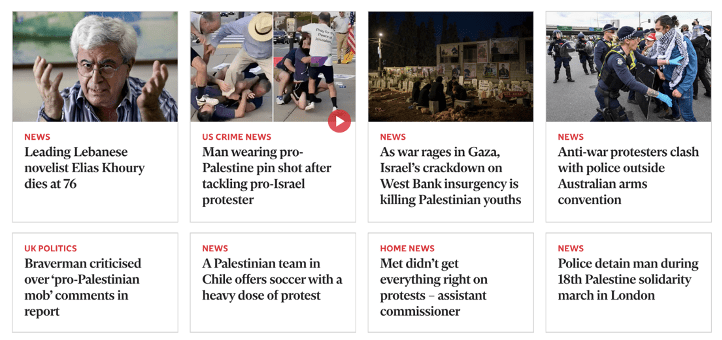
    Allen Meek’s examination of ‘cultural trauma narratives’ in his work, “Trauma in the Digital Age,” expounds upon collective trauma which suspends “the media image, like a traumatic memory, […] as the literal trace of an event: always dislocated in time and space yet experienced with a powerful sense of immediacy and involvement10.” In other words, trauma forms a collective voice and develops into a site of personal identification through photographs, articles, bolden headlines, until Palestine is suspended, rather dislocated in its present suffering and precarious voice, lost to the many countries attempting at amplifying their own testimony. Referring to Figure 2, the screenshot captures eight different narratives from countries like Chile, Australia, Lebanon, the UK, and the US, as their own social body is “recorded and disseminated,[16]” published for the correlation between personal violence and Palestine. Is it possible that the consistent exposure to traumatic images and human suffering initiated a collective narrative that has partially traumatized societies, due to an inability to fulfill Laub’s position of the listener within the survivor’s testimony? As most of this essay is formulated through inquiry, I will briefly return to Butler and Sontag to frame the possibility of such questions. In, On Photography, Susan Sontag returns to a past as she gazes upon graphic postcards: 

    “When I looked at those photographs, something broke. Some limit had been reached, and not only that of horror; I felt irrevocably grieved, wounded, but a part of my feelings started to tighten; something went dead, something is still crying. To suffer is one thing; another thing is living with the photographed images of suffering, which does not necessarily strengthen conscience and the ability to be compassionate. It can also corrupt them[17]

    Accordingly, trauma does not discriminate, and modernity is relentless to the morality of life; the repercussions are evident by both witnesses, that of the survivor and the listener, until their vulnerability of the skin infiltrates the emotional appeal of the Western mind. Modernity has expanded upon trauma, made it accessible, more frequent, louder, as the “agonized vocalization[18]” drowns must social construction trap the screams from the face and the displacements of the body into a lit-up screen, tucked in a back pocket. In other words, the unconscious relationship produced through social media entangles both parties, entrenched in norms and conventions, until “repeated exposure to images becomes less real.[19]” and while I doubt that apathy has severed global minds, does the repetition of screams appear duller due to their bare life? Once more, I acknowledge Butler’s framework to outline my questioning: “[…] how [do] such norms operate to produce certain subjects as “recognizable” persons and to make others decidedly more difficult to recognize.[20]” Does the precarious voice involuntarily appear less internationally, and more so through social media as repetition renders the global voice confused in its complicity? Subsequently, my field of questioning is theoretical and lacking in definitive solutions, yet the performance of social media is unequivocally fundamental to modern progression and demonstrations of a voice, and through this intertwined relationship, an analysis of global events can be attended to the immorality of human atrocity.

    Palestinian Testimony 

    Mustafa Abu Ali’s 1974 documentary, ‘They Do Not Exist’, addresses the political landscape of Palestine, Lebanon refugee camps, guerrilla training, while also converging aesthetics to construct the beauty of the country under Israeli bombardment. After disappearing for almost a decade after the bombings of Beirut, the twenty-four minutes construct a vulnerability, one which humanizes their precarity past western construction as letters pass between child to soldier, families gather rubble from their own bedrooms, and mothers grieve their deceased children.  

    When formulating the Palestinian voice, the dialogue confronts their persecution and ethnic suppression, rather than encompassing their culture, beliefs, and community. Their construction of a cultural narrative must be silenced by the subjection of bombardment, suppressing expression and voices, turning them into photographs and stills. It, as in the Palestinian voice since the Nakba in 1948 became precarious. Displaced, expunged, and socially conditioned to the biological premise of ‘bare life’, their ostracized identity must rest upon the Western Saviour complex. 

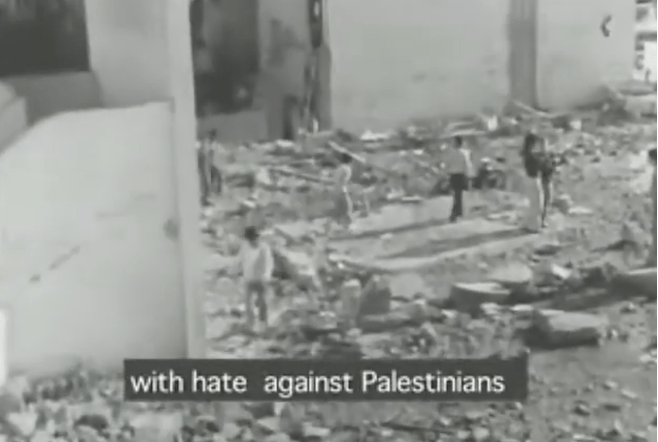
    The headline of Figure 3 as, “There is no more Palestine… It does not EXIST” exacerbates the cultural erasure through the capitalization and denotation of ‘Exist’ to the full stop of the statement — the contrast of ‘no more’ to ‘exist’ consciously elucidates a present existence, which can only be exterminated, hindered, injured, or sequester in order to deliver the promise of the statement. Through a present reception, the use of film, categorically shies away from social media within the five decades since it release, yet the removal of orality for the replacement of falling rubble, initiated a present depiction of ecological and physical devastation amongst Palestinian land and their people. It simply appears that Abu Ali’s understand of pathea within his film, characteristically shelters the Western opinion, overshadowing the generational pain, muted despair, and consistent violence to fit into the nature of aestheticism for saviour complexes.

    Giorgio Agamben extends Foucault’s biopolitics [30] to develop his theory of ‘bare life’. Akin to the precarity of voice, the Italian philosopher expresses: “[…] in the “politicization” of bare life – the metaphysical task par excellence – the humanity of living man is decided.[21]” Critically, the unconscious construction of ‘humanity’ must be postponed, hindered, and unapplicable within the application of politics — namely, a body politics of the Palestinian, unable to deconstruct the ‘Other’ or ‘Oriental’ life. Employed, the Palestinian body must integrate, join, and learn modern forms of media: TikTok, Instagram, Facebook, YouTube, etc. English must follow — plea-filled, desperate, filled to the brim with prayers to simply be heard. It is through this exchange that the endured trauma, the death and the injured, must hope that the new co-owner, the Western unprecarious voice, will deliver a testimony, careful to translate the urgency capable for movement. 

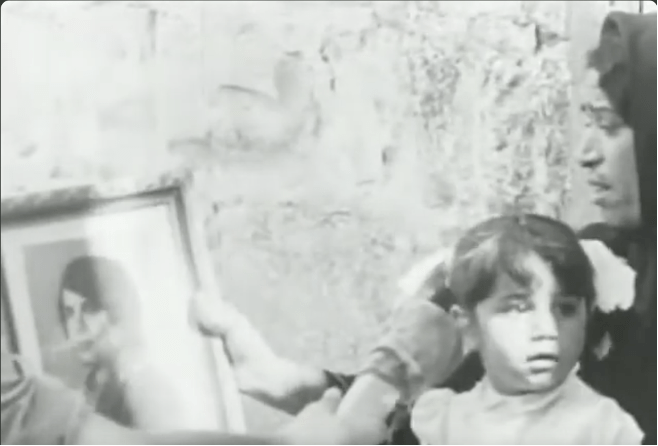
    Introducing Figure 4 and Figure 5, the screenshots taken from the documentary mirror the devastation in social media posts presently, yet, I find it necessary to display the Palestinian voices rupturing their own precarity, as their hope-filled monologues present a recovered future:

    “I was outside during the raise I rushed to rescue my children. I found only 4. The 5th (Jahar) was not there. […] finally they found him under the rubble. It is a burning suffering for a mother. Many Palestinian mothers went through this. […] He is not the only martyr. We are all ready to sacrifice for Palestine[23]” 

    Surrounded by her children, Figure 5, displays a mother holding a photograph of her eldest son, killed by the bombs dropped upon the Palestinians by Israel, yet my emphasizes rest upon her last line of, “We are all ready to sacrifice for Palestine.” These sentiments are expansive and embraced all around Palestine, a national belief and passion, that has been produced on their own land, production crew, people, and voices, untouched by media outlets and news articles. The testimony of the survivor is untainted, and most notably, ends in belief even with their repeated exposure to trauma. Within this sentiment, I find it necessary to allow this essay to not only become a co-owned testimony for Palestinian voice, but a construction of the voice they have held for centuries: “Our people will never bend to oppression and killing. We are fighting for peace and justice[24]”.

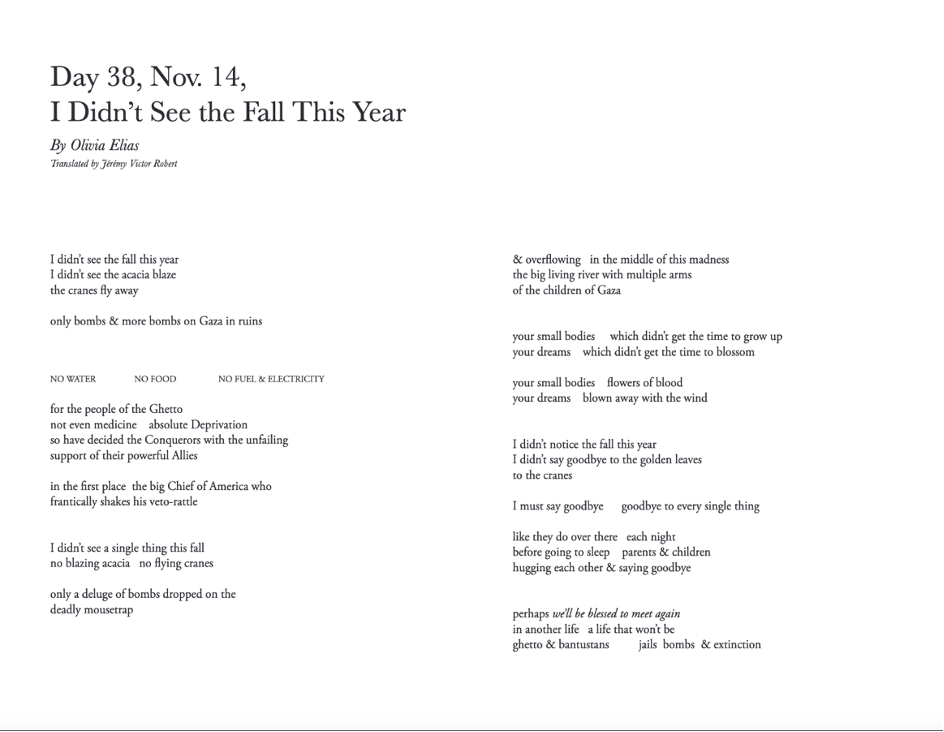
            A Palestinian poet, Olivia Elias’s piece “Day 38, Nov. 14, I Didn’t See the Fall This Year” captures the continuous bombing on Gaza from October 7th and her reflection on the genocide. Referenced as Figure 6, I want to draw attention to the constructed Palestinian voice through poetic form and repetition. The spaces are intentional, physical separators that cater to the repetitive, horrifying moments of descending bombs upon the land of Palestine. “Your small bodies     which didn’t get the time to grow up[25]” or “I must say goodbye    goodbye to every single thing[26]” construct Elias’s precarious voice, immersed in a politicized role of addressing the immoral conditions, the uninterrupted death, the exclusion as “the Big Chief of America[27]” and the “support of their powerful Allies[28]” decimate her personal voice, when “the cranes fly away” and fall lacks a return. Agamben returns to Aristotle quoting, “[a] living animal with the additional capacity for political existence[29]” and while the philosopher is speaking upon the existence of man, precarity illustrates the dehumanization, the subjection of ‘animal’ whose existence is political, similar to Abu Ali’s documentary as the expression of fascist beliefs shape their suppression.

    Overall, a lack of information is due to the limited scope of the Palestinian voice, its pertinence to social media, and its modern effects within trauma studies, leaving gaps within my claims. Several limitations present questions to be answered, as the persistent death of Palestinians and their irretrievable stories continue, yet answers may be possible in the future, especially in the field of literature, through non-fiction pieces and detailed records in the coming years. As the precarious voice was attempted, developed, and expanded, the acceptability of my remarks may be questioned, yet in the context of the political, it is necessary to address the inconsistencies and amend the rupture present in human right affairs and social issues. Overall, I attempt to argue the classified precarious voice of Palestinians, which is altered on social media not only as a witness to the events through the role of the listener, but alongside the modified testimony of the survivor as they fight to humanize themselves.

    Bibliography:

     Agamben, Giorgio. 1998. Homo Sacer: Sovereign Power and Bare Life (Stanford, California Stanford University Press) 

    Butler, Judith. 2004. Precarious Life: The Powers of Mourning and Violence (London ; New York: Verso) 

    Butler, Judith. 2009. Frames of War: When Is Life Grievable? (London; New York: Verso) 

    Dolar, Mladen. 2006. A Voice and Nothing More (Cambridge, Massachusetts: Mit Press, Cop) 

    Felman, Shoshana and Dori Laub. 1992. Testimony : Crises of Witnessing in Literature, Psychoanalysis and History (New York: Routledge) 

    Instagram. 2020. ‘Login • Instagram’, Instagram.com <https://www.instagram.com/explore/search/keyword/?q=palestine&gt; [accessed 20 November 2024]

    Meek, Allen, ‘Trauma in the Digital Age’, in Trauma and Literature, ed. by J. Roger Kurtz, Cambridge Critical Concepts (Cambridge: Cambridge University Press, 2018), pp. 167–80 

    Kuehl, Interviewed by Linda. 1978. ‘The Art of Fiction No. 71’, Www.theparisreview.org <https://www.theparisreview.org/interviews/3439/the-art-of-fiction-no-71-joan-didion&gt;

    Arab Lit. 2023. ‘A Poem by Olivia Elias from Day 38, Nov. 14’, ARABLIT & ARABLIT QUARTERLY <https://arablit.org/2023/11/18/a-poem-by-olivia-elias-from-day-38-nov-14/>&nbsp;

    Palestine Diary. 2010. ‘They Do Not Exist – Film by Mustafa Abu Ali’, Www.youtube.com <https://www.youtube.com/watch?v=2WZ_7Z6vbsg>&nbsp;

    Sontag, Susan. 1977. On Photography (New York Picador) 

    The Independent. 2024. ‘Palestine’, The Independent <https://www.independent.co.uk/topic/palestine?CMP=ILC-refresh>&nbsp;


    [1] Kuehl 1978.

    [2] Sontag 2002: 21.

    [3] Laub 1992: 57. 

    [4] Laub 1992: 68.

    [5] Laub 1992: 63.

    [6] Butler 2009: 8.

    [7] Laub 1992: 64.

    [8] Butler 2009: 14.

    [9] Butler 2009: 63.

    [10] Dolar 2006: 106.

    [11] Meek 2018: 170.

    [12] Instagram 2024

    [13] Meek 2018: 168.

    [14] Instagram 2024.

    [15] Ibid.

    [16] Meek 2018: 167.

    [17] Sontag 2002: 20.

    [18] Butler 2002: 133.

    [19] Sontag 2002: 20.

    [20] Butler 2009: 6.

    [21] Agamben 1998: 8.

    [23] Palestine Diary 2010: 19:57- 21:08.

    [24] Palestine Diary 2010: 18:06- 18:21.

    [25] Arab Lit 2023: l. 19.

    [26] Arab Lit 2023: l.20.

    [27] Arab Lit 2023: l. 10.

    [28] Arab Lit 2023 : l.9.

    [29] Agamben 1998: 7.

    [30] Foucault’s biopolitics can be discovered within his work, History of Sexuality, and develops the idea as ‘a political rationality which takes the administration of life and populations as its subject: ‘to ensure, sustain, and multiply life, to put this life in order”

    Figure 1: ScreenshotInstagram Feed when ‘Palestine’ is searched on the ‘For You’ page.

    Figure 2: Screenshot of the main page, Al Jazeera News Feed, September 15 2024.

    Figure 3: Screenshot of scene from ‘They Do Not Exist’. Youtube.

    Figure 4: Still from documentary, ‘They Do Not Exist’. Youtube.

    Figure 5: Still of documentary, ‘They Do Not Exist’. Youtube.

    Figure 6: Olivia Elias, ‘Day 38, Nov. 14, I Didn’t See the Fall This Year’

  • A Greek Mimesis of Persian Tragedy

    Grade: 65, 2:1; Drama, Term 4 (2500 words)

    *Paper has not been altered after feedback has been given.

    Tragedy is socially dramatized and linguistically undefined, positioning the polis1 toward ‘arbitrary and sterile2’ definitions, with little effect. The contextualisation of human suffering is mimetically presented within Aeschylus Persians, as Greek interpretation strives to imitate Persian political atrophy and civic decimation within a framework of the Persian – Greco War. Herein, Steiners’ definition of ‘Tragedy’ presents a dualistic argument able to sustain the dialogic expressions of the characters, as grief is constructed within the narrative: “The intentional focus can be narrow and specific, as in ‘a tragic accident’ or undefinably spacious, as in the shopworn phrase ‘a tragic sense of life’3”. I aim to expand upon choral identity within a narrative framework alongside a corporeality present in lamentations to explicate a reconstruction of human suffering of Persians’ through a mimetic, Greek, tragedian perspective.  

    Choral Identity and Vocalization 

    Participation of the chorus in Aeschylus Persians is strategically abnormal. Vocal and dominant within the dialogue, the group of women defy a traditional placement that is commonly mollified by moral ideology or a modest collective commentary, seen within Euripides Medea or even, Aeschylus Agamemnon. The presentation of the choral identity begins within Aeschylus temporal, theatrical depiction, as his “[…] display of an Athenian chorus dressed as Persian males right at the opening of his 472 BCE play was a daring and, as far as we know, unparalleled gesture4”. Aeschylus challenge toward the presentation of a female-dominant role, negates an ancient theatrical structure, submerged in gender presentation, social power, and vocality. This (‘daring’) act exemplifies the bold nature of the tragedian, whose decisive linguistic conventions, posit his work outside social convention — as I later argue, to utilize as means to further potent representations of human suffering.  Additionally, it’s “fundamentally chora medium5” rejects enforced civic displays of public mourning, that which was “permitted, although in a controlled form6” and could not be re-enacted by “women under the age of sixty, other than close relations, [who] could enter the chamber of the deceased or follow the procession to the tomb7”. Aeschylus’ intent surpasses a Greek, social presentation of mourning, to depict a Persian pathos existing outside Athenian civic obligation, elucidating the dramatic within a cacophony of chants, wails, laments, and lacerations.  

    To begin, I aim to construct a timeline of the Persian chorus to facilitate their progressive, polyphonic voice as it encounters a tragic framework of war. Before receiving word from the messenger, the Queen converses with the chorus on an omen she received with fear. The routine role of moral guidance is sustained within the response of the chorus, as they reply:  

    Mother, we do not wish to say what would make you wither unduly fearful or unduly optimistic. You should approach the gods with supplications and ask them, if there is anything sinister in what you saw8

    Yet, as the chorus immerses their voice within the Persian politic, “moments of ‘self-referentiality9” deconstruct their role within mediation, opting to dialogically employ pathea10 as means to draw the audience into the familiar condition of grief – an ‘integrated experience’ outlined by Carter. As the socio-political and economic life in the Persian city, Susa, bears transitional tension, the mimetic dramatized upon conditionally relies on Aeschylus knowledge on the Greek politic and legislation, to correctly divide the public and private sphere of potential suffering. The body of the chorus unflinchingly condemns Xerxes fatal actions, as the young king went to war with the Greeks: “Otototoi, you are saying / that the dead bodies of our loved ones / are floating, soaked and constantly buffeted by salt water, / shrouded in mantles that drift in the waves11”, reconstructing a new temperament of the chorus, through the sheer evaluation of Persian bodies floating amongst the sea. Steiner’s broad sense of tragedy captures dream-filled omens and spacious declaration – “and < in every house / the woman left behind > howls for her young husband12” – while also targeting the dead bodies of (‘loved ones), (‘buffeted), (‘shrouded) and (‘floating’) amongst the sea thousands of miles away. The intentional narration, vocality, and tonality immersed in accusation the chorus fosters their eventual barbaric action within laments and public bouts of mourning. This vocality of anguish slightly shifts in its accommodation from the internal to external justification, as the chorus directs their speech to the public space before them: “O you god who has caused such toil and grief, how very heavily you have leaped and trampled on the entire Persian race!13” The act, formerly confined to dialogue of the Queen, Messenger, and Chorus, is unconsciously torn as the women turn their attention to the metaphysical, to a God with capability to proctor death fit for immense human suffering. Placating, questioning, blaming, and sadness, the liminal atmosphere of the chorus’ bargaining eventually commences full-bodied laments that harbor a collective anguish, turmoil, and anger of the (‘Persian race’).  

    Furthermore, the mimetic performance rests upon an historic reality, which eliminates the prepotent of the mythic, until it becomes a“[…] kind of lamentation more shocking, for the audience is encouraged to compare what they see with their own funerary practices14”. The funerary procession is noncorporal, the bodies of the soldiers cannot be returned to Susa, leaving Xerxes in worn out attire, and a weeping chorus to fulfill a memorial of the lost men. Specifically, the function of the chorus as a collective, capable of anguished re-enactment, yet fundamentally immersed in Greek mimicry to feasibly represent the Persian individual concurrently encountering a personal, vivid suffering.  

    In comparison, Alice Oswald’s, Memorial, captures the similar literary essence of dedication amongst a funerary procession, developing an oral cemetery for the lost bodies: 

    DEMUCHUS 

    LAOGONUS 

    DARDANUS 

    TROS 

    MULIUS 

    RHIGMOS 

    LYCAON 

    MYDON15 

    Aeschylus’ Persian eulogy exacerbates the role of the chorus – their demands target the power dynamic between citizen and King, dismissing civic hierarchy to emphasize the suffering the women unconsciously feel. Language becomes a weapon of distrust, commencing verbal accusations against Xerxes through the use of (‘you’), while also suggest the young king is neither (‘brave’) and (‘nobly-born) due to his fatal actions. Before the lamentations proceed, the chorus bemoans stanzas of notable soldiers lost from this encounter, crying out: “Where did you leave Pharnuchus, / yes, and the brave Ariomardus? / Where is the lord Seuacles / or the nobly-born lilaeus, / Memphis, Tharybis and Masistras, / Artembares and Hystaechmas?/ I ask you this again16”. Mirroring Oswald’s declaration, the constructed voice of the once mediating chorus is left to return the dead amongst Persian lands by a verbal eulogy, leaving the group of women to unconsciously redefine their capabilities to a role of mourners.  

    Corporeality and Lamentations 

    Correspondingly, the two distinguished laments of the chorus, (l.255-59) and (l.908-1077) redefine characteristic responses to suffering, as Aeschylus shifts from the internal (private) to the external (public), within his displays of anguish. Yet, this shift into a public sphere, orients the mourning into the political, defining the act of laments indecent, unqualifiable, or unnecessary through representative measures of class, gender, and age. Paul Kottman expands upon the mimetic within a philosophical framework, denoting the theatrics to hold political qualities, allowing for the expansion into the role of the chorus: “[…] like the praxis it imitates – is also pre-political, for it is precisely the interaction that adheres in speaking and action among a plurality that opens the space for the polis17”. The Persian (‘polis’) is intertextual and heavily reliant on Aeschylus interpretation of the Greeks socio-economic, politic, and literary convention, simply due to the representative nature of mimesis. Therefore, Greek tragedies like The Fall of Miletus18 contrive anecdotes of tragic pathos Athenians experienced, whose substantially vivid baseline of grief, becomes a unification of meaning and significance, that would be pertinent to its application in Persian suffering19.  

    Within the tragedy, I aim to touch upon the severity of the laments exercised by the Chorus and the furthered incitement of verbal encouragement of the young king, Xerxes. Aeschylus’ stage directions signal a shift within the vocality of the chorus, alluding to an exacerbated tonal shift of anguish: “[They shift from chant to song] / The land laments its native youth / killed by Xerxes, who crammed Hades with Persians20”. The accusatory tone is projected within a unified, collective manner, yet a polyphonic21 structure surrounds the notion of ‘chant’ (i.e it necessitates a crowd to project in a unison manner) and produces a vivid spectacle of voice to demonstrate public suffering. Even further, the utilization of the body to endure laceration and physical punishment within a lamentation, is mimetic – representative of women in Greek processions of mourning: “[…] women displayed their mourning […] by beating, and sometimes baring, their chests, by loosening and tearing their hair, by crying and wailing, by tearing their robes and by scratching their cheeks22”. Persian suffering, therefore, rest upon the intertextual conceptions and assumption of character, alongside Aeschylus framework and personal encounter of war. 

    Ultimately, the expansion of corporal identity within the chorus expands to adjust to the demands of Xerxes, and crucially the lack of recovery toward the bodies of the soldiers:   

    Xerxes 

    and Chorus 

    Ototototoi! 

    Chorus 

    And mixed in with my groans will be – 

    oi! – black, violent blows. 

    Xerxes 

    Beat your breasts too, and accompany the action with a 

    Mysian cry. 

    Chorus 

    Painful, painful! 

    Xerxes 

    Now, please, ravage the white hairs of your beard23

    The (‘black, violent blows’) composed alongside the beating of the breast, produce a gendered, physical, and an aggressive tone defined by (‘groans’) and the (‘Mysian cry’). The suffering surpasses the emotional, liminal boundary to reassign the chorus as a witness and a narrator to their own grief. The collective identity of the chorus merges the private individual of the women to an uncontrollable entity, encouraged to experience the (‘painful’), fatal disposition of the Persian soldiers. Aeschylus continuation of mimetic narratives within a Greek understanding, situates Persian suffering past individual fatality to a unified, collective identity of civic collapse.  

    Thus, the ‘living memory24’ of Aeschylus and Athenians alike, constitute a relation to a ‘mimetic performance25’ that can support, characterize, and develop a theatrical performance of human suffering outside a cultural context. Aeschylus’ Persians interacts within a theoretical framework of polyphonic and mimetic analysis, expanding Steiners’ dichotomy of tragedy to a vivid corporeality and unique narration of a Persian chorus.  

    —–

    Footnotes:

    [1] See, The Oxford Classical Dictionary, definition of polis. In this paper, I will be referring to Oswyn Murray’s definition listed: The polis is the characteristic form of Greek urban life; its main features are small size, political autonomy, social homogeneity, sense of community and respect for law.

    [2] Steiner 2004: 2.

    [3] Steiner 2004: 1

    [4] Hopman: 58.

    [5] Hopman: 59.

    [6] Foley 2003: 25.

    [7] Foley 2003: 23.

    [8] Aeschylus 2008: l. 215-17.

    [9] Carter 2011: 247.

    [10] Utilized within a plural sense of pathos.

    [11] Aeschylus 2008: l. 274-77.

    [12] Aeschylus 2008: l. 12-13.

    [13] Aeschylus 2008: l. 515-6.

    [14] Swift 2010.

    [15] Oswald 2012: 12.

    [16] Aeschylus 2008: l. 967-73.

    [17] Kottman 2003: 82.

    [18] Kottman produces the account of Athenians watching the performance of The Fall of Miletus within the writing of Herodotus. I have taken an excerpt for reference of suggest claims above to articulate a baseline for Greek suffering. “The audience in the theater burst into tears, and the author was fined a thousand drachmae for reminding them of a disaster which touched them so closely. A law was subsequently passed forbidding anybody ever to put the lay on stage again” (Kottman 2003: 83.)

    [19] Further information is sourced from Steinby 2013: 2. Excerpt follows as such: “The unit of the world in aesthetic seeing is not a unity of meaning or sense – not a systematic unity, but a unity is concretely architectonic”

    [20] Aeschylus 2008: l. 923-26.

    [21] Polyphony in this context is was derived from Steinby 213: 10. The definition used is ‘polyphony’ arises from persons with different world views encountering each other in the concrete events of life”.

    [22] Hurschmann 2006: Brill.

    [23] Aeschylus 2008: l. 1052-56.

    [4] Kottman 2003: 97.

    [25] Ibid.

    Citations: 

    Αἰσχύλος., et al. Aeschylus. Edited by Alan H. Sommerstein, Harvard University Press, 2008. 

    Carter, D. M. Why Athens?: A Reappraisal of Tragic Politics. Oxford University Press, 2011. 

    Hurschmann, R. (. (2006). Mourning. In Brill’s New Pauly Online. Brill. https://doi-org.bris.idm.oclc.org/10.1163/1574-9347_bnp_e1219110  

    Kottman, P. A. (2003). Memory, “Mimesis,” Tragedy: The Scene before Philosophy. Theatre Journal, 55(1), 81–97. http://www.jstor.org/stable/25069181 

    Murray, O. (2012). polis. In The Oxford Classical Dictionary.: Oxford University Press. Retrieved 25 Mar. 2025,  

    https://www.oxfordreference.com/view/10.1093/acref/9780199545568.001.0001/acref-9780199545568-e-5162.

    Oswald, Alice. Memorial: An Excavation of the Iliad. Faber and Faber, 2011. 

    Steinby L. Bakhtin and Lukács: Subjectivity, Signifying Form and Temporality in the Novel. In: Steinby L, Tintti T, eds. Bakhtin and His Others: (Inter)Subjectivity, Chronotope, Dialogism. Anthem Press; 2013:1-18. 

    Steiner, G. (2004). “Tragedy,” Reconsidered. New Literary History, 35(1), 1–15. http://www.jstor.org/stable/20057818&nbsp;

    Swift, L. A., ‘7 Thrēnos and Ritual Lament’, The Hidden Chorus: Echoes of Genre in Tragic Lyric, Oxford Classical Monographs (Oxford, 2010; online edn, Oxford Academic, 1 May 2010), https://doi.org/10.1093/acprof:oso/9780199577842.003.0008, accessed 25 Mar. 2025.  

  • Roman Approach to ‘Other’ Cults

    Roman Approach to ‘Other’ Cults

    Grade: A*, First-Class Honours / Pagan Religions of the Roman Empire, Term 4

    Roman cults centred their religious, political, and social beliefs, around an anthropocentric system, as it captured ritualistic practices and lavish temples, establishing a metaphysical hierarchy. As Rome expanded into East and Western territories, the integration of regional ‘Other’ cults, their campaigns struggled to integrate Roman belief as Persian Magi, human sacrifice, and the presence of esoteric traditions threaten the sanctity of their established empire. The purpose of this essay is to address the dualistic approach and cultural dissension toward the Persian and Celtic-Gallic regions, as the construction of the ‘Other’ is formulated by literary narratives and political agendas.

    The ‘Oriental Other’ is textualized through a tumultuous history of the Persian and Roman Empire, as six centuries of conflict and religious distinction end with acculturation of regional cults. Notably, my approach to the Eastern Empire will rely upon strictly Roman textualization due to, “a paucity of Persian sources and the prevailing Western orientation1”.

    The Persian Magi existed within the semantic field of ‘philosophical-religious magic2’, of which presentation toward their wise character and a ‘hereditary priestly clan’, conspired a Roman literary tradition to interpret, and further demean, the tribe. The practice of Magi was fearsome by its ability to subvert the metaphysical hierarchy, eliminating the position of the daimon, a role necessary for communication to Gods in Roman cults. Herodotus and Catullus remark on the practices of the Magi, declaring, “the Magi as ‘employing enchantments’ when sacrificing white horses to cross the river Strymon3.” and “[…] regards them with contempt especially for the incestuous conjugal customs4 Ibid.”. Running concurrently with contempt, the fear displayed threaten political certainty through expansion and war. Augustus revaluation of the tribe left him to, ‘equate it [magia] with goetia5’. The degradation of the Persian Magi could be linked to the ‘Oriental Other’ the Romans utilized to address foreign cults, yet the Romanic approach to ‘magus’ solidified their dissension toward the Eastern Empire.

    Furthermore, the complexity of their conflict expands from the Roman-Persian Wars, 54 BC – 628 AD, defined by contradictory literary and religious rhetoric:

    The opponents whose despotism, slavishness, luxury and cruelty were the exact opposite of all the virtues of the Greeks. At the same time, though, they had been highly impressed by the Persians and in many spheres of life busily copied them6

    To a greater extent, the (‘opponents’) integration of Isis* and Osiris into the sphere of Roman cults exacerbates my dualistic approach, as the Hellenistic world’s apt attribution to religious acceptance marks a defining cultural modification. I aim to briefly capture the Romanization of Isis, as an Egyptian and Iranian cult figure, with literary compositions from The Metamorphosis of Apuleius and a modern explication from Susan Walker:

    *Upon feedback, it is to be noted that the importance of Isis within a Roman context, as she is not an Iranain diety, and can be furtherd through necessary integration of sources support my claims of Roman response.

    The dedication of a statue of Aphrodite to Isis surely indicates by the Hadrianic period Isis had taken over ground that had been sacred to Aphrodite. The record of the marble stele (4) shows that the two cults were unconnected in the first century B.C. By the second century A.D, Isis had become predominant7.


    Isis is re-positioned, re-constructed, and re-developed within Apuleius narrative until she succeeds power over the Roman god, Fortuna, and is reborn into the service and ‘the providence of the highest goddess8. ’ by the Numidian poet, Apuleius. The worship of Isis constitutes shrines, statues, and altars amongst the Capitol, through demolition, inauguration, or banishment of the cult by emperors. Figure 2 displays her sanctuary built in the early 2nd century, headless, and draped in Hellenistic garments, elucidating a dualism of permanence toward her standing statue, surrounded and covered in Romanic architecture, yet a by-product of dissent as her bodice is all that upholds the ‘Oriental’ other in Roman belief.

    Additionally, Roman approach to the Gallic-Celtic cults and Druidism, sustained a literary tradition of depreciation, demanding their practices were inhumane or impure through “barbaric forms of sacrifice and divination in [the] Gaul9”. Insistent on the devious nature in the Gallic-Celtic region, Lucan writes in his text, “[…] ceremonies of the gods / barbarous in ritual, altars furnished with hideous offerings, / every tree is sanctified with human blood10”. Specifically, the orientation of goetic magic was enriched and dramatized for literary enjoyment, drawing upon the visceral violence and human sacrifices (’sanctified with human blood’) the tribe seem to partake in. Consequentially, as Roman cults prohibited human sacrifice, deeming the action to be impure, the Druid rituals are deemed improper by cultural dissension, and therefore pose risk to Romanic religion through centrism and the transactional relationship with their Gods.

    The negative approach employed is fastened to political agendas — that which posit the Gallic-Celtic empire as foreign land critical to the expansion of the Roman Empire. Druidism, by association to the Gallic, parallels the harsh connotations of previous ‘Other’ cults, through political sovereignty and “intimations of the occult11”. The aristocracy of the Druids ‘united the Gallic tribes in a loose religious union12’, persisting alongside the Western territory during the Gallic Wars. Declared a political danger by Claudius, the metaphysical power posed critical advancements for the Romans, aimed toward the elimination of the Druids. Referring to Figure 1, David and Monnet place a Roman soldier at the centre of the sketch, depicting his stretched-out arm as an order, conducting the pointed finger to a fatal sentence for the Druids, tied upon a stake, to be punished to death by fire.

    Alongside the anti-Roman rhetoric of the Druids, the Gallic and Celtic Western regions encountered Romanic cultish belief during their period of expansion, as the convergence of differencing produced cultural dissension amongst Roman literary rhetoric. Classified as 1313 Strabo 1923.structure of the Romanic cult. “witlessness and boastful[…]13”, the character of the Britons was ultimately reconstructed as Roman cults approached their regional religions. The Celtic and Gallic territories faced submission through the integration of their land, relinquishing the nationalistic, political shape of a religious belief that ultimately threatened the

    Overall, Roman approach to ‘Oriental’ and ‘Other’ cults offer insight on their cultural dissension and a distinction in literary rhetorical dichotomies. The Persian Empire’s religious integration, yet belief and proceedings in Magi present contrasting Romanic approach through their six centuries of conflict. The Celtic-Gallic and Druids depict the general atmosphere of Roman expansion in foreign or regional lands, as political and cultural immersion shadows the Britons past of Magi and


    Figure 1. A Roman soldier is ordering the burning of the druids who are tied to a stake. Etching by F.A. David after C. Monnet

    Figure 2. Temple of Isis. Delos Island, Greece, Schmuel Magal, Sites and Photos

    1: Ehoward 2006

    2: Costantini 2019: 25.

    3: Costantini 2019: 26.

    4: Ibid.

    5: Costantini 2019: 27.

    6: Bremmer 2008: 243.

    7: Walker 1979: 248.

    8: Apuleius 1998: 226

    9: Last 1949: 3.

    10: Lucan 1992: l. 403-407.

    11: Dewitt 1938: 320.

    12: Tamblyn 1909: 22.

    13: Strabo 1923.


    Bibliography:

    Apuleius. 1998. The Golden Ass or Metamorphoses, (London, Penguin Books).

    Constantini, Leonardo. ‘Exploring the semantic complexity of the voces mediae: magus, magicus, and magia’, in Volume 1 Words and Sounds, ed. by Nigel Holmes, Marijke Ottink, Josine Schrickx and Maria Selig. (Berlin, Boston: De Gruyter), pp. 21-32.

    DeWitt, Norman J. “The Druids and Romanization.” Transactions and Proceedings of the American Philological Association, vol. 69, 1938, pp. 319–32. JSTOR, https://doi.org/10.2307/283182. Accessed 20 Mar. 2025.

    Ehoward. 2006. ‘The History of the Roman-Persian Wars’ < https://www.historynet.com/roman-persian-wars/.&gt; [Accessed: 15/3/2025]

    Last, Hugh. “Rome and the Druids: A Note.” The Journal of Roman Studies, vol. 39, 1949, pp. 1–5. JSTOR, https://doi.org/10.2307/297701. Accessed 20 Mar. 2025.

    Lucan. 1992. ‘Book 3’, in ‘Lucan: Civil War’ ed. by Susan H. Braund. (Oxford: Oxford University Press), l. 399-411.

    Monnet, Charles, 1732-1809?, and David, François-Anne, 1741-1824. A Roman Soldier Is Ordering the Burning of the Druids Who Are Tied to a Stake. Etching by F.A. David after C. Monnet. 1 print : etching, with engraving, [1784]. Wellcome Collection, JSTOR, https://jstor.org/stable/community.24887652. Accessed 19 Mar. 2025.

    Strabo, Geography 4. 4. 5, Volume II: Books 3-5, trans. by Horace Leonard Jones,

    Loeb Classical Library 50 (Cambridge, MA: Harvard University Press, 1923)

    Tamblyn, W. F. “British Druidism and the Roman War Policy.” The American Historical Review, vol. 15, no. 1, 1909, pp. 21–36. JSTOR, https://doi.org/10.2307/1835422. Accessed 20 Mar. 2025.

    Temple of Isis. Built ca. 166 – 88 BC. Sites and Photos. Artstor, JSTOR, https://jstor.org/stable/community.15229763. Accessed 19 Mar. 2025.

    Walker, S. (1979). A Sanctuary of Isis on the South Slope of the Athenian Acropolis. The Annual of the British School at Athens, 74, 243–258. http://www.jstor.org/stable/30103562