Tag: feminism

  • Re: Re: ‘A Woman’s Issue’ by Margaret Atwood [with notes].

    Persecution saturates the neck of young women. This damp exterior, crushed between jagged ribs and the unbecoming ill-remains of fat, will become explicit, R-rated, subverted to a perversion of this body, her body. Forget about the care we show intent — it is now stretched, disjointed; an awkward veil of femininty (lace and all.)

    [I could be remarkable, and prudish.]

    Should I talk upon the juvenile nature of flexibility? Where, the extension of ones hips [the landscape for childbirth] & career & jaw, remains sexual. Deceptiveley delicate ‘the woman’ is.

    Either way, the post / pre / birth of modern misogyny aligns a women to be knowledgeable in its ‘devices’ — that which shocks, suffocates, pricks, invades, redefines. That of a collar or hand, of personal persuasion to bind the stomach, the fat under the arms, the placement of the toes upon the feet — how they should curve until the bones snap.

    Then, there is the awful codification of ‘muse’, which could have been disastrous, but remained ill-defined as women began to carve space into art and music and fashion (still posing, hooked on devices, drugged to calm the eyes). Atwood was familiar with such inflexibility of women in art, or their use for it, and therefore made her own exhibit.


    Space: Part I

    Space: the three feet between their sunken back in line and your purse (controlled by stickers glued to the pavement and an awkward placement of your hands); the lack-there-of between a shared hug (how we create an allowance for the possibility of a greeting); an interval (the bell on a microwave, the minutes between contractions); the cycles of sleep (how religion was formed from hours of REM); a uterus (childbirth, cysts, IUDs’); the gap between breaths, cells, neurons, eyebrows.

    Briefly, I want you, the reader, to remove yourself from any understanding that you are about to read a poem (and any notion that it may be life changing). Rid yourself of excitement, pride, humility, or historical insight you may feel is relevant to the female body. Now, this intangibility of your intelligence should be caressed — held with enough care that dislocation from the physical body is nurturing, yet necessary.

    Here, I urge you simply, to consume.

    “The woman in the spiked device

    that locks around the waist and between

    the legs, which holds in it like a tea strainer

    is Exhibit A

    We must start with ‘The’, whose practical use in the sentence must provide a body, a root, for the further construction of a ‘woman’. Yet, Atwood extends past simple grammatical structures to dictate a tone of culpability, where name is unknown, and whose consciousness holds no weight in her description.  The ‘woman’ is dismissed – nameless, muted, and withheld. By the first sentence alone, Atwood introduces the present, systemic, pornographic reality of women (who endure sexual slavery, prostitution, brutish desires and ferocious kinks). She is silenced, and more importantly, spoken for.   

    Even further, the frequent sexual strangulation present in pornography and sexual encounters, is leaving women with irreparable brain damage. Therefore, suggestions of ‘the woman’ being implicated as ‘brain dead’ are probable, and often passively initiated when a ‘spiked device’ strains upon the neck and legs. It is then, that the omniscient voice must dictate her despair.  

    What are we to then make of ‘Exhibit A?’ Are the readers meant to watch, loosely, abhorrently, decisively like one does in an art exhibit? (Never too closely, or even somewhat thoughtfully, limited to opening hours and release dates, constrained by the attention span of the viewers). Is it possible Atwood is referring to an article, doused in symmetrical red circles and frilly skirts as the women try to cover their face? Do we place the symbolism past the women to inspect her constraints, (i.e the collar, the sunken waist, the immobility of mouth and body) and leave the connotations of ‘Exhibit A’ to schoolboys’ magazine as they move the image side to side.  

    By the end of the first stanza, the removal of the subject is dualistic. Atwood respects the privacy of ‘the woman’ enough to soften her features, deconstructing the hard contours of breasts or a demeanour that must be conquered, while being unable to free her body from the sexual, sociological constraints – that which ‘holds [here] like a tea strainer’. A tool, designed to grasp and clench; while also actively releasing parts of itself; the dilution of the women is uncanny to modern, female autonomy.  

    What pleasures have I given away?


    Space: Part II

    “The woman in black with a net window

    to see through and a four-inch

    wooden peg jammed up

    between her legs, so she can’t be raped

    is Exhibit B

    Let us assume that Exhibit B is a photograph, which was displayed on National Geographic for the features of her face (how the world could not fathom such beauty enduring starvation, or genocide, maybe sexual abuse, and modern slavery). Let us hide the wooden peg, claim that the object was in the way of the shot, (a mental disturbance at best for the viewer) and rather focus on how the pattern of the net reflecting amongst her skin. Please do not entertain the background (the refugee camp, the perished mountains and dry soil, those rushing toward flour or the individual surrounded by bottles) rather focus on the eyes.

    Who is violent, then?

    Exhibit B builds upon the sexual strangulation of ‘the women’ in ‘devices’, while precisely eliminating her personal liberation of sexual security. The viewer must walk between the exhibits, aware of the struggle the soles of their feet encounter with the wet, marble floor to the persecution of ‘the women’s’ skin (& the unforgotten space of flesh between her legs), which to them, is all movement anyway.

    Insertion is not dictated, nor coerced, it is ‘jammed’, pummelled, immobilized within her uterus. The violation is personal, yes, but the removal of space between her legs furthers the offence that she must lose in ones translation of all we are meant to sacrifice.

    There was a window, (Atwood recalls), which is pliant for the man. ‘The woman’ is now a dominion, conquerable and contagious in here lack of exploitation. He is goverend by assumption, and therefore, once capable of interfence, his depravity of his violence will surpass the insertion of the wooden peg.

    What is Exhibit B?

    a) The women of Tigray, who after being forcefully raped, succumbing to the pain of nails, screws, plastic rubbish, sand, gravel, and letters jammed into their uterus.

    b) Rape being a tactic of war and interastate conflicts in Sudan, by the RSF (Rapid Support Forces) which forced women into sexual enslavement, gangrape, sexual assualt against children, and enacting violence which displaced women and their children in the Dafur region.

    c) The men and women in the Abu Ghraib prision in Iraq, that faced psychological torture, sexual humiliation, rape, confinement, and electrical shocks which were produced by “enhanced interrogation techniques” and what we know today as “The Hooded Man”.

    d) Women, boys, girls, dogs, and animals in Palestine, Ukraine, Sudan, Congo, Vietnam, Afghantistan, Iraq, Ethipia, Mali, Nigeria, Somalia, Syria, Bosnia & Herzegovina (…) who become paramount staistics in reports a decade later, yet have succumbed to their injuries years prior.

    e) Annihilation.    

    16.10.25

    It was Denial in my throat. All of this.
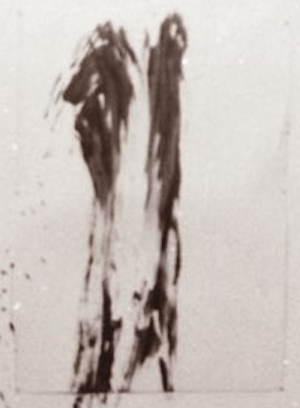
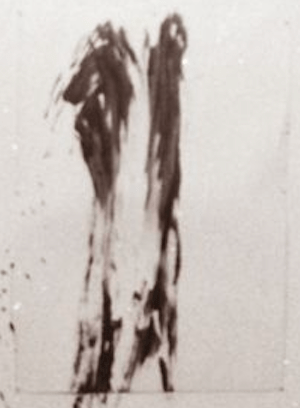
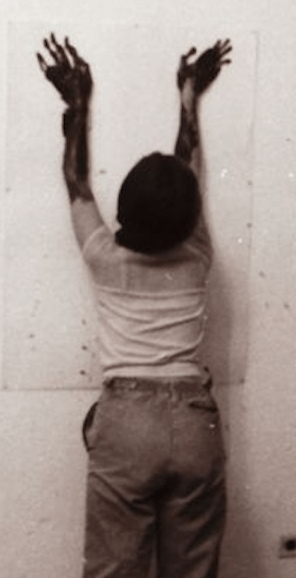
    Tania Bruguera, Title: Tribute to Ana Mendieta (1985)

    I was a petulant child, smothered by my own two hands — hands that were recognized, and therefore clenched.

    There was little articulation amongst the imposing stature of the self, maybe it was the balancing part I struggled amongst confrontation. This ‘self’ must be considerate enough to bruise it once in a while, alongside proving the subtlety of the act alone.

    Much of these days, intention is of that same false decree we hang religion from. Space (a tribute to oxymorons) must be weighed, sifted, and if appeased, saturated in front of ones mirror suitable for child-like identification. Our eyes no longer belong to the face of our mother, neither will these ‘petulant hands’, and what do I make of my righteous ability?

    I have already learned how to breath.

    A manuscript for greed, the breath is. Delicate and horrifyingly immeshed with a voice for death.

    What else have I known?


  • Space, Gender and Chastity: Domestic Space in The Rape of the Lock.

    Space, Gender and Chastity: Domestic Space in The Rape of the Lock.

    Literature 1550-1740, Term 2.

    Judith Butler in Gender Trouble (1989) develops the relationship between gender and space through a cultural discourse. An unprecedented work, Butler’s aim shifts the reflection of gender to the corporeal – the body, and by relation, the space in which the physical and mental are shaped by social intrusion. When addressing Alexander Pope’s, The Rape of the Lock, domestic space becomes a cultural and social inscription which is repressive toward women and an unexplored political playground roaming with the women’s plight toward sexual purity. Domestic space shapes the repressive nature spurred by class and patriarchal objectives until chastity defines the characteristics of a women.  

    Re-worked alongside theory, domestic space leans into dichotomies that allows for cultural inscription, a feat best represented by the Oxford Dictionary as they characterized the space to exist as, “The apartheid system dichotomized physical space into masculine and feminine categories, marginalizing the feminine1.” It is practical to notice the dualism, which must be addressed, where women’s domestic space caters to expansion, possibility, and subversive positions which warrants the growth of children, partners, and their developing passions, leaving the mother, daughter, or wife to cater excruciatingly to a force- fed oppression: “Women were relegated to the inferior physical and social space of the homelands where they were expected to farm, raise children, and care for the sick and elderly2.” In replicating the domestic space in The Rape of the Lock, Pope’s execution becomes fluid and satirical, relegating Beauty as a willingly, yet violent adornment alongside the female body, whose vain rituals profess an innocence not yet known to the woman.   

    Revisiting Butler, her suggestions of ‘cultural inscription’ and the body follows Pope’s domestic space of marriage and class, a notion summed up as,  

    “Space is never neutral but always discursively constructed, ideologically marked, and shaped by the dominant power structures and forms of knowledge… space is both created and articulated through cultural discourse, including gender discourse. Thus, we cannot grasp space outside a socially meditated perspective.3” 

    Pope drives the perception of wealth and space satirically in one excerpt, denoting the jewels and objects adorning the main character, Belinda, as a foolish desire the wealthy place on insignificant items. Class is seen as: 

      “Whether the Nymph shall break Diana’s law, / Or some frail China jar receive a Flaw, / Or stain her Honour, or her new Brocade, / Forget her Pray’rs, or miss a Masquerade, /Or lose her Heart, or Necklace, at a Ball;/ Or whether Heav’n has doom’d that Shock must fall.4” 

    Represented by ‘frail China,’ or her ‘new Brocade,’ the objects surrounding the female character shapes both a metaphysical and domestic space aligned with conforming to beauty practices upheld from a ‘socially meditated perspective,’ whose yearning for marriage is a presentation of ‘her Honour.’ In mock-epic fashion, Belinda’s description of wealth pervades human protection, as the Sylphs surround the embellished and objectifiable lady, leaving Pope to pursue the permeation of the body through the adornment of wealth and established performativity of gender roles: “Form a strong Line about the Silver Bound, / And guard the wide Circumference around.” (ii.121-122) The fixation on the ‘Necklace’ and a ‘Heart’ situate the body and the material in the same category of space – domestic, as Belinda unconsciously indulges the prospect of her situated repression – a decision by Pope, which posits her outside a space of volition and feeds into the class-act of marriage and wealth. The ‘circumference’ of Sylphs surrounding Belinda introduces the skin as a mode of space, a quality capable of permeation and personal condemnation, whose association to gender discourse, brings about the plights of the domestic space, as a limit to the female self:  

    “What constitutes the limit of the body is never merely material, but that of the surface, the skin, is systemically signified by taboos and anticipated transgressions indeed, the boundaries of the body become, within her analysis, the limits of the social per se5”  

    Now, the existence of space from the self to the social creates a distinction of physical limitations; performativity rest upon the beauty of her skin, its likeness to grace and wonders distinctive of innocence until the body performs its own objectivity – she enacts her own gender discourse through a desired cultural inclusion.  

    The significance of the domestic space is rendered to the adequacy of the female body, the forced objective beauty that is: “Th’ inferior Priestess, at her Altar’s side, / Trembling, begins the sacred Rites of Pride.” (i.127-28) Pope’s verbal control toward terms like ‘sacred’ and the aforementioned ‘pride’ by extension must exist in the domestic space of femininity – exemplifying the required attention the body must hold for the women. It is a space worthy of adoration and touch, where ‘rites’ signify the opportunity the woman holds, leaving the ‘trembling’ as Pope’s chosen dichotomy in the sentence: does the sacred nature of feminine rituals driven by excitement of reenactment or nervous acceptance toward her guarded purity and vanity she must act upon? 

    Ending physical permeation of the female body, one last signification of the domestic space is the internalization of the female body and young girls. Introducing Braidotti, Lois McNay states simply, “The internalization of representation of the female body by women is fundamental to the formation of the feminine identity.6” The formation is drawn clearly in Pope’s text, compared quickly alongside Belinda’s evolving vanity, and one which characterizes the female body as less, due to the directive nature one must adopt: “’Tis these that early taint the Female Soul, / Instruct the eyes of young Coquettes to roll, / Teach Infant Cheeks a bidden Blush to know, / And little Hearts to flutter at a Beau.” (i.87-90) Pope’s reference to ‘taint’ corresponds with his mock-epic attitude, drawing upon the absurdity of social adherence, the forceful nature of desire, seduction, and innocence that must be catered to, even when innocence is all the young body holds. The domestic space is manipulated, so much so that the submission must be unnatural – formulated for social coherence and the uplifting of gender roles, and in Butler’s simplest words, performative, until the body is lacking in space completely. 

    Hovering in the realm of the metaphysical, the metaphorical ‘rape’ of Belinda exposes the manipulation of the domestic space and repression of the female body by means of chastity. When positioning the ‘natural’ alongside the female body in Pope’s mock-epic, it becomes “…a device central to the legitimation of certain strategies of oppression,” until it lacks the signification held toward beauty and ornamental jewels of the self – a disruption to the desirable objectification of a ‘body [as] a site of conquest.7”. Belinda’s honed acceptance must follow and indulge toward repression, of self and sexual identity, until she foster’s the decoration of her own virginity, as Pope writes, “Fair Tresses Man’s Imperial insnare, / And Beauty draws us with a single Hair.(ii. 27-28)” The dichotomy rest in Belinda’s internalized and furthered materialized objectification of her beauty – a cultural process spurred by a patriarchal body, while also characterizing the male self to egregious behaviors akin to ‘rape’ and ‘insnare.’ The permeation of this dichotomy rest internally for Belinda, and it is only until the ‘rape’ of her lock is orchestrated by the Baron, does the domestic space wither: “So long my Honour, Name, and Praise shall live!” (iii.170) From her rage-filled declarations, the representation of the female body loses touch with feminine objectification when it eventually becomes ‘conquered,’ or when the honor and name have been stripped of pure, virgin innocence. The woman assembled through mock-epic fight scenes permeate a physical domestic space, where skin contends with its own internal and external oppressors and moral plights induce the voice of women such as Clarissa, Thalestris, and Belinda. 

    Quickly, Foucault’s revaluation of women and their bodies produces a hierarchy of their repression, noted as, “…individuals as docile bodies has the effects of pushing women back into the position of passivity and silence8.” The construction of metaphysical conceptions like honor, pride, and vanity develops what domestic space is and its significance to the female self; It was a rite of passage and a representation of women’s suppression, generational to “her Mother’s hairs/ Which long she wore, and now Belinda wears.” (v. 95-6) Pope references these facets of identity in multiples, contriving, “He spoke, and speaking, in proud Triumph spread / The long-contended Honours of her Head.” (iv.139-140) The hair as a metaphor for rape, or seizing, delineates ‘docile bodies’ enacting ‘passivity’ genealogically, until the unitary movement of the body, the objectified female self and the space in between becomes “a construction, a product of the effects of power.9” This ‘construction,’ lies within the critical nature of man described by Pope, as the female self internalized honor and pride and vanity on man’s decisive rule, yet it was used against them for their sexual identity and objectifiable pleasure.  

    Domestic space is arguably a metaphysical conception, overarchingly dependent on the women’s existence and played by Pope to represent the potential reversal of power between men and women. Canto V redefines the significance of domestic space, as women “killed him with a frown / She smil’d to see the doughty Hero slain” (v.68-9), or the echoing of Belinda’s rage-filled desires, “Restore the Lock! She cries; and all around / Restore the Lock! the Vaulted Roofs rebound.” (v.103-04) The female body, in the domestic space, warrants voice past the expression of honor or virtue but rather violence shed from lack thereof, and rather utilizes the metaphysical to create what can be termed a new ‘domestic space.’ Foucault redefines this shift as a“discourse [which] transmits and produces power; it reinforces it, but also undermines and exposes it, renders it fragile and makes it possible to thwart it.10” Pope’s decision to ‘thwart’ the systematic power over women, to alter the significance of the domestic space, is delivered by Clarissa, whose moral address is noted as such: “Think not, when Women’s transient Breath is fled, / That all her Vanities at once are dead” (i.51-52). Sequentially, the women’s consciousness and further assertions toward their vain plights recognizes space as its own body, capable of change and fluid movements must death alter the current inferiority of the female body, and rather renders the domestic space in favour of their own, personal space. Naturally, the power is seized from men the moment Belinda’s lock of hair tumbles into space, or what Pope denotes as “the shinning Sphere!” (v.143-44). 

    The figurative “domestic space,” the female body encounters welcomes a navigation not only through the construction of gender and sexual identity, but its interaction with metaphysical space and personal identity. Through Alexander Pope’s, The Rape of the Lock, and philosophers such as Judith Butler and Michel Foucault, the significance of space can be critically analysed through cultural inscription, and as a result, the spatial and social begin to develop the performativity of gender past the dichotomy of a domestic space. It is through these articulations that the female self is positioned past the theoretical to the present, capable body, much like Pope’s Belinda.  

    Bibliography: 

    A Dictionary of Geography. ‘Domestic Space,’ oxfordreference.com <https://www.oxfordreference.com/display/10.1093/oi/authority.20110803095725760

    Butler, Judith. 1990. ‘Bodily Inscriptions, Performative Subversions’ in Gender Trouble. Routledge 

    Jagger, Gill. 2008. ‘Judith Butler: Sexual Politics, Social Change and the Power of the Performative.” Routledge 

    McNay, Lois. 1992. ‘Foucault and Feminism: Power, Gender, and the Self.’ Polity Press 

    Pope, Alexander. 2007. The Rape of the Lock. (Vintage) 

    Wrede, Theda. 2015. ‘Theorizing Space and Gender in the 21st Century.’ Rocky Mountain Modern Language Association