Tag: books

  • Does the Child Know Best?: How Literacy Excels in Child’s Play

    Term 5, Myth and Creativity

    Freud’s psychoanalysis of child’s play was arguably a prominent source within the field of children studies, yet the work was in dire need of improvement. The neurologist satisfied his claim through a categorical dichotomy; the ‘phantasies’ that the adult engaged with, which would have transpired from the imaginative play of the child, would be identified as ambitious wishes or erotic phantasies. Eventually, the hands-on, intimate, motor-oriented movement of the child was forgotten in lieu of archetypal characters in the “less pretentious authors of novels1”. Yet, an idea was peeking from Freud’s interpretive piece – the inability for the human mind to relinquish memory. The individual ingests the linear timeline of past, present, or future precedents that are capable of retention insofar that, “[the mind] can never give anything up; [it can] only exchange one thing for another. […] In the same way, the growing child, when he stops playing, gives up nothing but the link with real objects; instead of playing, he now phantasies2”.  

    So, Freud’s conditions of ‘phantasies’ produce enough substance to tread the psychoanalytic inquiry of imagination to adult literary creation, yet I am to expand upon Freud’s categories of ambition / eroticism to encompass sensation. Furthermore, a three-dimensional approach on attention, emotions, and delayed closure will be utilized to illustrate the modern tradition in childhood studies presently.  

    Key words: Freud, phantasies, sensation, memory 

    Introduction 

    D.B Elkonin within his publication, ‘Theories of Play’ examines K. Groos and D.A Colozza attempts to outline the psychological processes of child’s play, as the two theorist’s varying modes of thought contradict accepted beliefs in childhood studies. D. A. Colozza argues:  

    For higher animals, including humans, the struggle for existence is initially not that different and cruel. Newborn babies get assistance, protection, and care from their mothers, or, in the majority of cases, from both their mothers and fathers. Their lives are, to a significant extent, maintained by the labour and actions of those who brought them into the world; their energies, which they do not yet have to use for obtaining food, are spent freely, in way that can hardly be considered 

    Colozza’s statement re-introduces the parents within the sphere of child’s play – the child is not merely maintained by their mind alone, but also the body, intellect, and orality of the parent, as the child is introduced to varying environments. A stark contrast to Freud, the surroundings of the child are not merely societal interventions like eroticism or wish fulfilment, but rather the maintenance of labour and the significant extent to protect, assist and care for the child. It is then, the adaptation of qualities (empathy, communication skills, problem-solving, etc) will work alongside the feedback of the parents to formulate a present and future response Freud considers to become ‘phantasies.’ 

    Sustained Attention 

    Robert Strom in his psychoanalytic piece, ‘Observing Parent-Child Fantasy Play’, provides ten categories of play observation between child and parent to analyse their mimetic behaviour. While milestones such as crawling, rolling over, walking or their first word are substantial in preliminary observations of child development, touch and verbal sensations amongst progressive cognition arouse a psychoanalytic inquiry notably interpreted amongst Sigmund Freud, K. Groos, and Maria Montessori. Initially, Strom’s proposition of categories is introduced by the child’s ability to ‘sustain attention’; a query the theorist regarded as, “The readiness of pre-schoolers to sustain attention while at play can be timed. This ability to pay attention is for the process of play rather than any among the discontinuous events or plots on which process may focus3”. The study concluded that the child’s attention was substantially longer when partaking in activities they personally enjoyed, as opposed to window-shopping with their mothers the day prior, or engaging in adult-like activities such as grocery shopping, card games, or going to restaurants. Plainly, adult action was not stimulating enough, nor was it digestible for the child who wished to touch, smell, or speak freely.  

    The consistent engagement satisfies a broad acceptance of attention to detail, memory recall, and critical thinking found in gradual literacy or creative writing. Therefore, if the child is to receive an education focused on literacy, the maturation of toys from blocks to dolls, or eventually sports, will inform a growing imagination through the senses. Executive Function will then proceed as a goal-directed behaviour alongside the foundation of inhibition, which largely suppress the distractions commonly associated within developing children. So, if Strom’s assertion of ‘Sustained Attention’ is an acting agent into a relationship of child’s play and literary creation, then research into cognitive maturation or sensory play are far more sustainable than inquiries into ‘phantasies’. 

    Part I: Sensation of Touch 

    At Freud’s insistence, his piece, ‘Creative Writers and Daydreaming’, assumes three moments in the individual where the ideation of a ‘phantasy’ develops: the present provokes the occasion to daydream, the past is utilized as a basin for memory (often in a younger stage of life), and a future which would represent the fulfilled fantasy. Yet, what if the implied linearity, which must rely on the memory of the individual, was replaced by the relationship of internal comprehension to external recognition brought by sensation? 

    English paediatrician and psychoanalyst, Donald Winnicott delivered the ‘transitional phenomena’ present in childhood over half a century ago. The infant utilizes an object, often with little significance or reason, to hold, chew, or throw as means of representing present emotions they are otherwise unable to verbalise. Winnicott proposes: 

    […] perhaps a bundles of wool or the corner of a blanket or eiderdown, or a word or tune, or a mannerism – that becomes vitally important to the infant for use at the time of going to sleep, and is a defence against anxiety, especially anxiety of depressive type4

    The sensation of touch connects the infant to a world outside of them – an experience Jacques Lacan labels as the ‘mirror stage’. Gathered by the eighth month in infancy, the child’s state of helplessness, spurred by ‘motor impotence and nursling dependence5’ will illicit negative feelings akin to distress or anxiety. 

    To the young child, motivated by these negative affects, a crucial component of the enthralling lure exerted by the fascinating image of his/her body is this image’s promise that he/she can overcome his/her Hilflosigkeit6 and be a unified, pulled-together whole, an integrated, coordinated totality like the bigger, more mature others he/she sees around him/her-self7

    The embolden subjectivity the child experiences when the mirror stage is engaged is crucial to actualizing the sensation of touch outside the breast of their mother. The ego begins to form, alongside the presence of their body, as Winnicott’s theory of ‘Transitional Phenomena’ effectively replaces the intimacy and warmth of the parent. If we are to broaden our subject to the social environment around them, the sensation of touch will allows the child to self-soothe when encountering anxiety or distress but will also allow the mind to begin the process of touch by engaging in the object, toy, or person around them. It will then be inevitable, that the ‘phantasies’ Freud investigates are to be evident with the child’s play as they subscribe transitionary feeling to all that is around them.  

    Part II: Sensation of Hearing 

    After the touch of the mother, commences the prominence of her voice. The child will hear their name sung, muttered, yelled, or enunciated as they acknowledge the vibrations that carry past physical touch, to their ears. Amidst K. Groos’s work, The Play of Man, the sensation of hearing for the infant is visceral, and all-encompassing: 

    From the suckling’s delight in his own guttural gurgling’s to the most refined enjoyment of a concert-goer, from the uncouth efforts of the small child to produce all sorts of sounds, to the creative impulse which controls the musical genius, there is, in the light of history, a progressive and consistent development8 

    The ‘consistent development’ alluded by Groos, is a matter of maturation toward one’s senses. A child will begin with the voice of the mother to the representative noises of its own, until assertion of the self is simply expected. It is persistent, often unconscious, and is mainly impulsive in the early stages of development. The theorist’s observation of children was accompanied by external examination of family friend’s or other psychoanalysts since the child’s birth, and within his catalogue, K. Gross noted a common impulse:  

    I have often seen three- and four-year-old children skip about when they heard enlivening band music, as if they wish to catch the time of the rhythmic movement, an impulse which indeed affects adults as well9  

    Accompanied by the senses, the body corroborates with motor processes and the external environment with enough space to ‘skip about’, that a visual scene naturally aligns with verbal cues – this is how a child comes to learn distinction, delayed response, and expressed emotions. Attending to the fanatical world of creative writers, the scenic images or grotesque portrayals are stimulated by child-like experiences. The fear, anger, or sadness that we once clung to with that teddy bear in our mouth, is expanded to the rage-filled screaming of a character experiencing loss. Groos’s portrayal of sound follows similar cues as the psychologist examines its textual sensations: 

    I would instance the cherry crackling of flames in a fireplace, the frou-frou of silken garments, the singing of caged birds, the sound of wind howling of storms, rolling of thunder, rustling of leaves, splashing of brooks, seething of waves, etc. Most of these, it is true, contain elements of intellectual pleasure as well, and so through association link themselves to genuine aesthetic enjoyments10

    Delayed Closure 

    Strom’s second moment of classification emerged in the notion of ‘Delayed Closure’ which corresponds with attention span and emotion regulation by measuring, “[the child’s] ability to successively engage in play events without their serial completion, illustrates the delay of closure. Persons of this ability demonstrate a tolerance for incomplete events and the consequent tension of ambiguity11.” Yet, the relationship of children and delay often produce fits of rage or bouts of screaming as the child discerns, they cannot immediately obtain what it is presently desired. So, if adjustment of behaviour, alongside the progression of self-identity is persistently developed, then it is no longer just a practice of an internal, personal dilemma but rather the delayed closure response would interact with the child’s external space, i.e society, relationships, or individuals. Therefore, the child’s engagement with the surrounding environment will shape, “each moment under an enormous vertical and horizontal pressure of information, potent with ambiguity, meaning-full, unfixed, and certainly incomplete12.” 

    Correspondingly, Albert Camus in his piece, The Stranger, delivers the invisible, ambiguous suspense within his opening lines. He leans into a delayed atmosphere, pressing into the uncertainty of his own narrative capabilities, while also producing scepticism within the reader: 

    MOTHER died today. Or, maybe, yesterday; I can’t be sure. The telegram from the Home says: YOUR MOTHER PASSED AWAY. FUNERAL TOMORROW. DEEP SYMPATHY. Which leaves the matter doubtful; it could have been yesterday13.” 

    So, how does delayed closure extend to exploitative tension? The child will grasp distinction as the writer makes a point to utilize it. Simply, the fanatical persona Freud attributed to child’s play was not entirely harmless, yet key moments in the child’s development, in which the toys are coddled or thrown away, are symbolic enough to fissure his pre-existing notions of just daydreams. Play becomes more. The creative writer will sensationalize their murder mystery, romance novel, or fanfic adaptation. Their childhood self has already corroborated on the experience of instability, loss, and unidentified anxiety to spur on their future works. Expressed Emotion 

    In fact, Strom’s category of ‘Expressed Emotion’, that accounts for the ‘relative absence of inhibition […] for the verbal and nonverbal intensity with which [the child] expresses emotion’, supports the intensity and depth the child holds to play or transitional objects. Children assume a position of authority over the object, the conversation, or the free movement to which role playing, fantasy play, or notable modes of entertainment, like dress up, invoke surges of confidence within speech and overall expression.  

    Alongside patience and regulation, the presence of affective empathy is integral to child’s play. A. E. Denham’s, Empathy and Literature, posits the review as a line of critical questioning read as, “What is it to read empathically?” or, “Does reading make us more empathic?” to investigate such phenomenon and its influential backbone of social relations. In her piece, Denham elucidates a modern rendition of empathy, or rather how we have developed literature to have such a visceral effect on the reader itself, in what is known as ‘affective empathy’, later defined as: 

    The first-personal experiences of affective states (including emotions, motivations, and visceral sensations) in response to observations (perceptual or otherwise, veridical or non-verdical) of natural manifestations or second-order representations of those states in another, while maintaining awareness of self and other as distinct subjects of experience14 

    Keenly, Denham’s relationship between experience and observation purposes an awareness that must be gathered within the child to replicate, assume or even deny through the practice of empathy, but more generally the expression of emotion. An awareness of the self is assumed by the ego, yet the child stepping out of the developing self (second-order manifestations) to help a friend who cut their knee or happens to ‘feel down’ because their parents were fighting the night prior, alludes to how relationships are formed and consistently upheld within a physical present (of tending to a sore knee or offering a hug) or a stimulating, literary future (lead by romance, passion or the growing popularity of tropes to pursue a level of care we offer to others).  

    Literacy and Creative Writing 

    Eventually, the correlation between child’s play and creative writing does not appear as bleak. The motor cognition developed in childhood often unconsciously transcends into the lyric, narrative, or poetical work created for the pleasure of the writer. It is then, the literary work acknowledges a form of play once entertained as children – an action Mielonen and Paterson describe as: 

    […] they [the child] arouse their memories to assist to connect their play to pre-literacy skills such as naming and symbolic thought. Children recall their past play experiences and create new meanings each time they play15

    The feedback loop of internal eagerness brought forth by play and the external response of children/adults, is unavoidable as the child adopts the skills of listening, attention, and inhibition. It is then that ‘symbolic thought’ arouses the cyclical nature of action – evidence – consequence to a broader investigative technique explored by critics and writers years later. Correspondingly, Amanda Porter’s investigation into the translation of ancient myth into modern context presents a piece on a growing form of literary text, fanfiction. Laid out in, ‘Atalanta Just Married’: A Case Study in Greek Mythology-Based Fan Fiction’, the flexible, exploratory mode of writing, takes the Greek goddess, Atalanta, and handpicks certain skills, experience, or overall appearance to fit their narrative. Amongst her investigation, Porter notes: “Atalanta is usually the heroine of these stories, a ‘Mary Sue’ character who represents the author, often a schoolgirl coming to terms with her divine heritage, like the author herself coming to terms with teenage life16”. Crucially, Porter’s depiction of the fanfic writer ’coming to terms’ with their life suggests the adaptation, but even further, the implementation of the fanatical to either combat childhood stressors or become malleable enough to arouse myth as an exposition of modern times. The relation to a future the writer holds the character Atalanta to explore, hints at the creative effect of ’phanatsies’ Freud engrossed his psychoanalytic work into, and would later explain the day-dreaming, or maladaptive dreaming, presently researched by modern scientists and writers alike.  

    Conclusion 

    Alongside most investigations into children’s studies, the conclusions are often sparse and vying for additional research. My aim and further work here, was exploratory in nature and largely dependent on variables, gaps in research and arguments afforded by personal a priori. The utilization of Freud’s theoretical framework of daydreams and ‘phantasies’ posited a weak and inconclusive argument that overlooked the child’s development of sensation and motor skills. It is then, that we must investigate such unconscious practices or refined tools for learning, akin to growing attention spans, illusory endings, and boundless emotions to demonstrate the link between child’s play and creative writing as I have argued for within this paper.  

    Bibliography: 

    Camus, Albert. 1942. The Stranger (Vintage International) 

    Denham, A E. 2024. ‘Empathy & Literature’, Emotion Review, 16.2 (SAGE Publishing) <https://doi.org/10.1177/17540739241233601>&nbsp;

    Elkonin, D. 2005. ‘Chapter 3 : Theories of Play’, Journal of Russian & East European Psychology, 43.2: 3–89 <https://doi.org/10.1080/10610405.2005.11059246>&nbsp;

    Groos, K. 2018. ‘The Project Gutenberg: Play of Man’, Gutenberg.org <https://www.gutenberg.org/files/58411/58411-h/58411-h.htm#Page_7>&nbsp;

    Hejinian, Lyn. 2020. ‘The Rejection of Closure by Lyn Hejinian’, Poetry Foundation <https://www.poetryfoundation.org/articles/69401/the-rejection-of-closure>&nbsp;

    Johnston, Adrian. 2024. ‘Jacques Lacan (Stanford Encyclopedia of Philosophy/Summer 2024 Edition)’, Stanford.edu <https://plato.stanford.edu/archives/sum2024/entries/lacan/>&nbsp;

    Maurice, Lisa, and Amanda Porter. 2017. Rewriting the Ancient World : Greeks, Romans, Jews and Christians in Modern Popular Fiction (Brill) 

    Mielonen, Alissa, and Wendy Paterson. 2009. ‘Developing Literacy through Play’, Journal of Inquiry and Action in Education, 3.1 <https://digitalcommons.buffalostate.edu/jiae/vol3/iss1/2>&nbsp;

    Raver, C. Cybele, and Clancy Blair. 2016. ‘Neuroscientific Insights: Attention, Working Memory, and Inhibitory Control’, The Future of Children, 26.2: 95–118 <https://www.jstor.org/stable/43940583>&nbsp;

    Strom, Robert D. 1974. ‘Observing Parent-Child Fantasy Play’, Theory into Practice, 13.4 (Taylor & Francis, Ltd.): 287–95 <https://doi.org/10.2307/1475889>&nbsp;

    Winnicott, Donald. 1971. Playing and Reality: Transitional Objects and Transitional Phenomena <https://web.mit.edu/allanmc/www/winnicott1.pdf&nbsp;

    Footnotes:

    1 Freud 1908: 425.  

    2 Freud 1908: 422. 

    3 Strom 1974: 287. 

    4 Winnicott 1971. 

    5 Johnston 2018. 

    6 Freud established the term to be a ‘biologically dictated prematurational helplessness naturally predestines the human being to the predominance of social nurture over material nurture’ due to a predetrmined reliance on the person in regard to life or death.  

    7 Johnston 2018. 

    8 Groos 2018: 19. 

    9 Gross 2018: 21. 

    10 Groos 2018: 22. 

    11 Strom 1974: 288. 

    12 Hajinian 2009. 

    13 Camus 1942: 1.  

    14 Denham 2024: 86. 

    15 Mielonen & Paterson 2009: 17. 

    16 Porter 2017: 147. 
  • Medea and Nyasha

    Writing and Crit., Paris 2023

    I have been going through feedback from years prior, it comes with the changing of the years, or the manifestations boards we pry from the backrooms of pinterest. Anyway, I stumbled upon an email from a previous professor on a final I wrote almost three years ago — a favourite of mine simply because I didn’t need to crawl into the recess of my brain for an argument. I could simply hold a conversation. The question went as such:

    Write a dialogue between two characters chosen from different texts studied this term. How might the characters advise the other? Be inventive, but make sure the characters are addressing a theme common to both text.

    Muddled in the haze of summer, I recieved an email from her a few weeks after landing in London. She wrote:

    “I also wanted to shout out your diualogue: it’s moving, its funny, and you skillfully weave in the themes of both works without ever losing the rhythm of an actual conversation”

    Here is my brazen attempt to publish this work once more…

    [Setting: Both women have just entered the room at their therapist office. Medea’s appointment is to discuss the mistreatment of prescription pills prescribed from her bipolar disorder. Nyasha is undergoing treatment for anorexia. Both women take a seat on the opposing couch, (more pillows than actual couch). They happen to clash appointment times as Medea was running late due to fussy children and Nyasha appearing early from an overwhelming episode the night prior. This is their first and only meeting.]


    Medea: I have a lint roller in my bag.

    Nyasha [looks up] : Excuse me?


    Medea: Your shirt is covered in lint. I can see it from here. Do you need the roller, yes or no?


    Nyasha [unwillingly putting her hand out for the roller] : (muttering) Thanks.
    [Both gaze around in the silence, elduing any type of eye contact. The The minute hand on the clock has passed two black bold lines and a recpetionist at has yet to call either of their names. Nyasha refrains from chucking the lint roller back at Medea, opting to roll it upon the carpet flooring to the older women across the room.]


    Medea: What’s your name?


    Nyasha: Nyasha. Do you want my social security next?


    Medea: I could give you mine if that would appease you. [The clock must continue to tick]. What do they have you in for?


    Nyasha: [Her gaze caught the brief display of Medea’s phone case littered in a grotesque animation of cats playing sports.] My diagnosable hatred for cats, its chronic, I’m afraid. [She offers up a cough as her eyes begin to close]


    Medea: [Awfuly she wants to laugh, but resorts to this bigger person act and purposefully sets her phone on her legs with the case visible. She smiles at Nyasha’s eye roll] You on any prescription pills? Stay away from the Atavan alright, makes you question to much about life, about the woes of being a women, if you can even form a thought, that is.


    [Nyasha exudes disinterest but is throughly entertained by the lack of etiqutte this woman seems to hold]: I was thinking more on the route of opioids, but I’ll get back to you on my successes. [Deciding to reach out in the conversation, Nyasha begins the questions] Do you have a tampon? Or even a pad? I don’t trust the ones in the bathroom, they are too colorful to open.


    [Medea rummages through her bag forgetting her period stoped two years prior. She shakes her head slighlty, a hand still in the pocket of her purse, grasping onto the white lid of a pill bottle. Nyasha sighs once again as she begins to lean over. The lights were distracting and she could feel her heart beat smoothered as she laid on her side.].

    Medea: Is your mother around?


    Nyasha: Nope. [She pops her mouth at the end of the word] She has decided that she must tend to dinner, and breakfast, and lunch. Oh, don’t forget appeasing any man she encounters, or horrifyingly lowering herself down to knees for forgiveness, or maybe from muscle fatigue, because I refuse to believe there is a sort of pleasure she recieves as her skin becomes bruised. I find her submission tactics revolting. (Arms leave the space by her head to slowly rise in the air) I mean what is the point of submitting to a man who can’t even operate a laundry machine, or fails to understand the soap container in the dishwasher, and worst of all not knowing where his folded pants are in the morning. I get embarrassed simply seeing her subdued. Between you and me, I question if I am a woman sometimes because of this. Because of her.


    Medea: [At the last sentence she frowns. Quite frankly, she doesn’t know the best way to approach this situation – her mother succumbed to cancer two years ago, a brother dead from a drug overdose, and a father still trying to climb that ladder of fame. That is to say, she didn’t think about herself that much, as a person capable of revulsion or identity. So, she was left to questions.] Does her submission scare you or anger you?


    Nyasha: It mostly embarrasses me. I mean, she gave birth to three children who are able to breath and run around fast enough to eventually scrap their knees or hand their ridiculous pictures our parents will eventually hang on the fridge with the very damn hands that she grew! Does she not understand that we all suffer from the patriarchy already, from the day she gave me my name with the wierd little lifting syllable at the end, it would erase me. That sixteen years down the line, I would be percieved less than because they saw my tits? Jesus. (Nyasha doesn’t realize she is whispering now, not until Medea finds enough surface to talk) Sometimes, I want to cradle her against my chest and whisper, ‘why must we punish ourselves too’? I mean, she has to listen to submit, why can she not acknowledge the bruises on her knees in the process?


    [Medea looks past Nyasha’s head, a brief tilt to acknowledge the youngers gaze that has not left in the five minutes]

    Medea: I suppose that is how she is to fight. If we are being honest here, I have sacrificed my hands and my clothes and that ridiculous amount of time one losses sitting in the car park waiting for their child, just to save a bit of my energy. Maybe, I am wrong in sacrificing moments of my identity. It was painful, it always is. Not like childbirth, this pain is not a by-product but it is internal enough to envoke endurance in some and submission in others. (A long pause is held for the passing sirens) Either way, the embarrasment does not leave you. You will see it resemble your skin in the shower, or the way your hands grip a steering wheel, or more predictably when you are in the same room with your father.

    [Nyasha tilts her head down, seeimgly focused on the broken hem in her shirt, resisting the urge to keep pulling] How do you take control? [Medea’s confusion is clear] I mean, how do you, I don’t know… become you again? I know there is the embarrassment, but there has to be a way to work around this, I mean, (Nyasha exasperation is evident) we have the pain, the dread we carry in our purses and the bedroom, but, come on, there has to be a way I can become a different person who doesn’t need to come to an office like this, weekly?


    Medea: You know, I used to try these therapy sessions because I thought I would be easier to love if I didn’t have any pain, but as my lovely therapist informed me, I would be rid of my memories. I don’t think we as humans are pure enough to not know the fear and forgetfullness, or the subsequent regret. Truthfully, between you and me, I think the whole idea of becoming pure is a man’s doing, where we need to constantly be changing to fit some holy or divine ideal. Hell, they were the ones who created religion just to know what it felt like to be a God. So, if you want to hold your mom close, in that wierd hug that you mentioned earlier, then maybe you should both be happy you are a little messed up. Fuck that pure shit and trust me on this sweetheart, the moment you feel the lick of freedom upon your skin you will be so happy to have never prayed to a man to get there.


    [Nyasha watches as Medea leans backward, a subtle wink thrown her way as the older women comes to a stop; Nyasha can’t simmer in the self-assurance just yet] Have you ever thrown up before? [Medea nodes slightly] You know that anxiety you get right before you are about to bend over and you have to accept that this uncomfortable act you is natural, so you must continue to breath even through the panic? How do you kill the part of yourself that loves it? That instead of fear they sometimes feel relief?


    Medea: [She pauses for a moment, enough to make Nyasha back off once more, arms gripping one another to turn the knuckles white.]


    Nyasha: Never mind, forget I said anything.


    Medea: It is okay to want control in your life Nyasha so long as you know what it is you must control. Now I am not going to go on that bullshit tangent where I claim to be wise because I am going through menopause, or whatever they say, but I don’t think it is necessarily a situation where ‘if you know, you know’. As we are being honest here, I didn’t know I was being abused until seven years into my marriage, carrying a child on my hip and a dead phone in my hand. It was only until a late friend of mine called me up to discuss her weekend that I burst out into tears looking at frozen pizza’s at my grocery store, wondering what the hell happened. I mean, I used to do ballet, and rather than my pelvic floor crumbling each time I need a wee, I only had to deal with the blood that barely came out of those damn shoes. [There is a long pause as Medea catches her breath, seemingly relieved to tell someone this part of her] I am jealous of you. You have thought about killing the control, I have only force-fed it. Maybe that is what having kids does to you — you want to assume that death is to far away, light years away in fact, but they encounter it everyday. So, my motherly advice to you is to feel that “relief” more than you want to get rid of it. Either way, one is bound to work for you anyway, eh?


    Nyasha: [A timer goes off on her phone, a daily reminder to take her birth control. Medea looks wistful and courageous and in pain. They both want to laugh at this ridculous situation]


    Medea: You know, when I was younger I dreamed of being that relief for people. That little saviour that would sit on their shoulder, without actually having to save then, but instead I would just listen. It was a small act, but I was a dreamer so it was became extradionary to me. But, Nyasha I think you wear that dream beautifully.


    [Nyasha opens her mouth once more, wanting to know what to do next, but Medea has just been called by their therapist and so she lost focus on the woman once in front of her. She places the packet of pills back into her pocket, not caring to adjust the fallen sleeve on her shoulder or follow the ticking of the clock behind her. Rather, she wonders what she is going to have for dinner tonight.]

  • Colonial Oppression, Resistance and Revenge in a South Asian Diaspora: The Role of English in Post Colonial Translations

    Introduction 

    The belly of the world1 relies on the inevitability of language. The concept of The Self, its material relations imposed upon the body, the limits and traditions aroused by a collective, sustained a moralizing, passionate, and tainted reliance on the voice. We have allocated a multiplicity of words to navigate our loudest quality: morphology, semantic, lexicon, linguistic, communicative. Yet, the present limitations of low literacy rates, linguistic assimilation, or lack of receptive multilingualism acknowledged a new form of social discourse, that of post-colonial studies.   

    Provided the tools and proper education, the fabrication of the voice is reliant on that of tones, nuances and paradigms, yet if the embodiment and articulation of the individual is compressed/forgotten/unacknowledged, how is the culture affected?  Sara Suleri and her text, The Rhetoric of English India, posits, “To tell the history of another is to be pressed against the limits of one’s own – thus culture learns that terror has a local habitation and name2”. Post-colonial studies became that catalyst of stretched limitations, by the recognition of subalternity and the tense ambivalence that dominates a diaspora. Moreover, my aim in this essay is to address how writers of South Asian heritage utilize the English language within cultural narratives to explicate a history of colonial oppression, resistance, and revenge amongst linguistic ‘Otherness’.  

    Colonial Oppression and Translation 

    Harish Trivedi and Susan Bassnett began to tackle the complexity of post-colonial translation as a literary phenomenon – that which disregards physical space or metaphoric, cultural ‘transportation’, for a literary field prescribed as an ‘interlingual translation provid[ing] an analogue for post-colonial writing3.’ Notably, the utilization of the prefix post- or pre-, upholds a function as linear identifiers, capable of separating a before, a beginning or an aftermath. Therefore, their actions are stationary, emblematic as a point of reference on a historical timeline or a previous state of existence. Yet, the prefix trans- disrupts a literary tradition with measurable outcomes; rather, it’s embraced as an ambiguous, stratified, social concept which must evaluate relevant discourse of personhood, identity and cultural subjugation to understand hierarchical systems of oppression. Plainly, it thrives on theoretical frameworks that become a necessary foreground for a ‘metatext of culture4.’   

    Namely, the ‘transcolonial’ or ‘translocation’ interacts with a complexity of geographical boundaries in conjunction to the morphological, the semantic, or the linguistic attitudes within a diasporic nation. The mitigation of ‘trans-’ must suffice as a competent descriptor of the transient identity the colonized subject is to retain. Rennhak attempts to tackle the marginal role of this dislocated pre-fix: 

    […] they [‘transnational’, ‘transcultural’] do not focus on the links between two given entities – nations, cultures – assuming that these entities essentially remain the same; they rather presuppose (personal emphasis) border transgressions and constitutive transformations to take place all along, and they explore the productive instabilities, fluidities and conflicts within such entities – nations, cultures – which render all political attempts to draw a rigid boundary around them questionable5 

    The conditions of a diasporic identity are innately cyclical. The persistence of the English Language is repetitive, brazen in nature, and reliant on practices of assimilation. As such, the linguistic paradigms and cultural integrity of Eurocentric nations, disrupt the social harmony and ability to regulate ‘intercultural’ relationship between the ‘trans-’, foreign tongue and Standard Written English6. Ania Loomba in ‘Colonialism / Postcolonialism’, enriches Spivak’s’ influential postulation of the subalterns’ agency in her essay, ‘Can the Subaltern Speak?’, by pressing a linguistic dimension of the colonial subject. She writes, “In what voices do the colonised speak – their own, or in the accent borrowed from their masters7?” The mitigation of ‘borrowed’ to be an action wilfully taken on by the colonized individual elucidates a prevailing history of assimilation – that of the subaltern carrying a voice not of their own yet incapable of cultural possession of the colonizer’s language. English bears the commonality of hegemony and expansion; Urdu/Hindi became the fragment of agency left to the South Asian writer. So, how does the South Asian writer speak?  

    Salman Rushdie knew well of the ‘translated man’, who knew English and could not reject its presence. The writer was not to engage in a cultural fusion of the Indo-European, but rather the “locational disrupture8that must decentre the writer’s native homeland, rendering the land ‘imaginary’ amidst memories. By default, the space for Indian work in English media is how loose the accent becomes, the timidity of a colonial replication, or the biting silence of conversations. Language exists in these tensions of subversion – the utilization of ‘Othering’ to argue their uncivilized authority (‘savage, brute, uncouth, unsophisticated, barbarian, […] primitive’) and the political action necessary to reject the British, colonial role within India. Rushdie explores the former concept of linguistic subversion through the act of creating a new language entirely: 

    English, no longer an English language, now grows from many roots; and those whom it once colonized are carving out large territories within the language for themselves. The Empire is striking back9 

    As I begin to carve out my argument on Resistance and Revenge writing, the individual must be positioned accordingly. Edward Said in his book Orientalism procures an academic, philosophical, and intimate depiction of the ‘Other’. A raw and passioned piece of text, Said narrates a poli-cultural exposition to shape the Orient amongst the linguistic paradigms of language, repetition, and mimicry. 

    It is an elaboration not only of a basic geographical distinction (the world is made up of two unequal halves, Orient and Occident) but also a whole series of ‘interests’ […] it not only creates, but also maintains; it is, rather than expresses, a certain will or intention to understand, in some cases to control, manipulate, even to incorporate, what is a manifestly different world10 

    Notably, the Orient succumbs to a duality of identity, ‘Orient and Occident’, while enforcing the maintenance, incorporation, or intention into a subjected alterity. These distinctions are disjointed and unregulated by linear conceptions of time, reliant on the colonial subject to execute with recognition of language. Post-colonial studies resist the dualism of identity through the conception of abrogation. It is then that the alterity of the voice can be heard.  

    Resistance: Allowing the Subaltern to Speak 

    “Something of the unwashed odour of the chamcha lingers around its cadences.” 

    Salman Rushdie, The Empire Writes Back with Vengeance 

    The political tradition of resistance within a colonial territory is unabashedly physical. The land becomes violated — seeped in blood or deficient in institutions, rendering the body of the land contaminated by the imposed, imperial command. Yet, a lingering dialect of the people resist the violence of this colonial policy, as a tactic recognized for Linguistic Imperialism. A conception that seeks to structurally, ideologically, and with exploitative intent, privilege a dominant language, in this instance English, over an ‘uncivilized’ language – that of the native, colonial dialect. Phillipson on Linguistic Imperialism, empirically investigates the characteristics of dominate and suppressed languages in common expansion practices, global trade, and the waves of post-colonial critique. An English Professor at the University of Copenhagen, Phillipson offers an analytic list of necessary qualities present within linguistic imperialism – for my argument, I will be listing a few critical points: “Linguistic imperialism is invariably contested and resisted,” [..] “The dominance is hegemonic: It is internalized and naturalized as being ‘normal,’” […] “Linguistic imperialism interlocks with a structure of imperialism in culture, education, the media, communication, the economy, politics, and military activities11” Yet, with a limited implementation of a native, colonial language, in this instance Hindi and Urdu, the writers, linguists, religious practices, teachers and individuals, connected to their native tongue, are unable to express the consumptive process of colonialization precisely within the English language. They are stuck amidst the boundaries of translation. The invariable resistance Phillipson mentions attaches Trivedi and Bassnet’s theoretical framework of an intra-personal conflict the South Asian writer encounters, writing: 

    [The Indian who writes] in spite of our ambiguity towards it, or because of that, perhaps because we find in that linguistic struggle a reflection of other struggles taking place in the real world, struggles between the cultures within ourselves and the influences at work upon our societies12 

    The genesis of linguistic resistance necessitates cultural reflection, their current ambiguity within society, or even further, the South Asian writer must begin to frame the discourse their language arouses within global conversations as their own. My attempt within this section is to display the expanse of linguistic dislocation and the corresponding response of the ‘Other’ — that when utilized by the oppressed, begins to critique, dismantle, and outright resist the structuralism of imperial languages13 (i.e English). To apply pressure at the root of my argument, an opposition of colonial rhetoric is essential, or precisely what Doering labels as ’counter-discourse’: 

    Such a process by which oppositional forces emerge from within established power structures and begin to redefine or re-employ their mechanisms, is usefully described as ‘counter-discourse’ […] Yet to fight this cause, the means are taken up in different, unconventional, unexpected ways and so, instead of endorsing the discursive structures, are now used to manipulate their elements, appropriate their signs and ultimately change them14 

    Present-day media has allowed for the unconventional, raw, or often violent to be globally recognized, or most importantly heard. But what of the South Asian writer who nurtures a philological attitude within their work? How does the rhyme match the tension of their native tongue? Does the translation they are engaging with accurately elucidate the words missing from their vocabulary, lost in colonial regimes and decades of linguistic hegemony? Is this all their voice would become known for? 

    Section II: Shame, Salman Rushdie 

    Salman Rushdie prepares a space amongst literature to produce a body of work on shame. The basis of power, that which surpasses royal status, political affiliations, marriage, or economic abundance rather commences at the welcoming of resistance. The opposition amongst these cultural notifiers, is decerned by their relational qualities, that of challenging authority, situation, dependency on movements/protest/action, and a social response. Within his novel, Shame, Rushdie’s pivotal reflection on the shamelessness of political corruption or of gendered persecution, actualizes the 1947 Partition of Pakistan and India as a space capable of satirization from a South Asian writer: 

    Wanting to write about shame, I was at first haunted by the imagined spectre of that dead body, its throat slit like a halal chicken, lying in a London night across a zebra crossing […] I thought of the crime as having been committed right there, publicly, ritually, white at the windows eyes.15 

    Intimacy permeates the mode of resistance for Rushdie. The personal implication of acknowledging shame, writing the complexity and qualities of the brash emotion, while reflecting the feeling in a narrative based on a post-partition Pakistan alludes to the rigid silence desirable by that linguistic imperialism. Rushdie utilizes English to write the South Asian experience tainted by a British, colonial upheaval; the grasp of shame is not a quality of the Oriental body, but a consequence of the Occident invasion. Crucially, the body is not forgotten, rather personified to hold the violent persecution of shame, leaving a ‘throat slit like a halal chicken’ and the remnant of the figure is left publicly for all to witness the crime. The metaphoric body is abruptly killed at night, laid in the street of blinking lights and zebra crossings, to carry an outline of a voice Rushdie cannot carry, but his text can. The acknowledgement, publication and enunciation of the by-product of shame upholds a space to question and observe the experience of the subject, while also examining the encounter the South Asian author witnessed to know such characteristics of shame. Salman Rushdie’s metaphoric examination of shame became a bite of resistance as he set out to write the Oriental struggle in a colonial language of English.  

    Revenge: The English Expansion 

    “Babu-English, chamcha-English, and turn it against  

    itself: the instrument of subservience became a weapon of liberation16” 

    Yet, what does revenge look like within one’s fight against linguistic imperialism? The British poet, Daljit Nagra, arguably performs within his notable works ‘British Museum’ and ‘Look We Have Coming to Dover!’ a channel for a counter-discourse, often challenging mainstream narratives within the complexity of post-colonial language itself.  In his piece, ‘For the Wealth of India17’, a disparate dialect leads the scene of Nagra’s ’ancestral homeland’ through the bazaar tracks and the ’brightly lit boutiques’, yet as the speaker begins to brandish the wealth through Sari-shopping, the diction aligns with British, formal expressions: ”That is the style mummy! / I need it now mummy!” while a few lines later, Nagra creates a linguistic space for the mother, as her Indian accent seeps through the dialogue: “[…] until mum / clears them with her finest English: / Vut is dis corruption? Vee need it fut-a-fut, or must vee / go to the clean nosed Hindu with cut-cut scissors, next door? / Daddy would applaud if he wasn’t slogging at the concrete factory18.” Nagra decisively disregards the aesthetic judgement, or embarrassment toward an accent untouched by British expression, but rather proceeds within a position of authority. Rather, the mothers accent becomes a state of great wealth, a symbol of power which can refuse the work of British tailors to go to the ’clean nosed Hindu next door.’ Doering comments on the phenomena of power and language stating,” […] ’power’ should not be understood as a matter of physical violence only (personal emphasis) but of language, of everyday practices […] but which all bear serious thinking and reconsideration because none of them are historically unchanging nor without alternative19.” Precisely, the British poet is critical of the framework of power present within language. The piece subverts the English voice, saturated in a British (colonial) accent, as inferior within the conversation; the tailors are silenced, contained to slight movements as they ’scratch their necks, snort / reversing some phlegm’. 

    Nagra employs a notable portmanteau, ‘Punglish20’, as a keynote to his work. A fusion of the British-Asian experience, the writers revenge begins at the concoction of a new lexicon, a merging of a voice oppressed for an ’uncivilized’ presence amongst an enforced colonial language. Rather, Nagra’s work becomes an antithesis to assimilation. In his piece, ’He Do the Foreign Voices’, the voice becomes disjointed, mixed with an extension of an occupying English dialect, yet ripe in the lyrical intonation of Punglish. The disruption is vital to sustain the control of language, whether it be a mesh of English-Hindi, or translations from Hindi to English. Nagra ends the piece as, “You drive away, yet somehow affirmed, / more in love with your pretty airs / that update the same old / that speak to power and fear, / whether they’re heard or not, they’ll say, head on, / before family and blood and wealth / our hoard of words must cleanse the world21” In defiance, the ’hoard of words’ utilized is no longer metaphorical, or lapsed through linguistic assimilation, rather Nagra punishes the English aesthetic with gaps, pauses and enough space to let his ’Punglish’ voice lament the history of Indian imperialism.  Eurocentrism is disrupted, in favour of the world which must be cleansed, before that of ’family and blood and wealth’ comes the distinction of the Punjab voice.  

    Section III: Partition Voices 

    BBC Radio 4 series on ‘Partition Voices’ interviewed British-Asians and militia in the British Colonial forces to cover the 1947 Partition between India and Pakistan. The migrations of millions, uneducated borders imposed by British officials resulting in border disputes, the dislocation of language between Hindi and Urdu, and the religious affiliations between Muslims and Sikhs/Hindu left last damage between the two countries over seven decades later. The broadcast titled ‘Legacy’ and ‘Inheritors of Partition’ assemble the consequence and tense aftermath of the Partition while also providing a voice for the generations of British-Asians who feel the effect years later.  o a greater extent, the coverage provided a concrete foundation for the South Asian voice to explicate, deconstruct, or just remain an active participant within the conversation. Amongst the first of the series, a Pakistani gentleman provides a metaphoric illustration of the Partition, stating: “[…] You know when a lady does an abortion, child has died, she bleeds. We Sikh community, we aborted from our home, but we were alive. She [homeland in Pakistan] must be bleeding22.” Recalling the instigation of power within post-colonial studies, the space carved by this podcast allows for a representation of South Asian identity, while also embracing the violence of resistance through verbal expression. Therefore, the mode of ’revenge’ is not a physical, aggressive display of power, but one found is reuniting a dislocated, transcolonial identity a platform to utilize a voice once repressed, disregarded, or linguistically altered.  

    Conclusion 

    Translation and the industry of literature are neoteric guides amongst post-colonial discourse. A bridge between the ‘Oriental’ voice and the hegemonic listener, the mode of morphology and interpretation deliver banished stories, untold narratives and forgotten dialects as foundational to the modern socio-cultural and political atmosphere. As post-colonial studies progress, my argument surrounded the colonial, diasporic voice and revenge may be acknowledged, but my theoretical framework posited through poetry, narratives, and alternative media expand upon a literary tradition of orality and interpretation. The South Asian writer, individual, speaker and experience do carry a voice capable of resistance amidst colonial oppression, but also with a strength to engage in revenge as well.  

    Footnotes:

    1 Referenced from Sadiya Hartman in her piece, The Belly of the World. Utilized in this instance to replace how the modern follows the conception of language, relying on its birth and future endeavours to establish identity. Therefore, language is a symbol of birth, which is inevitably once conceived, but also critical to modern development.  

    2 Suleri 1992: 2.  

    3 Bassnet, Trivedi 1999: 35. 

    4 Bassnett, Trivedi 1999: 3.  

    5 Doring 2019: 30. 

    6 The definition of SWE is utilized in the context of David Foster Wallace, ‘Democracy, English, and The Wars Over Usage’ referenced in Harper’s Magazine. (2001). Wallace makes considerable effort to indebt his work with abbreviations, where he makes racially charged statements elucidating a difference between SBE (Standard Black English) and SWE, (Standard White English). This is to be noted due to the clear erasure of accents, tones and phrases used within cultures, to where they are considered ‘Other’ and unconventional. Notably, this mindset settles in with the debate of language in South Asian Diasporas.  

    7 Loomba 1998: 229.  

    8 Trevidi 1998: 13. 

    9 Rushdie 1982. 

    10 Said 1978: 13.  

    11 Phillipson 2024.  

    12 Bassnett & Trivedi 1999: 58. 

    13 It is to be noted that given the nuances of language, English is represented within linguistic imperialism due to its histography within British, colonial rule in India, yet many other language like Spanish, French and German were utilized in a similar manner within colonization to inflict structural, linguistic impositions on the native subject. 

    14 Doering 2019: 26.  

    15 Rushdie 1983: 116. 

    16 Rushdie 1982.  

    17 Daljit Nagra, Look We Have Coming to Dover!  

    18 Nagra 2019: 9.  

    19 Doering 2019: 22

    20 A combination of Punjabi and English. 

    21 Nagra 2017: 19.  

    22 BBC Radio 2017: 00:43.  

    References:  

    Bassnett, Susan, and Harish Trivedi. 1999. Post-Colonial Translation: Theory and Practice (Milton Keynes: Lightning Source) 

    Döring, Tobias. 2011. Postcolonial Literatures in English (Stuttgart Klett Lernen Und Wissen) 

    Gallagher, Michael, Tim Smith, and Ant Adeane. 2017. ‘Legacy, Partition Voices’ (BBC Radio 4) 

    Loomba, Ania. 1998. Colonialism-Postcolonialism (London Etc.: Routledge) 

    Nagra, D. (2017). British Museum. Faber & Faber. 

    Nagra, D. (2019). Look We Have Coming to Dover! Faber & Faber.  

    Phillipson, Robert. 2024. ‘Linguistic Imperialism’, The Encyclopedia of Applied Linguistics (Wiley): 1–5 <https://doi.org/10.1002/9781405198431.wbeal0718.pub3>&nbsp;

    Rushdie, Salman. (1982) ‘The Empire writes back with a vengeance’, Times, 03 Jul, 8, available: https://link-gale-com.bris.idm.oclc.org/apps/doc/CS134843107/TTDA?u=univbri&sid=bookmark-TTDA&pg=8&xid=013e846f 

    Rushdie, Salman. 2010. Imaginary Homelands: Essays and Criticism 1981-1991 (London: Vintage Books) 

    Said, Edward W. 1978. Orientalism (New York: Pantheon Books) 

    Singh, K., Maheshwari, K. (2024). Primitivizing the Hindus: Hindus as Oppressive and Hierarchical. In: Colonial Discourse and the Suffering of Indian American Children. Palgrave Macmillan, Cham. https://doi.org/10.1007/978-3-031-57627-0_3 

    Suleri, Sara. 2011. The Rhetoric English India (Chicago ; London: The University Of Chicago Press) 

  • Re: Re: ‘A Woman’s Issue’ by Margaret Atwood [with notes].

    Persecution saturates the neck of young women. This damp exterior, crushed between jagged ribs and the unbecoming ill-remains of fat, will become explicit, R-rated, subverted to a perversion of this body, her body. Forget about the care we show intent — it is now stretched, disjointed; an awkward veil of femininty (lace and all.)

    [I could be remarkable, and prudish.]

    Should I talk upon the juvenile nature of flexibility? Where, the extension of ones hips [the landscape for childbirth] & career & jaw, remains sexual. Deceptiveley delicate ‘the woman’ is.

    Either way, the post / pre / birth of modern misogyny aligns a women to be knowledgeable in its ‘devices’ — that which shocks, suffocates, pricks, invades, redefines. That of a collar or hand, of personal persuasion to bind the stomach, the fat under the arms, the placement of the toes upon the feet — how they should curve until the bones snap.

    Then, there is the awful codification of ‘muse’, which could have been disastrous, but remained ill-defined as women began to carve space into art and music and fashion (still posing, hooked on devices, drugged to calm the eyes). Atwood was familiar with such inflexibility of women in art, or their use for it, and therefore made her own exhibit.


    Space: Part I

    Space: the three feet between their sunken back in line and your purse (controlled by stickers glued to the pavement and an awkward placement of your hands); the lack-there-of between a shared hug (how we create an allowance for the possibility of a greeting); an interval (the bell on a microwave, the minutes between contractions); the cycles of sleep (how religion was formed from hours of REM); a uterus (childbirth, cysts, IUDs’); the gap between breaths, cells, neurons, eyebrows.

    Briefly, I want you, the reader, to remove yourself from any understanding that you are about to read a poem (and any notion that it may be life changing). Rid yourself of excitement, pride, humility, or historical insight you may feel is relevant to the female body. Now, this intangibility of your intelligence should be caressed — held with enough care that dislocation from the physical body is nurturing, yet necessary.

    Here, I urge you simply, to consume.

    “The woman in the spiked device

    that locks around the waist and between

    the legs, which holds in it like a tea strainer

    is Exhibit A

    We must start with ‘The’, whose practical use in the sentence must provide a body, a root, for the further construction of a ‘woman’. Yet, Atwood extends past simple grammatical structures to dictate a tone of culpability, where name is unknown, and whose consciousness holds no weight in her description.  The ‘woman’ is dismissed – nameless, muted, and withheld. By the first sentence alone, Atwood introduces the present, systemic, pornographic reality of women (who endure sexual slavery, prostitution, brutish desires and ferocious kinks). She is silenced, and more importantly, spoken for.   

    Even further, the frequent sexual strangulation present in pornography and sexual encounters, is leaving women with irreparable brain damage. Therefore, suggestions of ‘the woman’ being implicated as ‘brain dead’ are probable, and often passively initiated when a ‘spiked device’ strains upon the neck and legs. It is then, that the omniscient voice must dictate her despair.  

    What are we to then make of ‘Exhibit A?’ Are the readers meant to watch, loosely, abhorrently, decisively like one does in an art exhibit? (Never too closely, or even somewhat thoughtfully, limited to opening hours and release dates, constrained by the attention span of the viewers). Is it possible Atwood is referring to an article, doused in symmetrical red circles and frilly skirts as the women try to cover their face? Do we place the symbolism past the women to inspect her constraints, (i.e the collar, the sunken waist, the immobility of mouth and body) and leave the connotations of ‘Exhibit A’ to schoolboys’ magazine as they move the image side to side.  

    By the end of the first stanza, the removal of the subject is dualistic. Atwood respects the privacy of ‘the woman’ enough to soften her features, deconstructing the hard contours of breasts or a demeanour that must be conquered, while being unable to free her body from the sexual, sociological constraints – that which ‘holds [here] like a tea strainer’. A tool, designed to grasp and clench; while also actively releasing parts of itself; the dilution of the women is uncanny to modern, female autonomy.  

    What pleasures have I given away?


    Space: Part II

    “The woman in black with a net window

    to see through and a four-inch

    wooden peg jammed up

    between her legs, so she can’t be raped

    is Exhibit B

    Let us assume that Exhibit B is a photograph, which was displayed on National Geographic for the features of her face (how the world could not fathom such beauty enduring starvation, or genocide, maybe sexual abuse, and modern slavery). Let us hide the wooden peg, claim that the object was in the way of the shot, (a mental disturbance at best for the viewer) and rather focus on how the pattern of the net reflecting amongst her skin. Please do not entertain the background (the refugee camp, the perished mountains and dry soil, those rushing toward flour or the individual surrounded by bottles) rather focus on the eyes.

    Who is violent, then?

    Exhibit B builds upon the sexual strangulation of ‘the women’ in ‘devices’, while precisely eliminating her personal liberation of sexual security. The viewer must walk between the exhibits, aware of the struggle the soles of their feet encounter with the wet, marble floor to the persecution of ‘the women’s’ skin (& the unforgotten space of flesh between her legs), which to them, is all movement anyway.

    Insertion is not dictated, nor coerced, it is ‘jammed’, pummelled, immobilized within her uterus. The violation is personal, yes, but the removal of space between her legs furthers the offence that she must lose in ones translation of all we are meant to sacrifice.

    There was a window, (Atwood recalls), which is pliant for the man. ‘The woman’ is now a dominion, conquerable and contagious in here lack of exploitation. He is goverend by assumption, and therefore, once capable of interfence, his depravity of his violence will surpass the insertion of the wooden peg.

    What is Exhibit B?

    a) The women of Tigray, who after being forcefully raped, succumbing to the pain of nails, screws, plastic rubbish, sand, gravel, and letters jammed into their uterus.

    b) Rape being a tactic of war and interastate conflicts in Sudan, by the RSF (Rapid Support Forces) which forced women into sexual enslavement, gangrape, sexual assualt against children, and enacting violence which displaced women and their children in the Dafur region.

    c) The men and women in the Abu Ghraib prision in Iraq, that faced psychological torture, sexual humiliation, rape, confinement, and electrical shocks which were produced by “enhanced interrogation techniques” and what we know today as “The Hooded Man”.

    d) Women, boys, girls, dogs, and animals in Palestine, Ukraine, Sudan, Congo, Vietnam, Afghantistan, Iraq, Ethipia, Mali, Nigeria, Somalia, Syria, Bosnia & Herzegovina (…) who become paramount staistics in reports a decade later, yet have succumbed to their injuries years prior.

    e) Annihilation.    

    16.10.25

    It was Denial in my throat. All of this.

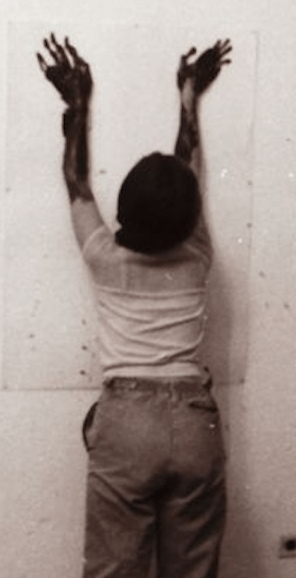
    Tania Bruguera, Title: Tribute to Ana Mendieta (1985)

    I was a petulant child, smothered by my own two hands — hands that were recognized, and therefore clenched.

    There was little articulation amongst the imposing stature of the self, maybe it was the balancing part I struggled amongst confrontation. This ‘self’ must be considerate enough to bruise it once in a while, alongside proving the subtlety of the act alone.

    Much of these days, intention is of that same false decree we hang religion from. Space (a tribute to oxymorons) must be weighed, sifted, and if appeased, saturated in front of ones mirror suitable for child-like identification. Our eyes no longer belong to the face of our mother, neither will these ‘petulant hands’, and what do I make of my righteous ability?

    I have already learned how to breath.

    A manuscript for greed, the breath is. Delicate and horrifyingly immeshed with a voice for death.

    What else have I known?


  • A Greek Mimesis of Persian Tragedy

    Grade: 65, 2:1; Drama, Term 4 (2500 words)

    *Paper has not been altered after feedback has been given.

    Tragedy is socially dramatized and linguistically undefined, positioning the polis1 toward ‘arbitrary and sterile2’ definitions, with little effect. The contextualisation of human suffering is mimetically presented within Aeschylus Persians, as Greek interpretation strives to imitate Persian political atrophy and civic decimation within a framework of the Persian – Greco War. Herein, Steiners’ definition of ‘Tragedy’ presents a dualistic argument able to sustain the dialogic expressions of the characters, as grief is constructed within the narrative: “The intentional focus can be narrow and specific, as in ‘a tragic accident’ or undefinably spacious, as in the shopworn phrase ‘a tragic sense of life’3”. I aim to expand upon choral identity within a narrative framework alongside a corporeality present in lamentations to explicate a reconstruction of human suffering of Persians’ through a mimetic, Greek, tragedian perspective.  

    Choral Identity and Vocalization 

    Participation of the chorus in Aeschylus Persians is strategically abnormal. Vocal and dominant within the dialogue, the group of women defy a traditional placement that is commonly mollified by moral ideology or a modest collective commentary, seen within Euripides Medea or even, Aeschylus Agamemnon. The presentation of the choral identity begins within Aeschylus temporal, theatrical depiction, as his “[…] display of an Athenian chorus dressed as Persian males right at the opening of his 472 BCE play was a daring and, as far as we know, unparalleled gesture4”. Aeschylus challenge toward the presentation of a female-dominant role, negates an ancient theatrical structure, submerged in gender presentation, social power, and vocality. This (‘daring’) act exemplifies the bold nature of the tragedian, whose decisive linguistic conventions, posit his work outside social convention — as I later argue, to utilize as means to further potent representations of human suffering.  Additionally, it’s “fundamentally chora medium5” rejects enforced civic displays of public mourning, that which was “permitted, although in a controlled form6” and could not be re-enacted by “women under the age of sixty, other than close relations, [who] could enter the chamber of the deceased or follow the procession to the tomb7”. Aeschylus’ intent surpasses a Greek, social presentation of mourning, to depict a Persian pathos existing outside Athenian civic obligation, elucidating the dramatic within a cacophony of chants, wails, laments, and lacerations.  

    To begin, I aim to construct a timeline of the Persian chorus to facilitate their progressive, polyphonic voice as it encounters a tragic framework of war. Before receiving word from the messenger, the Queen converses with the chorus on an omen she received with fear. The routine role of moral guidance is sustained within the response of the chorus, as they reply:  

    Mother, we do not wish to say what would make you wither unduly fearful or unduly optimistic. You should approach the gods with supplications and ask them, if there is anything sinister in what you saw8

    Yet, as the chorus immerses their voice within the Persian politic, “moments of ‘self-referentiality9” deconstruct their role within mediation, opting to dialogically employ pathea10 as means to draw the audience into the familiar condition of grief – an ‘integrated experience’ outlined by Carter. As the socio-political and economic life in the Persian city, Susa, bears transitional tension, the mimetic dramatized upon conditionally relies on Aeschylus knowledge on the Greek politic and legislation, to correctly divide the public and private sphere of potential suffering. The body of the chorus unflinchingly condemns Xerxes fatal actions, as the young king went to war with the Greeks: “Otototoi, you are saying / that the dead bodies of our loved ones / are floating, soaked and constantly buffeted by salt water, / shrouded in mantles that drift in the waves11”, reconstructing a new temperament of the chorus, through the sheer evaluation of Persian bodies floating amongst the sea. Steiner’s broad sense of tragedy captures dream-filled omens and spacious declaration – “and < in every house / the woman left behind > howls for her young husband12” – while also targeting the dead bodies of (‘loved ones), (‘buffeted), (‘shrouded) and (‘floating’) amongst the sea thousands of miles away. The intentional narration, vocality, and tonality immersed in accusation the chorus fosters their eventual barbaric action within laments and public bouts of mourning. This vocality of anguish slightly shifts in its accommodation from the internal to external justification, as the chorus directs their speech to the public space before them: “O you god who has caused such toil and grief, how very heavily you have leaped and trampled on the entire Persian race!13” The act, formerly confined to dialogue of the Queen, Messenger, and Chorus, is unconsciously torn as the women turn their attention to the metaphysical, to a God with capability to proctor death fit for immense human suffering. Placating, questioning, blaming, and sadness, the liminal atmosphere of the chorus’ bargaining eventually commences full-bodied laments that harbor a collective anguish, turmoil, and anger of the (‘Persian race’).  

    Furthermore, the mimetic performance rests upon an historic reality, which eliminates the prepotent of the mythic, until it becomes a“[…] kind of lamentation more shocking, for the audience is encouraged to compare what they see with their own funerary practices14”. The funerary procession is noncorporal, the bodies of the soldiers cannot be returned to Susa, leaving Xerxes in worn out attire, and a weeping chorus to fulfill a memorial of the lost men. Specifically, the function of the chorus as a collective, capable of anguished re-enactment, yet fundamentally immersed in Greek mimicry to feasibly represent the Persian individual concurrently encountering a personal, vivid suffering.  

    In comparison, Alice Oswald’s, Memorial, captures the similar literary essence of dedication amongst a funerary procession, developing an oral cemetery for the lost bodies: 

    DEMUCHUS 

    LAOGONUS 

    DARDANUS 

    TROS 

    MULIUS 

    RHIGMOS 

    LYCAON 

    MYDON15 

    Aeschylus’ Persian eulogy exacerbates the role of the chorus – their demands target the power dynamic between citizen and King, dismissing civic hierarchy to emphasize the suffering the women unconsciously feel. Language becomes a weapon of distrust, commencing verbal accusations against Xerxes through the use of (‘you’), while also suggest the young king is neither (‘brave’) and (‘nobly-born) due to his fatal actions. Before the lamentations proceed, the chorus bemoans stanzas of notable soldiers lost from this encounter, crying out: “Where did you leave Pharnuchus, / yes, and the brave Ariomardus? / Where is the lord Seuacles / or the nobly-born lilaeus, / Memphis, Tharybis and Masistras, / Artembares and Hystaechmas?/ I ask you this again16”. Mirroring Oswald’s declaration, the constructed voice of the once mediating chorus is left to return the dead amongst Persian lands by a verbal eulogy, leaving the group of women to unconsciously redefine their capabilities to a role of mourners.  

    Corporeality and Lamentations 

    Correspondingly, the two distinguished laments of the chorus, (l.255-59) and (l.908-1077) redefine characteristic responses to suffering, as Aeschylus shifts from the internal (private) to the external (public), within his displays of anguish. Yet, this shift into a public sphere, orients the mourning into the political, defining the act of laments indecent, unqualifiable, or unnecessary through representative measures of class, gender, and age. Paul Kottman expands upon the mimetic within a philosophical framework, denoting the theatrics to hold political qualities, allowing for the expansion into the role of the chorus: “[…] like the praxis it imitates – is also pre-political, for it is precisely the interaction that adheres in speaking and action among a plurality that opens the space for the polis17”. The Persian (‘polis’) is intertextual and heavily reliant on Aeschylus interpretation of the Greeks socio-economic, politic, and literary convention, simply due to the representative nature of mimesis. Therefore, Greek tragedies like The Fall of Miletus18 contrive anecdotes of tragic pathos Athenians experienced, whose substantially vivid baseline of grief, becomes a unification of meaning and significance, that would be pertinent to its application in Persian suffering19.  

    Within the tragedy, I aim to touch upon the severity of the laments exercised by the Chorus and the furthered incitement of verbal encouragement of the young king, Xerxes. Aeschylus’ stage directions signal a shift within the vocality of the chorus, alluding to an exacerbated tonal shift of anguish: “[They shift from chant to song] / The land laments its native youth / killed by Xerxes, who crammed Hades with Persians20”. The accusatory tone is projected within a unified, collective manner, yet a polyphonic21 structure surrounds the notion of ‘chant’ (i.e it necessitates a crowd to project in a unison manner) and produces a vivid spectacle of voice to demonstrate public suffering. Even further, the utilization of the body to endure laceration and physical punishment within a lamentation, is mimetic – representative of women in Greek processions of mourning: “[…] women displayed their mourning […] by beating, and sometimes baring, their chests, by loosening and tearing their hair, by crying and wailing, by tearing their robes and by scratching their cheeks22”. Persian suffering, therefore, rest upon the intertextual conceptions and assumption of character, alongside Aeschylus framework and personal encounter of war. 

    Ultimately, the expansion of corporal identity within the chorus expands to adjust to the demands of Xerxes, and crucially the lack of recovery toward the bodies of the soldiers:   

    Xerxes 

    and Chorus 

    Ototototoi! 

    Chorus 

    And mixed in with my groans will be – 

    oi! – black, violent blows. 

    Xerxes 

    Beat your breasts too, and accompany the action with a 

    Mysian cry. 

    Chorus 

    Painful, painful! 

    Xerxes 

    Now, please, ravage the white hairs of your beard23

    The (‘black, violent blows’) composed alongside the beating of the breast, produce a gendered, physical, and an aggressive tone defined by (‘groans’) and the (‘Mysian cry’). The suffering surpasses the emotional, liminal boundary to reassign the chorus as a witness and a narrator to their own grief. The collective identity of the chorus merges the private individual of the women to an uncontrollable entity, encouraged to experience the (‘painful’), fatal disposition of the Persian soldiers. Aeschylus continuation of mimetic narratives within a Greek understanding, situates Persian suffering past individual fatality to a unified, collective identity of civic collapse.  

    Thus, the ‘living memory24’ of Aeschylus and Athenians alike, constitute a relation to a ‘mimetic performance25’ that can support, characterize, and develop a theatrical performance of human suffering outside a cultural context. Aeschylus’ Persians interacts within a theoretical framework of polyphonic and mimetic analysis, expanding Steiners’ dichotomy of tragedy to a vivid corporeality and unique narration of a Persian chorus.  

    —–

    Footnotes:

    [1] See, The Oxford Classical Dictionary, definition of polis. In this paper, I will be referring to Oswyn Murray’s definition listed: The polis is the characteristic form of Greek urban life; its main features are small size, political autonomy, social homogeneity, sense of community and respect for law.

    [2] Steiner 2004: 2.

    [3] Steiner 2004: 1

    [4] Hopman: 58.

    [5] Hopman: 59.

    [6] Foley 2003: 25.

    [7] Foley 2003: 23.

    [8] Aeschylus 2008: l. 215-17.

    [9] Carter 2011: 247.

    [10] Utilized within a plural sense of pathos.

    [11] Aeschylus 2008: l. 274-77.

    [12] Aeschylus 2008: l. 12-13.

    [13] Aeschylus 2008: l. 515-6.

    [14] Swift 2010.

    [15] Oswald 2012: 12.

    [16] Aeschylus 2008: l. 967-73.

    [17] Kottman 2003: 82.

    [18] Kottman produces the account of Athenians watching the performance of The Fall of Miletus within the writing of Herodotus. I have taken an excerpt for reference of suggest claims above to articulate a baseline for Greek suffering. “The audience in the theater burst into tears, and the author was fined a thousand drachmae for reminding them of a disaster which touched them so closely. A law was subsequently passed forbidding anybody ever to put the lay on stage again” (Kottman 2003: 83.)

    [19] Further information is sourced from Steinby 2013: 2. Excerpt follows as such: “The unit of the world in aesthetic seeing is not a unity of meaning or sense – not a systematic unity, but a unity is concretely architectonic”

    [20] Aeschylus 2008: l. 923-26.

    [21] Polyphony in this context is was derived from Steinby 213: 10. The definition used is ‘polyphony’ arises from persons with different world views encountering each other in the concrete events of life”.

    [22] Hurschmann 2006: Brill.

    [23] Aeschylus 2008: l. 1052-56.

    [4] Kottman 2003: 97.

    [25] Ibid.

    Citations: 

    Αἰσχύλος., et al. Aeschylus. Edited by Alan H. Sommerstein, Harvard University Press, 2008. 

    Carter, D. M. Why Athens?: A Reappraisal of Tragic Politics. Oxford University Press, 2011. 

    Hurschmann, R. (. (2006). Mourning. In Brill’s New Pauly Online. Brill. https://doi-org.bris.idm.oclc.org/10.1163/1574-9347_bnp_e1219110  

    Kottman, P. A. (2003). Memory, “Mimesis,” Tragedy: The Scene before Philosophy. Theatre Journal, 55(1), 81–97. http://www.jstor.org/stable/25069181 

    Murray, O. (2012). polis. In The Oxford Classical Dictionary.: Oxford University Press. Retrieved 25 Mar. 2025,  

    https://www.oxfordreference.com/view/10.1093/acref/9780199545568.001.0001/acref-9780199545568-e-5162.

    Oswald, Alice. Memorial: An Excavation of the Iliad. Faber and Faber, 2011. 

    Steinby L. Bakhtin and Lukács: Subjectivity, Signifying Form and Temporality in the Novel. In: Steinby L, Tintti T, eds. Bakhtin and His Others: (Inter)Subjectivity, Chronotope, Dialogism. Anthem Press; 2013:1-18. 

    Steiner, G. (2004). “Tragedy,” Reconsidered. New Literary History, 35(1), 1–15. http://www.jstor.org/stable/20057818&nbsp;

    Swift, L. A., ‘7 Thrēnos and Ritual Lament’, The Hidden Chorus: Echoes of Genre in Tragic Lyric, Oxford Classical Monographs (Oxford, 2010; online edn, Oxford Academic, 1 May 2010), https://doi.org/10.1093/acprof:oso/9780199577842.003.0008, accessed 25 Mar. 2025.  

  • Temptation and Excess in ‘Goblin Market

    Temptation and Excess in ‘Goblin Market

    Preface: This essay stirred self-doubt and questionable career paths due to its final grade. While I have made a few tweaks to this paper, I felt it was necessary to release a piece that invoked excitement and curiosity within my work at university. My relationship with criticsm has mirrored a complexity of my love for literature in general, so as a way of letting go, i felt it was necessary to uplift a voice not understood, or markedly seen as wrong.


    “The evil of [her] self-indulgence, the fraudulence of sensuous beauty, and the supreme duty of renunciation[1],” delivers Rossetti‘s conflicting dispositions in her fairy-tale world of the “sensuous, […] ascetic[2],” and religious. On reading Christina Rossetti’s ‘Goblin Market,’ sexual desire permeates the text of the fairy-tale world of the poem yet, I argue, we should go further and examine the eroticism of the mouth in maidenhood, to capture consumption through a lense of temptation and excess, eventually altering the body.

    Christina Rossetti’s brother, Dante and his painting, The Annunciation, cited as Image A, composed the Virgin Mary, cowering in the corner of the bed, leaning away from archangel, Gabriel, to capture inciting fear of an approaching holy figure. Yet, the psychological realism confronts the young maiden through a forceful motherhood. Hilda Koe’s painting, referenced as Image B, introduces similar implications as Dante’s piece, of white gowns, biblical references from golden circles to tempting apples, fearful eyes as the man imposes into female spaces. The condition of the women merges here, as she is now tempted by possibility, of the taste of fruit or the holy summoning, yet unaddressed by the sexual nature of the offering, that which is the social insistence of motherhood.

    Laura approaches the Goblin men, by “stretch[ing] her gleaming neck[3]” like a ‘poplar branch,’ an gesture of intrigue, until “[her] last restraint is gone[4].” Desire is initiated by the maiden until the temptation compels her to cut a lock of golden hair; “’Buy from us with a golden curl’ / She clipped a precious golden lock[5].” Her virgin maidenhood shifts to female eroticism, transactional is relingquishing a piece of herself, notably her youth, until the emodiment of seductress follows the expanse of her mouth. Eventually a physical rupture of Laura’s virginity hungrily commences when, “She dropped a tear more rare than pearl / Then sucked the fruit globes fair or red[6],” till the “mouth-watering urgency[7]” she trembles with, incites a realm of perversion. It is through this desirable loss of innocence, her mouth becomes a sexual orifice, filled with, “hunger and satiation[8]” and as a result, temptation becomes animalisitc as her oral state is transfixed on consumption for, “She sucked and sucked and sucked the more / … / She sucked until her lips were sore[9].” Must she bite into the fruit, a mirror of Eve who held the red apple, the ‘fruits that thy soul lusted after[10]’ leave the maiden to be consumed by an erotic madness, which now sustains her body. A hunger which can no longer be satiated by the forbidden fruit “sweeter than honey[11].” The temptation in now embedded within the lining of her stomach and the taste lingering in her mouth, until she must return for more, utilizing such a mouth to speak, kiss, and desire: “’Nay hush, my sister: / I ate and ate my fill, / Yet my mouth water still: / To-morrow night I will / Buy more,’ and kissed her[12].”

                Noted in religious text as the “Fall of Man” with Eve’s temptation of the apple, to the “Fallen Woman” during the pre-Raphaelite era, biblical interpreations begin to center the sexual corruption of women. Sharon Smulders’s, Christina Rossetti Revisited, reimagines Laura’s actions toward that of Eve writing, “Indeed, while the sisters’ temptations double on Eve’s temptation, the fruits multiply outrageously. If the first fruit of the goblin as well as Satanic temptation is the allusive apple, the second fruit (the quince) and the twenty-first (the pear) belong to the apple genus.[13]” Precisely, the relationship between the mouth of a biblical, virginal, or maiden women consume a ‘sinful’ fruit, prescribes her ‘fallen’ stature and immoral standing with God, until the hunger which riddles temptation can only be led by the mouth of a man.

    From this moment, the decay of Laura unfolds. She becomes an “all-giving, all receiving womb[14],” yearning to embrace the taste and the sensuality to suck upon the fruit which fills her mouth, dependent on the pleasure she is to receive. Marsh conceives this phenomena arguing, “This is also the essence of desire: once attained, it ceases to satisfy, vainly driving the sensual urge to repetition, seeking to regain the first, orgasmic joy[15].” As a result, the animalization of Laura recenters the mouth to hold her forbidden carnality, while also supplying bestial gestures as eroticism reconstructs her previous maiden identity: “She gnashed her teeth for balked desire, and wept / As if her heart would break[16].” 

    Correspondingly, Victorian history alongside prostitution produced conversations on venereal dieases, leaving women to become the center of another social illness. Eager to consume only the body of women,[AS1]  their mouths produced the sexual desire, the necessary tempation, to leave the women are their “…hair grew thin and gray: / […] dwindled, as the fair full moon doth turn / To swift decay , and burn / Her fire away[17].” The mouth now rids her of vitality, sprititually depleting the maiden, and a site once fit for eroticism fades swiftly as, “Her tree of life drooped from the root[18]:” until she can no longer serve, nor consume eagerly as a biblical woman.

    As I divulge into ‘excess’ in ‘Goblin Market,’ the maiden’s peverse actions are analyzed through the lens of, “violence of passion[s]; extravagant or rapturous feeling; [and] unrestrained manifestations of grief[19].” Arthur Rackham’s illustration as Image C, drowns Lizzie in the “Cat-like and rat-like, Ratel- and wombat-like[20]” creatures, tearing at her white dress, as their hands force sinful fruit into the maiden’s face. Otto Greiner’s sketches seen as Image D, attracts a desirable comparison between the poised women: the body is malleable, desirable, corporeal as its skin holds the hands of those below them, each head turned purposefully, the mouth shut and unwilling to concede, skin wrapped with pure intention. Sap-filled pastures, blooming lilies, to the maiden’s milking the cows, the intersection of nature within Rossetti’s poem expands Dijkstra’s thoughts, “Thus, the eroticized body of woman became the late nineteenth-century male’s universal symbol of nature and of all natural phenomena. She sat, a flower among flowers, a warm, receiving womb and body, waiting patiently for man, the very incarnation of the spirit of the rose[21].”

    The development of Lizzie from a cautious, untouched maiden insistent of the deviant sexual nature the goblins present to excessively urging her sister to lick upon her face, is no coincidence. A rational, modest maiden who “churned butter, whipped up cream, / Fed their poultry, sat and sewed[22]” to:

    “Come and kiss me.

    Never mind my bruises

    Hug me, kiss me, suck my juices

    Squeezed from goblin fruits for you

    Goblin pulp and goblin dew.

    Eat me, drink me, love me[23]; “

    captures the sexual sacrifice explored by Rossetti, through an excessive, ‘unrestrained manifestations of grief” of Laura’s declining state. A transitionary moment for both sisters, the exploration of excess expands with the rape of Lizzie as the goblins forcefully invade her body with the forbidden fruit. Moreover, Freud’s construction of hysteria, the breach of the mind can develop from, “[…] any pains, whatever their cause, reach maximum intensity and that any afflictions are ‘terrible’ and ‘unbearable’[24]” accompanies the demanding, desperate tone to present her face covered in the ejaculation of the goblin men. Even further, Dijkstra argues alongside Albert Von Keller painting as Image E, of feminine submission as “[…] sadistic pleasure [is felt from] the representation of a vulnerable, naked woman tied to a cross[25].” Mirrored alongside Image C, the subjection of Lizzie as the goblins constrain her body against the tree, in possession of her vulnerable nature, displays the carnality she exhibits as the poem ends.

    As a result, the self-sacrifice must become transactional – Lizzie “put[s] a silver penny in her purse, / Kiss’d Laura” while the carnal desires of the goblins were “unrestrained[AS2] , erotic”, and held that penny to exhibitionism of her now hyper-sexualized body[26]:

    “Tho’ the goblins cuffed and caught her,

    Coaxed and fought her,

    Bullied and besought her

    Scratched her, pinched her black as ink.

    Kicked and knocked her,

    Mauled and mocked her[27]

    It is in the rape of Lizzie, that her new role is to indulge in Laura’s lasting sexual temptations, and most notably, the desperation that inhabits her dying sister’s eroticized mouth, as excess constructs her body to a palatable feast. In the midst of her assault, Lizzie sealed the opening of her mouth, a distant allusion to the virginal qualities that can be physically penetrated, and specifically, Rossetti emphasizes the sacrificial nature of the maiden to relinquish her body instead, “Lizzie uttered not a word; / Would not open lip from lip / … / But laughed in heart to feel the drip / Of juice which syruped her face[28].” An offering, a face covered in forbidden juices, delievers her skin, ripe in sexual pleasure to her sister, until she allows herself to be ruined, perfect for her starving mouth: “Kissed and kissed and kissed her: / Tears once again / Refreshed her shrunken eyes, / Dropping like rain / … / She kissed and kissed her with a hungry mouth[29].” Thus, a promiscious mouth, riddled in ‘raptuous feelings’ of her self-sacrifice, Lizzie transforms her body to capture the erotic desires of Laura’s previously penetrated mouth, until the latter knows of hunger again.

                Altogether, an examination of the mouth is pertinent to grasping the inclusion of eroticism within the poem, and more specifically, in the realm of temptation and excess. Returning to Image D of Greiner’s ‘Gaia,’ the supporting quote, ‘The woman is the man’s root in the earth[30],’ illustrates the sensual relationship between Laura and Lizzie, as each supply their bodies – and more specifically their mouths – to confront maidenhood.


    Bibliography

    Bram Dijkstra (1986). Idols of Perversity. Oxford University Press, USA.

    Breuer, J. and Freud, S. (2013). Studies in hysteria. Digireads.com Publishing.

    Marsh, J. (2012). Christina Rossetti : a literary biography. London: Faber Finds.

    Mermin, D. (1983). Heroic Sisterhood in ‘Goblin Market’. Victorian Poetry, [online] 21(2), pp.107–118. doi:https://doi.org/10.2307/40002024.

    Oxford English Dictionary, s.v. “excess (n.), sense 9,” June 2024, https://doi.org/10.1093/OED/4381276791.

    Rossetti, C. (1862). Goblin Market. [online] Santa Clara University. https://webpages.scu.edu/ftp/lgarber/courses/eng67F10texts/RossettiGoblinMarket.pdf [Accessed 1 Nov. 2024].

    Smulders, S. (1996). Christina Rossetti Revisited. Hall Reference Books.

    [Image A]: Rossetti, Dante. ‘The Annunciation’, 1849-50. https://www.tate.org.uk/art/artworks/rossetti-ecce-ancilla-domini-the-annunciation-n01210 [Accessed 20 November 2024].

    [Image B]: Koe, Hilda. ‘The Goblin Market’, 1895. < https://theharvestmaidsrevenge.com/2023/04/05/revisiting-christina-rossettis-goblin-market-an-early-folk-horror-classic/ [Accessed 19 November 2024].

    [Image C]: Rackman, Arthur. ‘Goblin Market,’ 1933. https://commons.wikimedia.org/wiki/File:Goblin_Market_032.jpg [Accessed 20 November 2024].

    [Image D]: Greiner, Otto. ‘Gaia’ [Mother Earth],’ 1912. http://www.symbolismus.com/ottogreinerg228a1912.html [Accessed 21 November 2024].

    [Image E]: Von Keller, Albert. ‘In the Moonlight,’ 1894. http://www.symbolismus.com/albertvonkeller2.html [Accessed 20 November 2024].


    [1] Mermin 1983: 107.

    [2] Ibid.

    [3] Rossetti 1862: l. 81.

    [4] Rossetti 1862: 86.

    [5] Rossetti 1862: 125-6.

    [6] Rossetti 1862 : 127-8.

    [7] Marsh 2012: 231.

    [8] Dijkstra 1986: 62.

    [9] Rossetti 1862: 134, 136.

    [10] Ibid.

    [11] Rossetti 1862: 129.

    [12] Rossetti 1862: 164-8.

    [13] Smulders 1996: 35.

    [14] Dijkstra 1986: 85.

    [15] Marsh 2012: 233.

    [16] Rossetti 1862: 267-8.

    [17] Rossetti 1862: 277-80.

    [18] Rossetti 1862: 260.

    [19] Oxford English Dictionary 2024.

    [20] Rossetti 1862: 340-1.

    [21] Dijkstra 1986: 87.

    [22] Rossetti 1862: 207-8.

    [23] Rossetti 1862: 466-71.

    [24] Breuer and Freud 2013: 241-42.

    [25] Dijkstra 1986: 34.

    [26] Rossetti 1862: 324-5.

    [27] Rossetti 1862: 424-29.

    [28] Rossetti 1862: 430-4.

    [29] Rossetti 1862: 486-9, 492.

    [30] Dijkstra 1986: 85.


     [AS1]come back to cite

     [AS2]“These images were expressive of men’s dreams of generous, unrestrained inclusion; of nature as simultaneously receptacle, fertile soil, and comforting breast” (85)