Tag: art

  • Is Violence Against Nature Superior to Human-On-Human Violence?


    Histories of Violence, Term 5

    Key words: Anthropocene, Climate Change, Environment, Violence, Ecocriticism 

    Lewis and Maslin, a pair of Professors in Geology at UCL, present a paper in MacMillian as ‘Defining the Anthropocene1’ aimed at consolidating the ‘possible Anthropocene-specific’ dates, alongside ‘evidence-based decisions’ which would elucidate the consequence of this Anthropocene Epoch. A scientific and social discourse barely half a century old, the ‘Anthropocene’ Era is reliant on the deconstruction and processing power of humanity to become a primary agent of environment change, often coined Climate Change. For further precision, the introduction of the Anthropocene by the pair above, define the term within its critical tensions:  

    The magnitude, variety and longevity of human-induced changes, including land surface transformation and changing the composition of the atmosphere, has led to the suggestion that we should refer to the present, not as within the Holocene Epoch (as it is currently referred to), but instead as within the Anthropocene Epoch2.  

    Utilizing evidence-based papers and scientific diagrams, I aim to position ecological violence enacted by individuals as superior to human-on-human violence by exploring industrial pollution of Roman antiquity and the occupation of military infrastructure which posits the natural world as incorporeal. 

    Industrial Pollution 

    Humanity has been consistent in exploiting industrial pollutants, namely carbon emission and sulphur compounds. By 400 BC, Hippocrates published, ‘On Airs, Waters, and Places’ which explored the critical role of an individual (and later collective) interacting with nature. The introduction offered a candid argument of the environment, space, and human interaction: “There was a rational element, which relied upon accurate observation and accumulated experience. This rationalism concluded that disease, and health depended on environment3.” By Hippocrates argument, the individual must surpass a co-dependent relation to the outright reliance onto the environment for overall survival. Correspondingly, the naturalist and naval commander of the early Roman Empire, Pliny the Elder, dedicated pieces to the ongoing mobilization and further urbanization of the Roman Empire. A mirror of Hippocrates four centuries later, the scientist writes, “We taint the rivers and the elements of natures, and the air itself, which is the main support of life, we turn into a medium for the destruction of life4.” 

    Susanne Knittel5, within the field of Memory Studies examines a ‘forgotten’ approach to environmental violence, one that does not pose the socio-cultural field as its primary application: “Often, the way ecological violence is framed as violence relies on repertoires, forms and conventions for representing and commemorating genocides and other acts of large-scale violence against humans… [we should explore] the turn towards the environment and the non-human6.” Knittel’s implication of broaching the incorporeal, that which is ‘non-human’, posits the metaphysical hierarchy, currently recognized as the Anthropocene7. Applying Knittel’s proposal to the groundwork of Industrial Pollution in the Roman Empire, we can begin to address the lineage of ecological violence, beginning with lead measurements in Greenland Ice.  

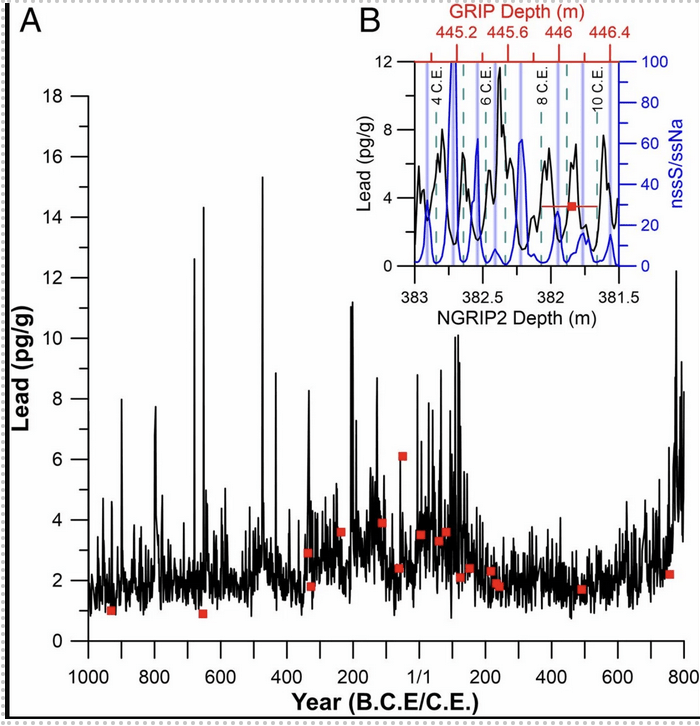
    In 2018, the multidisciplinary scientific journal PNAS8, delivered a research article within Environmental Sciences, known as, ‘Lead Pollution Recorded in Greenland ice Indicates European Emissions Tracked Plagues, Wars, and Imperial Expansion during Antiquity’, which provided evidence on Roman industrial pollution peaking at the start of its emerging empire. Referencing Figure 1, the chart provides data of fluctuating lead measurements in relation to critical centuries of human development, which is contextualized by the articles abstract:  

    Here we show, using precisely data records of estimated lead emissions between 1100 BCE and 800 CE derived from sub annually resolved measurements in Greenland ice and detailed atmospheric transport modelling, that annual European lead emissions closely varied with historical events, including imperial expansions, wars, and major plagues9

    Figure 1. Lead measurements in Greenland Ice derived from PNAS article.  

    Environmental exploitation in the Roman Empire lacked any legal mediation or government interference unless the natural resource was guarded for ‘indiscriminate exploitation10.’ Notably, the persistent exploitation of ‘high temperature smelting’, large scale extraction of conquered lands and valuable elements, deforestation to combat rapid expansion, and industrial-scale operations for mining for economic profit11, produced enough emissions to penetrate the integrity of the soil and land from 500 BCE. Moreover, the biological and microscopic structures of the ice utilized for this data collection showed immense morphological changed nearly two millennium later.  

    Section II: Current Industrial Pollution 

    Many of the present phenomena, field of studies, or terminology fall under Waring, Wood and Szathmarys’ procedure of ‘Group-level Environmental Management Traits12’. Precisely, larger groups will encounter more challenges to manage their environment as they lack consistent evolutionary qualities or solutions to the developing involutions (e.g extinct species). Correspondingly, we are unable to manage the scale of social organization to readjust, convene, or faithfully deconstruct previous systems of belief.  

    Macroecology, a subfield in ecological studies, focuses on ‘large-scale ecological patterns across broad spatial and temporal scales,’ and is only a present-day distinction. It was a side-effect without the precaution of mobility, in which, the development of a new ecological system was necessary and could not be removed without further dislocation from the original objective. Therefore, the structures of biological and environmental distinctions must be expanded to address, study, or report on the rapid shift in our present climate conditions.  

    Moreover, to establish violence in the context of industrial pollution, we must refer to Serene Jones explication of the ‘traumatized physical environment’- that which must witness the ‘integrity of the creation [become] violated13’. The ‘violation’ is eventually dualistic, as the physical degradation of plants, landscapes, and synchronic climates correspond to the conceptual, biological, and evolutionary framework we have once prescribed upon nature. This ‘twofold approach’ must present a concurrent discourse of the existing conditions of nature and all that is absent to consider the future. Correspondingly, the condition of the environment will become integral to daily interaction, allowing for the destabilization of an anthropogenic perspective, as human-on-human action becomes secondary to the foundation of landscape, matter and the self-regulating processes of the Earth. 

    Turning to Fig. 2., The University of Leeds produced linear graphs depicting the quality of air pollution between The United Kingdom and Pakistan, drawing upon the a ‘global disparity’ amongst pollutants. While the contrast of colours may produce a positive or negative attributes, the diversity of shades becomes a concerning ‘cocktail of pollutants14’. The agriculture, cars, forest fires, burning of oil, vehicle exhaust, power plants and the fossil fuel industry united as a primary cause to a degrading ozone layer, acid rain, bleached coral reefs, scorched landscapes, and a lack of biodiversity within plants. A rather careless violence stuck in a cycle too repair itself.  

    Fig 2. The United Kingdom, Global Air Quality Trends15 

    Fig. 2, Global Air Quality Trends16  

    Moreover, if we are to return to Hippocrates, the presence of dense air and floating sulphur pollutants is a familiar topic. Referencing his notable texts, On ‘Airs, Waters and Places’, the naturalist writes, “They are likely to have deep, hoarse voices, because of the atmosphere, since it is usually impure and unhealthy in such places17.” The individual’s innate reliance on oxygen produced by a stable, homeostatic body, will suffer a similar violation as the integrity of the body is compromised. So, if the co-dependency of humanity onto the expansive, biological function of the Earth, reduces the anthropocentric measures to a more equal baseline of existence between nature and humans, the violence upon the environment will be held to the severity, repercussions and justice that humans have awarded themselves.  

    Military Infrastructure 

    Roman Antiquity 

    […] argued that the emergence of modern bureaucratic, territorialized and centralized nation-states — marked by the monopolization of the means of violence […]  — was in large part the result of protracted wars and highly expensive military campaigns, a process of co-evolution whereby ‘war made the state and state made the war18’. 

    Roman, military grounds were littered with dead bodies. Their armour was weaponized, buried, or reused for the solider next in line. Deforestation become a building block for invasions, providing enough resources for fuel, materials for weapons, and the space for military sites. Yet, how was military infrastructure displayed in an active war? Josephus, Jewish War, presents the siege of Jotapata as the Roman army sought the Jewish stronghold for further power in their campaign to Galilee. As the campaign makes way, the distraction of military weapons and an erected stone wall is as much a Roman display of power as it is a forceful overtaking of integral landscape: 

    Vespasian now brought up his artillery engines — 160 in all — and set them in a semi-circle with order to fire on the defenders on the wall. In one concerted barrage the catapults sent their spears whistling through the air, the stone-throwers hurled hundredweight rocks, and both flaming and regular arrows flew in a hail19.  

    Eventually, the earth will begin to scream of thirst, the charred dirt will be forced to recover, the cement left behind from the battering ram will stand still as a trophy depicting their conquer. The city will continue, with or without the inhabitants, conquerors, or those in-between, but the landscape must reclaim a buried ecosystem once more.  

    Section II: The Present 

    […] where I, for a fraction of time, caused a security alert, because I violated this order by standing on a scrap of grass, next to a public highway, looking through a fence20.  

    This ‘scrap of grass’ — a space designed to hold up the fence, the shoes of her body, the cement that is to guide aircrafts, bustling bases, and artillery weapons is barely a register. The purpose has changed, unbeknownst to the grass covered in gravel or the roots pulled for concrete bases, the land lacks recognition. Nature became the first casualty, with the title of victim but lacking in the finality of justice. Thus, they are just a victim.  

    Fig. 3. Burning of Oil Wells in Kuwait during The Gulf War. Noted to be ‘one of the worse environmental disasters’ in recent history21.  

    Returning to the Anthropocene, the self-awareness of humankind becomes imperative to the assumptions one must accept for central power. An awareness catering to conditions, that of: 

    […] continental trade and transport networks, eradication policies for nuisance species and diseases, agricultural pollution fines, genetic modification, anti-extinction policies and the emergence of global environmental law22

    While armed forces sustained Weapons of Mass Destruction (WMD): 

    [..] from uranium mining and milling; through transport of ‘yellowcake’, MOX and other nuclear materials; fabrication of fuel rods; reprocessing and fast-breeder reactors; and the problems of storage of nuclear waste over millennia23

    Unsurprisingly, Nature will lack the corporeal rights, or rather the right to co-exist fairly, within a centrist collective. Even further, the environmental laws, annual summit meetings, prosecution by fines or trespassing warnings are in favour of the individual, not of the planet. They become exercises of free will, faux determinism, or ill-informed manuscripts delivered with enough enthusiasm to think moral implications are censored. We will continue to address future generations in decorated speeches, before questioning the soil degradation in Sudan. Reports of, “50 nuclear warheads and 11 nuclear reactors littering the ocean floor24” will be cleared an ‘accident’ yet the responsibility of the ocean to absorb the force of a nuclear weapon, must be rationalized as a the only ‘right’ Nature can afford.  

    Fig 3. is a makeshift military infrastructure. An active battlefield, with no soldiers as enemies, but rather the land as their final target. While the burning of oil wells in Kuwait were documented as a military tactic, or an economic loss for the country, the campground, uniforms, artillery shells, surveillance helicopters, and the bodies, traumatized that land. The burning fuel was violent, the weakening ground was silenced, and the smoke-filled air traumatized the natural, surrounding life. It would take over eleven months for the last oil well to be capped and the miles of ‘fire trenches25’ would be discovered.  
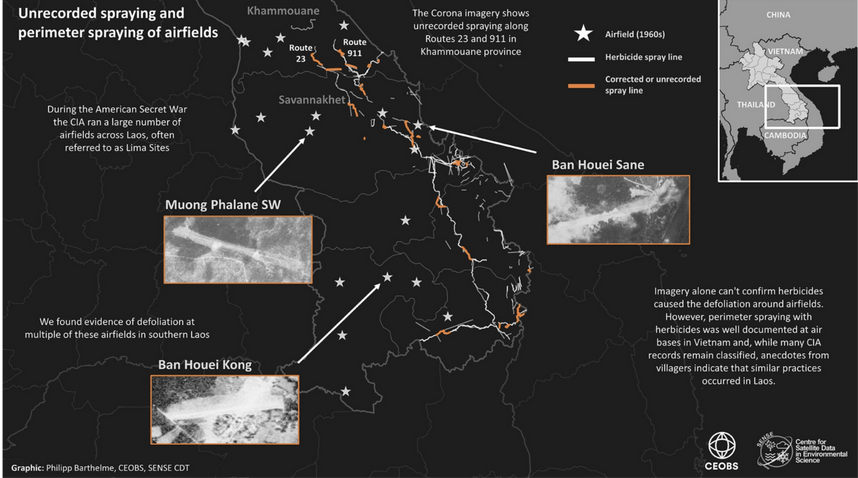
    Fig 4. Unrecorded spraying of Agent Orange in Vietnam War26.  

    Lastly, there are a few human disasters to touch upon. Captured in Fig. 4, the use of Agent Orange in the Vietnam War became a hidden ecological disaster, as released FBI files lack the extensive records of using chemical warfare. As the black-and-white photographs display, the thick, scar-like line amongst the tree is defoliation. A common tactic within war to uncover food, shelter and aid harvesting of the opposition. The chemical agent utilized biologically alters the structures and / or compounds of the plant, forcing them to de-shed, often permanently. The land cannot recover, and the herbicide will flourish in the soil of next year’s harvest. Put simply by Pearson, “the militarization of landscape is rarely complete or final27.” 

    Conclusion 

    My aim within this paper balanced loosely between a personal, corporeal discernment and sympathies toward the incorporeal. What rights, as an individual, have I willingly taken from the environment to further this violation? Could we, as a collective, repair the tension, brutality, and suffering we have posited to be correct, moral and justified? Either way, our violence is noticeable. It is then, imperative to start on the contrary to modern thought, to focus on the corporeality, the body of the environment, as a necessary right to life.  

    Bibliography: 

    Barthleme, Phillip. 2024. ‘New Data on Agent Orange Use during the US’s Secret War in Laos – CEOBS’, CEOBS <https://ceobs.org/new-data-on-agent-orange-use-during-the-uss-secret-war-in-laos/#6&gt; [accessed 2 December 2025] 

    Bostock, John, and Henry Riley. 2018. ‘The Project Gutenberg EBook of the Natural History of Pliny, Vol I., by Pliny the Elder.’, Gutenberg.org <https://www.gutenberg.org/files/57493/57493-h/57493-h.htm>&nbsp;

    Hay-Edie, David. 1991. THE MILITARY’S IMPACT on the ENVIRONMENT: A NEGLECTED ASPECT of the SUSTAINABLE DEVELOPMENT DEBATE a Briefing Paper for States and Non-Governmental Organisations (Sebastian) <https://www.ipb.org/wp-content/uploads/2017/03/briefing-paper.pdf&gt; [accessed 1 November 2025] 

    Jones, W.H.S , and Hippocrates. 2023. ‘On Airs, Waters, and Places [Attributed to Hippocrates (C. 460 – C. 370 B.C.)] : Hippocrates : Free Download, Borrow, and Streaming : Internet Archive’, Internet Archive <https://archive.org/details/hippocrates-airs-waters-places-l-147/page/XIII/mode/2up>&nbsp;

    Kersten, Jens. 2017. ‘Who Needs Rights of Nature?’, RCC Perspectives: 9–14 <https://www.jstor.org/stable/26268370>&nbsp;

    Knittel, Susanne C. 2023. ‘Ecologies of Violence: Cultural Memory (Studies) and the Genocide–Ecocide Nexus’, Memory Studies, 16.6 (SAGE Publishing): 1563–78 <https://doi.org/10.1177/17506980231202747>&nbsp;

    Leeds, University of. 2024. ‘New Images Reveal Global Air Quality Trends | University of Leeds’, Leeds.ac.uk <https://www.leeds.ac.uk/news-environment/news/article/5635/new-images-reveal-global-air-quality-trends>&nbsp;

    Lewis, Simon, and Mark Maslin. 2015. ‘(PDF) Defining the Anthropocene’, ResearchGate <https://www.researchgate.net/publication/273467448_Defining_the_Anthropocene>&nbsp;

    McConnell, Joseph R., Andrew I. Wilson, Andreas Stohl, Monica M. Arienzo, Nathan J. Chellman, and others. 2018. ‘Lead Pollution Recorded in Greenland Ice Indicates European Emissions Tracked Plagues, Wars, and Imperial Expansion during Antiquity’, Proceedings of the National Academy of Sciences, 115.22: 5726–31 <https://doi.org/10.1073/pnas.1721818115&gt;  

    McSorley, Kevin. 2014. ‘Towards an Embodied Sociology of War’, The Sociological Review, 62.2_suppl: 107–28 <https://doi.org/10.1111/1467-954x.12194>&nbsp;

    Pearson, Chris, Peter A Coates, and Tim Cole. 2010. Militarized Landscapes : From Gettysburg to Salisbury Plain (London ; New York: Continuum) 

    Salgado, Sebastiao. 2016. ‘When the Oil Fields Burned’, The New York Times <https://www.nytimes.com/interactive/2016/04/08/sunday-review/exposures-kuwait-salgado.html>&nbsp;

    Serene Jones. 2009. Trauma and Grace : Theology in a Ruptured World (Louisville, Ky.: Westminster John Knox) 

    Waring, Timothy M, Zachary T Wood, and Eörs Szathmáry. 2023. ‘Characteristic Processes of Human Evolution Caused the Anthropocene and May Obstruct Its Global Solutions’, Philosophical Transactions of the Royal Society B, 379.1893 (Royal Society) <https://doi.org/10.1098/rstb.2022.0259>&nbsp;

    Whiston, William. 1737. ‘Josephus: Of the War, Book III’, Penelope.uchicago.edu <https://penelope.uchicago.edu/josephus/war-3.html>&nbsp;

    Woodward, Rachel. 2004. Military Geographies (Malden, Ma: Blackwell Pub) 

    Zvereva, Elena L, Eija Toivonen, and Mikhail V Kozlov. 2008. ‘Changes in Species Richness of Vascular Plants under the Impact of Air Pollution: A Global Perspective’, Global Ecology and Biogeography, 17.3 (Wiley): 305–19 <https://doi.org/10.2307/30137862>&nbsp;

  • Re: Re: ‘A Woman’s Issue’ by Margaret Atwood [with notes].

    Persecution saturates the neck of young women. This damp exterior, crushed between jagged ribs and the unbecoming ill-remains of fat, will become explicit, R-rated, subverted to a perversion of this body, her body. Forget about the care we show intent — it is now stretched, disjointed; an awkward veil of femininty (lace and all.)

    [I could be remarkable, and prudish.]

    Should I talk upon the juvenile nature of flexibility? Where, the extension of ones hips [the landscape for childbirth] & career & jaw, remains sexual. Deceptiveley delicate ‘the woman’ is.

    Either way, the post / pre / birth of modern misogyny aligns a women to be knowledgeable in its ‘devices’ — that which shocks, suffocates, pricks, invades, redefines. That of a collar or hand, of personal persuasion to bind the stomach, the fat under the arms, the placement of the toes upon the feet — how they should curve until the bones snap.

    Then, there is the awful codification of ‘muse’, which could have been disastrous, but remained ill-defined as women began to carve space into art and music and fashion (still posing, hooked on devices, drugged to calm the eyes). Atwood was familiar with such inflexibility of women in art, or their use for it, and therefore made her own exhibit.


    Space: Part I

    Space: the three feet between their sunken back in line and your purse (controlled by stickers glued to the pavement and an awkward placement of your hands); the lack-there-of between a shared hug (how we create an allowance for the possibility of a greeting); an interval (the bell on a microwave, the minutes between contractions); the cycles of sleep (how religion was formed from hours of REM); a uterus (childbirth, cysts, IUDs’); the gap between breaths, cells, neurons, eyebrows.

    Briefly, I want you, the reader, to remove yourself from any understanding that you are about to read a poem (and any notion that it may be life changing). Rid yourself of excitement, pride, humility, or historical insight you may feel is relevant to the female body. Now, this intangibility of your intelligence should be caressed — held with enough care that dislocation from the physical body is nurturing, yet necessary.

    Here, I urge you simply, to consume.

    “The woman in the spiked device

    that locks around the waist and between

    the legs, which holds in it like a tea strainer

    is Exhibit A

    We must start with ‘The’, whose practical use in the sentence must provide a body, a root, for the further construction of a ‘woman’. Yet, Atwood extends past simple grammatical structures to dictate a tone of culpability, where name is unknown, and whose consciousness holds no weight in her description.  The ‘woman’ is dismissed – nameless, muted, and withheld. By the first sentence alone, Atwood introduces the present, systemic, pornographic reality of women (who endure sexual slavery, prostitution, brutish desires and ferocious kinks). She is silenced, and more importantly, spoken for.   

    Even further, the frequent sexual strangulation present in pornography and sexual encounters, is leaving women with irreparable brain damage. Therefore, suggestions of ‘the woman’ being implicated as ‘brain dead’ are probable, and often passively initiated when a ‘spiked device’ strains upon the neck and legs. It is then, that the omniscient voice must dictate her despair.  

    What are we to then make of ‘Exhibit A?’ Are the readers meant to watch, loosely, abhorrently, decisively like one does in an art exhibit? (Never too closely, or even somewhat thoughtfully, limited to opening hours and release dates, constrained by the attention span of the viewers). Is it possible Atwood is referring to an article, doused in symmetrical red circles and frilly skirts as the women try to cover their face? Do we place the symbolism past the women to inspect her constraints, (i.e the collar, the sunken waist, the immobility of mouth and body) and leave the connotations of ‘Exhibit A’ to schoolboys’ magazine as they move the image side to side.  

    By the end of the first stanza, the removal of the subject is dualistic. Atwood respects the privacy of ‘the woman’ enough to soften her features, deconstructing the hard contours of breasts or a demeanour that must be conquered, while being unable to free her body from the sexual, sociological constraints – that which ‘holds [here] like a tea strainer’. A tool, designed to grasp and clench; while also actively releasing parts of itself; the dilution of the women is uncanny to modern, female autonomy.  

    What pleasures have I given away?


    Space: Part II

    “The woman in black with a net window

    to see through and a four-inch

    wooden peg jammed up

    between her legs, so she can’t be raped

    is Exhibit B

    Let us assume that Exhibit B is a photograph, which was displayed on National Geographic for the features of her face (how the world could not fathom such beauty enduring starvation, or genocide, maybe sexual abuse, and modern slavery). Let us hide the wooden peg, claim that the object was in the way of the shot, (a mental disturbance at best for the viewer) and rather focus on how the pattern of the net reflecting amongst her skin. Please do not entertain the background (the refugee camp, the perished mountains and dry soil, those rushing toward flour or the individual surrounded by bottles) rather focus on the eyes.

    Who is violent, then?

    Exhibit B builds upon the sexual strangulation of ‘the women’ in ‘devices’, while precisely eliminating her personal liberation of sexual security. The viewer must walk between the exhibits, aware of the struggle the soles of their feet encounter with the wet, marble floor to the persecution of ‘the women’s’ skin (& the unforgotten space of flesh between her legs), which to them, is all movement anyway.

    Insertion is not dictated, nor coerced, it is ‘jammed’, pummelled, immobilized within her uterus. The violation is personal, yes, but the removal of space between her legs furthers the offence that she must lose in ones translation of all we are meant to sacrifice.

    There was a window, (Atwood recalls), which is pliant for the man. ‘The woman’ is now a dominion, conquerable and contagious in here lack of exploitation. He is goverend by assumption, and therefore, once capable of interfence, his depravity of his violence will surpass the insertion of the wooden peg.

    What is Exhibit B?

    a) The women of Tigray, who after being forcefully raped, succumbing to the pain of nails, screws, plastic rubbish, sand, gravel, and letters jammed into their uterus.

    b) Rape being a tactic of war and interastate conflicts in Sudan, by the RSF (Rapid Support Forces) which forced women into sexual enslavement, gangrape, sexual assualt against children, and enacting violence which displaced women and their children in the Dafur region.

    c) The men and women in the Abu Ghraib prision in Iraq, that faced psychological torture, sexual humiliation, rape, confinement, and electrical shocks which were produced by “enhanced interrogation techniques” and what we know today as “The Hooded Man”.

    d) Women, boys, girls, dogs, and animals in Palestine, Ukraine, Sudan, Congo, Vietnam, Afghantistan, Iraq, Ethipia, Mali, Nigeria, Somalia, Syria, Bosnia & Herzegovina (…) who become paramount staistics in reports a decade later, yet have succumbed to their injuries years prior.

    e) Annihilation.    

    16.10.25

    It was Denial in my throat. All of this.

    Tania Bruguera, Title: Tribute to Ana Mendieta (1985)

    I was a petulant child, smothered by my own two hands — hands that were recognized, and therefore clenched.

    There was little articulation amongst the imposing stature of the self, maybe it was the balancing part I struggled amongst confrontation. This ‘self’ must be considerate enough to bruise it once in a while, alongside proving the subtlety of the act alone.

    Much of these days, intention is of that same false decree we hang religion from. Space (a tribute to oxymorons) must be weighed, sifted, and if appeased, saturated in front of ones mirror suitable for child-like identification. Our eyes no longer belong to the face of our mother, neither will these ‘petulant hands’, and what do I make of my righteous ability?

    I have already learned how to breath.

    A manuscript for greed, the breath is. Delicate and horrifyingly immeshed with a voice for death.

    What else have I known?


  • A Greek Mimesis of Persian Tragedy

    Grade: 65, 2:1; Drama, Term 4 (2500 words)

    *Paper has not been altered after feedback has been given.

    Tragedy is socially dramatized and linguistically undefined, positioning the polis1 toward ‘arbitrary and sterile2’ definitions, with little effect. The contextualisation of human suffering is mimetically presented within Aeschylus Persians, as Greek interpretation strives to imitate Persian political atrophy and civic decimation within a framework of the Persian – Greco War. Herein, Steiners’ definition of ‘Tragedy’ presents a dualistic argument able to sustain the dialogic expressions of the characters, as grief is constructed within the narrative: “The intentional focus can be narrow and specific, as in ‘a tragic accident’ or undefinably spacious, as in the shopworn phrase ‘a tragic sense of life’3”. I aim to expand upon choral identity within a narrative framework alongside a corporeality present in lamentations to explicate a reconstruction of human suffering of Persians’ through a mimetic, Greek, tragedian perspective.  

    Choral Identity and Vocalization 

    Participation of the chorus in Aeschylus Persians is strategically abnormal. Vocal and dominant within the dialogue, the group of women defy a traditional placement that is commonly mollified by moral ideology or a modest collective commentary, seen within Euripides Medea or even, Aeschylus Agamemnon. The presentation of the choral identity begins within Aeschylus temporal, theatrical depiction, as his “[…] display of an Athenian chorus dressed as Persian males right at the opening of his 472 BCE play was a daring and, as far as we know, unparalleled gesture4”. Aeschylus challenge toward the presentation of a female-dominant role, negates an ancient theatrical structure, submerged in gender presentation, social power, and vocality. This (‘daring’) act exemplifies the bold nature of the tragedian, whose decisive linguistic conventions, posit his work outside social convention — as I later argue, to utilize as means to further potent representations of human suffering.  Additionally, it’s “fundamentally chora medium5” rejects enforced civic displays of public mourning, that which was “permitted, although in a controlled form6” and could not be re-enacted by “women under the age of sixty, other than close relations, [who] could enter the chamber of the deceased or follow the procession to the tomb7”. Aeschylus’ intent surpasses a Greek, social presentation of mourning, to depict a Persian pathos existing outside Athenian civic obligation, elucidating the dramatic within a cacophony of chants, wails, laments, and lacerations.  

    To begin, I aim to construct a timeline of the Persian chorus to facilitate their progressive, polyphonic voice as it encounters a tragic framework of war. Before receiving word from the messenger, the Queen converses with the chorus on an omen she received with fear. The routine role of moral guidance is sustained within the response of the chorus, as they reply:  

    Mother, we do not wish to say what would make you wither unduly fearful or unduly optimistic. You should approach the gods with supplications and ask them, if there is anything sinister in what you saw8

    Yet, as the chorus immerses their voice within the Persian politic, “moments of ‘self-referentiality9” deconstruct their role within mediation, opting to dialogically employ pathea10 as means to draw the audience into the familiar condition of grief – an ‘integrated experience’ outlined by Carter. As the socio-political and economic life in the Persian city, Susa, bears transitional tension, the mimetic dramatized upon conditionally relies on Aeschylus knowledge on the Greek politic and legislation, to correctly divide the public and private sphere of potential suffering. The body of the chorus unflinchingly condemns Xerxes fatal actions, as the young king went to war with the Greeks: “Otototoi, you are saying / that the dead bodies of our loved ones / are floating, soaked and constantly buffeted by salt water, / shrouded in mantles that drift in the waves11”, reconstructing a new temperament of the chorus, through the sheer evaluation of Persian bodies floating amongst the sea. Steiner’s broad sense of tragedy captures dream-filled omens and spacious declaration – “and < in every house / the woman left behind > howls for her young husband12” – while also targeting the dead bodies of (‘loved ones), (‘buffeted), (‘shrouded) and (‘floating’) amongst the sea thousands of miles away. The intentional narration, vocality, and tonality immersed in accusation the chorus fosters their eventual barbaric action within laments and public bouts of mourning. This vocality of anguish slightly shifts in its accommodation from the internal to external justification, as the chorus directs their speech to the public space before them: “O you god who has caused such toil and grief, how very heavily you have leaped and trampled on the entire Persian race!13” The act, formerly confined to dialogue of the Queen, Messenger, and Chorus, is unconsciously torn as the women turn their attention to the metaphysical, to a God with capability to proctor death fit for immense human suffering. Placating, questioning, blaming, and sadness, the liminal atmosphere of the chorus’ bargaining eventually commences full-bodied laments that harbor a collective anguish, turmoil, and anger of the (‘Persian race’).  

    Furthermore, the mimetic performance rests upon an historic reality, which eliminates the prepotent of the mythic, until it becomes a“[…] kind of lamentation more shocking, for the audience is encouraged to compare what they see with their own funerary practices14”. The funerary procession is noncorporal, the bodies of the soldiers cannot be returned to Susa, leaving Xerxes in worn out attire, and a weeping chorus to fulfill a memorial of the lost men. Specifically, the function of the chorus as a collective, capable of anguished re-enactment, yet fundamentally immersed in Greek mimicry to feasibly represent the Persian individual concurrently encountering a personal, vivid suffering.  

    In comparison, Alice Oswald’s, Memorial, captures the similar literary essence of dedication amongst a funerary procession, developing an oral cemetery for the lost bodies: 

    DEMUCHUS 

    LAOGONUS 

    DARDANUS 

    TROS 

    MULIUS 

    RHIGMOS 

    LYCAON 

    MYDON15 

    Aeschylus’ Persian eulogy exacerbates the role of the chorus – their demands target the power dynamic between citizen and King, dismissing civic hierarchy to emphasize the suffering the women unconsciously feel. Language becomes a weapon of distrust, commencing verbal accusations against Xerxes through the use of (‘you’), while also suggest the young king is neither (‘brave’) and (‘nobly-born) due to his fatal actions. Before the lamentations proceed, the chorus bemoans stanzas of notable soldiers lost from this encounter, crying out: “Where did you leave Pharnuchus, / yes, and the brave Ariomardus? / Where is the lord Seuacles / or the nobly-born lilaeus, / Memphis, Tharybis and Masistras, / Artembares and Hystaechmas?/ I ask you this again16”. Mirroring Oswald’s declaration, the constructed voice of the once mediating chorus is left to return the dead amongst Persian lands by a verbal eulogy, leaving the group of women to unconsciously redefine their capabilities to a role of mourners.  

    Corporeality and Lamentations 

    Correspondingly, the two distinguished laments of the chorus, (l.255-59) and (l.908-1077) redefine characteristic responses to suffering, as Aeschylus shifts from the internal (private) to the external (public), within his displays of anguish. Yet, this shift into a public sphere, orients the mourning into the political, defining the act of laments indecent, unqualifiable, or unnecessary through representative measures of class, gender, and age. Paul Kottman expands upon the mimetic within a philosophical framework, denoting the theatrics to hold political qualities, allowing for the expansion into the role of the chorus: “[…] like the praxis it imitates – is also pre-political, for it is precisely the interaction that adheres in speaking and action among a plurality that opens the space for the polis17”. The Persian (‘polis’) is intertextual and heavily reliant on Aeschylus interpretation of the Greeks socio-economic, politic, and literary convention, simply due to the representative nature of mimesis. Therefore, Greek tragedies like The Fall of Miletus18 contrive anecdotes of tragic pathos Athenians experienced, whose substantially vivid baseline of grief, becomes a unification of meaning and significance, that would be pertinent to its application in Persian suffering19.  

    Within the tragedy, I aim to touch upon the severity of the laments exercised by the Chorus and the furthered incitement of verbal encouragement of the young king, Xerxes. Aeschylus’ stage directions signal a shift within the vocality of the chorus, alluding to an exacerbated tonal shift of anguish: “[They shift from chant to song] / The land laments its native youth / killed by Xerxes, who crammed Hades with Persians20”. The accusatory tone is projected within a unified, collective manner, yet a polyphonic21 structure surrounds the notion of ‘chant’ (i.e it necessitates a crowd to project in a unison manner) and produces a vivid spectacle of voice to demonstrate public suffering. Even further, the utilization of the body to endure laceration and physical punishment within a lamentation, is mimetic – representative of women in Greek processions of mourning: “[…] women displayed their mourning […] by beating, and sometimes baring, their chests, by loosening and tearing their hair, by crying and wailing, by tearing their robes and by scratching their cheeks22”. Persian suffering, therefore, rest upon the intertextual conceptions and assumption of character, alongside Aeschylus framework and personal encounter of war. 

    Ultimately, the expansion of corporal identity within the chorus expands to adjust to the demands of Xerxes, and crucially the lack of recovery toward the bodies of the soldiers:   

    Xerxes 

    and Chorus 

    Ototototoi! 

    Chorus 

    And mixed in with my groans will be – 

    oi! – black, violent blows. 

    Xerxes 

    Beat your breasts too, and accompany the action with a 

    Mysian cry. 

    Chorus 

    Painful, painful! 

    Xerxes 

    Now, please, ravage the white hairs of your beard23

    The (‘black, violent blows’) composed alongside the beating of the breast, produce a gendered, physical, and an aggressive tone defined by (‘groans’) and the (‘Mysian cry’). The suffering surpasses the emotional, liminal boundary to reassign the chorus as a witness and a narrator to their own grief. The collective identity of the chorus merges the private individual of the women to an uncontrollable entity, encouraged to experience the (‘painful’), fatal disposition of the Persian soldiers. Aeschylus continuation of mimetic narratives within a Greek understanding, situates Persian suffering past individual fatality to a unified, collective identity of civic collapse.  

    Thus, the ‘living memory24’ of Aeschylus and Athenians alike, constitute a relation to a ‘mimetic performance25’ that can support, characterize, and develop a theatrical performance of human suffering outside a cultural context. Aeschylus’ Persians interacts within a theoretical framework of polyphonic and mimetic analysis, expanding Steiners’ dichotomy of tragedy to a vivid corporeality and unique narration of a Persian chorus.  

    —–

    Footnotes:

    [1] See, The Oxford Classical Dictionary, definition of polis. In this paper, I will be referring to Oswyn Murray’s definition listed: The polis is the characteristic form of Greek urban life; its main features are small size, political autonomy, social homogeneity, sense of community and respect for law.

    [2] Steiner 2004: 2.

    [3] Steiner 2004: 1

    [4] Hopman: 58.

    [5] Hopman: 59.

    [6] Foley 2003: 25.

    [7] Foley 2003: 23.

    [8] Aeschylus 2008: l. 215-17.

    [9] Carter 2011: 247.

    [10] Utilized within a plural sense of pathos.

    [11] Aeschylus 2008: l. 274-77.

    [12] Aeschylus 2008: l. 12-13.

    [13] Aeschylus 2008: l. 515-6.

    [14] Swift 2010.

    [15] Oswald 2012: 12.

    [16] Aeschylus 2008: l. 967-73.

    [17] Kottman 2003: 82.

    [18] Kottman produces the account of Athenians watching the performance of The Fall of Miletus within the writing of Herodotus. I have taken an excerpt for reference of suggest claims above to articulate a baseline for Greek suffering. “The audience in the theater burst into tears, and the author was fined a thousand drachmae for reminding them of a disaster which touched them so closely. A law was subsequently passed forbidding anybody ever to put the lay on stage again” (Kottman 2003: 83.)

    [19] Further information is sourced from Steinby 2013: 2. Excerpt follows as such: “The unit of the world in aesthetic seeing is not a unity of meaning or sense – not a systematic unity, but a unity is concretely architectonic”

    [20] Aeschylus 2008: l. 923-26.

    [21] Polyphony in this context is was derived from Steinby 213: 10. The definition used is ‘polyphony’ arises from persons with different world views encountering each other in the concrete events of life”.

    [22] Hurschmann 2006: Brill.

    [23] Aeschylus 2008: l. 1052-56.

    [4] Kottman 2003: 97.

    [25] Ibid.

    Citations: 

    Αἰσχύλος., et al. Aeschylus. Edited by Alan H. Sommerstein, Harvard University Press, 2008. 

    Carter, D. M. Why Athens?: A Reappraisal of Tragic Politics. Oxford University Press, 2011. 

    Hurschmann, R. (. (2006). Mourning. In Brill’s New Pauly Online. Brill. https://doi-org.bris.idm.oclc.org/10.1163/1574-9347_bnp_e1219110  

    Kottman, P. A. (2003). Memory, “Mimesis,” Tragedy: The Scene before Philosophy. Theatre Journal, 55(1), 81–97. http://www.jstor.org/stable/25069181 

    Murray, O. (2012). polis. In The Oxford Classical Dictionary.: Oxford University Press. Retrieved 25 Mar. 2025,  

    https://www.oxfordreference.com/view/10.1093/acref/9780199545568.001.0001/acref-9780199545568-e-5162.

    Oswald, Alice. Memorial: An Excavation of the Iliad. Faber and Faber, 2011. 

    Steinby L. Bakhtin and Lukács: Subjectivity, Signifying Form and Temporality in the Novel. In: Steinby L, Tintti T, eds. Bakhtin and His Others: (Inter)Subjectivity, Chronotope, Dialogism. Anthem Press; 2013:1-18. 

    Steiner, G. (2004). “Tragedy,” Reconsidered. New Literary History, 35(1), 1–15. http://www.jstor.org/stable/20057818&nbsp;

    Swift, L. A., ‘7 Thrēnos and Ritual Lament’, The Hidden Chorus: Echoes of Genre in Tragic Lyric, Oxford Classical Monographs (Oxford, 2010; online edn, Oxford Academic, 1 May 2010), https://doi.org/10.1093/acprof:oso/9780199577842.003.0008, accessed 25 Mar. 2025.  

  • Temptation and Excess in ‘Goblin Market

    Temptation and Excess in ‘Goblin Market

    Preface: This essay stirred self-doubt and questionable career paths due to its final grade. While I have made a few tweaks to this paper, I felt it was necessary to release a piece that invoked excitement and curiosity within my work at university. My relationship with criticsm has mirrored a complexity of my love for literature in general, so as a way of letting go, i felt it was necessary to uplift a voice not understood, or markedly seen as wrong.


    “The evil of [her] self-indulgence, the fraudulence of sensuous beauty, and the supreme duty of renunciation[1],” delivers Rossetti‘s conflicting dispositions in her fairy-tale world of the “sensuous, […] ascetic[2],” and religious. On reading Christina Rossetti’s ‘Goblin Market,’ sexual desire permeates the text of the fairy-tale world of the poem yet, I argue, we should go further and examine the eroticism of the mouth in maidenhood, to capture consumption through a lense of temptation and excess, eventually altering the body.

    Christina Rossetti’s brother, Dante and his painting, The Annunciation, cited as Image A, composed the Virgin Mary, cowering in the corner of the bed, leaning away from archangel, Gabriel, to capture inciting fear of an approaching holy figure. Yet, the psychological realism confronts the young maiden through a forceful motherhood. Hilda Koe’s painting, referenced as Image B, introduces similar implications as Dante’s piece, of white gowns, biblical references from golden circles to tempting apples, fearful eyes as the man imposes into female spaces. The condition of the women merges here, as she is now tempted by possibility, of the taste of fruit or the holy summoning, yet unaddressed by the sexual nature of the offering, that which is the social insistence of motherhood.

    Laura approaches the Goblin men, by “stretch[ing] her gleaming neck[3]” like a ‘poplar branch,’ an gesture of intrigue, until “[her] last restraint is gone[4].” Desire is initiated by the maiden until the temptation compels her to cut a lock of golden hair; “’Buy from us with a golden curl’ / She clipped a precious golden lock[5].” Her virgin maidenhood shifts to female eroticism, transactional is relingquishing a piece of herself, notably her youth, until the emodiment of seductress follows the expanse of her mouth. Eventually a physical rupture of Laura’s virginity hungrily commences when, “She dropped a tear more rare than pearl / Then sucked the fruit globes fair or red[6],” till the “mouth-watering urgency[7]” she trembles with, incites a realm of perversion. It is through this desirable loss of innocence, her mouth becomes a sexual orifice, filled with, “hunger and satiation[8]” and as a result, temptation becomes animalisitc as her oral state is transfixed on consumption for, “She sucked and sucked and sucked the more / … / She sucked until her lips were sore[9].” Must she bite into the fruit, a mirror of Eve who held the red apple, the ‘fruits that thy soul lusted after[10]’ leave the maiden to be consumed by an erotic madness, which now sustains her body. A hunger which can no longer be satiated by the forbidden fruit “sweeter than honey[11].” The temptation in now embedded within the lining of her stomach and the taste lingering in her mouth, until she must return for more, utilizing such a mouth to speak, kiss, and desire: “’Nay hush, my sister: / I ate and ate my fill, / Yet my mouth water still: / To-morrow night I will / Buy more,’ and kissed her[12].”

                Noted in religious text as the “Fall of Man” with Eve’s temptation of the apple, to the “Fallen Woman” during the pre-Raphaelite era, biblical interpreations begin to center the sexual corruption of women. Sharon Smulders’s, Christina Rossetti Revisited, reimagines Laura’s actions toward that of Eve writing, “Indeed, while the sisters’ temptations double on Eve’s temptation, the fruits multiply outrageously. If the first fruit of the goblin as well as Satanic temptation is the allusive apple, the second fruit (the quince) and the twenty-first (the pear) belong to the apple genus.[13]” Precisely, the relationship between the mouth of a biblical, virginal, or maiden women consume a ‘sinful’ fruit, prescribes her ‘fallen’ stature and immoral standing with God, until the hunger which riddles temptation can only be led by the mouth of a man.

    From this moment, the decay of Laura unfolds. She becomes an “all-giving, all receiving womb[14],” yearning to embrace the taste and the sensuality to suck upon the fruit which fills her mouth, dependent on the pleasure she is to receive. Marsh conceives this phenomena arguing, “This is also the essence of desire: once attained, it ceases to satisfy, vainly driving the sensual urge to repetition, seeking to regain the first, orgasmic joy[15].” As a result, the animalization of Laura recenters the mouth to hold her forbidden carnality, while also supplying bestial gestures as eroticism reconstructs her previous maiden identity: “She gnashed her teeth for balked desire, and wept / As if her heart would break[16].” 

    Correspondingly, Victorian history alongside prostitution produced conversations on venereal dieases, leaving women to become the center of another social illness. Eager to consume only the body of women,[AS1]  their mouths produced the sexual desire, the necessary tempation, to leave the women are their “…hair grew thin and gray: / […] dwindled, as the fair full moon doth turn / To swift decay , and burn / Her fire away[17].” The mouth now rids her of vitality, sprititually depleting the maiden, and a site once fit for eroticism fades swiftly as, “Her tree of life drooped from the root[18]:” until she can no longer serve, nor consume eagerly as a biblical woman.

    As I divulge into ‘excess’ in ‘Goblin Market,’ the maiden’s peverse actions are analyzed through the lens of, “violence of passion[s]; extravagant or rapturous feeling; [and] unrestrained manifestations of grief[19].” Arthur Rackham’s illustration as Image C, drowns Lizzie in the “Cat-like and rat-like, Ratel- and wombat-like[20]” creatures, tearing at her white dress, as their hands force sinful fruit into the maiden’s face. Otto Greiner’s sketches seen as Image D, attracts a desirable comparison between the poised women: the body is malleable, desirable, corporeal as its skin holds the hands of those below them, each head turned purposefully, the mouth shut and unwilling to concede, skin wrapped with pure intention. Sap-filled pastures, blooming lilies, to the maiden’s milking the cows, the intersection of nature within Rossetti’s poem expands Dijkstra’s thoughts, “Thus, the eroticized body of woman became the late nineteenth-century male’s universal symbol of nature and of all natural phenomena. She sat, a flower among flowers, a warm, receiving womb and body, waiting patiently for man, the very incarnation of the spirit of the rose[21].”

    The development of Lizzie from a cautious, untouched maiden insistent of the deviant sexual nature the goblins present to excessively urging her sister to lick upon her face, is no coincidence. A rational, modest maiden who “churned butter, whipped up cream, / Fed their poultry, sat and sewed[22]” to:

    “Come and kiss me.

    Never mind my bruises

    Hug me, kiss me, suck my juices

    Squeezed from goblin fruits for you

    Goblin pulp and goblin dew.

    Eat me, drink me, love me[23]; “

    captures the sexual sacrifice explored by Rossetti, through an excessive, ‘unrestrained manifestations of grief” of Laura’s declining state. A transitionary moment for both sisters, the exploration of excess expands with the rape of Lizzie as the goblins forcefully invade her body with the forbidden fruit. Moreover, Freud’s construction of hysteria, the breach of the mind can develop from, “[…] any pains, whatever their cause, reach maximum intensity and that any afflictions are ‘terrible’ and ‘unbearable’[24]” accompanies the demanding, desperate tone to present her face covered in the ejaculation of the goblin men. Even further, Dijkstra argues alongside Albert Von Keller painting as Image E, of feminine submission as “[…] sadistic pleasure [is felt from] the representation of a vulnerable, naked woman tied to a cross[25].” Mirrored alongside Image C, the subjection of Lizzie as the goblins constrain her body against the tree, in possession of her vulnerable nature, displays the carnality she exhibits as the poem ends.

    As a result, the self-sacrifice must become transactional – Lizzie “put[s] a silver penny in her purse, / Kiss’d Laura” while the carnal desires of the goblins were “unrestrained[AS2] , erotic”, and held that penny to exhibitionism of her now hyper-sexualized body[26]:

    “Tho’ the goblins cuffed and caught her,

    Coaxed and fought her,

    Bullied and besought her

    Scratched her, pinched her black as ink.

    Kicked and knocked her,

    Mauled and mocked her[27]

    It is in the rape of Lizzie, that her new role is to indulge in Laura’s lasting sexual temptations, and most notably, the desperation that inhabits her dying sister’s eroticized mouth, as excess constructs her body to a palatable feast. In the midst of her assault, Lizzie sealed the opening of her mouth, a distant allusion to the virginal qualities that can be physically penetrated, and specifically, Rossetti emphasizes the sacrificial nature of the maiden to relinquish her body instead, “Lizzie uttered not a word; / Would not open lip from lip / … / But laughed in heart to feel the drip / Of juice which syruped her face[28].” An offering, a face covered in forbidden juices, delievers her skin, ripe in sexual pleasure to her sister, until she allows herself to be ruined, perfect for her starving mouth: “Kissed and kissed and kissed her: / Tears once again / Refreshed her shrunken eyes, / Dropping like rain / … / She kissed and kissed her with a hungry mouth[29].” Thus, a promiscious mouth, riddled in ‘raptuous feelings’ of her self-sacrifice, Lizzie transforms her body to capture the erotic desires of Laura’s previously penetrated mouth, until the latter knows of hunger again.

                Altogether, an examination of the mouth is pertinent to grasping the inclusion of eroticism within the poem, and more specifically, in the realm of temptation and excess. Returning to Image D of Greiner’s ‘Gaia,’ the supporting quote, ‘The woman is the man’s root in the earth[30],’ illustrates the sensual relationship between Laura and Lizzie, as each supply their bodies – and more specifically their mouths – to confront maidenhood.


    Bibliography

    Bram Dijkstra (1986). Idols of Perversity. Oxford University Press, USA.

    Breuer, J. and Freud, S. (2013). Studies in hysteria. Digireads.com Publishing.

    Marsh, J. (2012). Christina Rossetti : a literary biography. London: Faber Finds.

    Mermin, D. (1983). Heroic Sisterhood in ‘Goblin Market’. Victorian Poetry, [online] 21(2), pp.107–118. doi:https://doi.org/10.2307/40002024.

    Oxford English Dictionary, s.v. “excess (n.), sense 9,” June 2024, https://doi.org/10.1093/OED/4381276791.

    Rossetti, C. (1862). Goblin Market. [online] Santa Clara University. https://webpages.scu.edu/ftp/lgarber/courses/eng67F10texts/RossettiGoblinMarket.pdf [Accessed 1 Nov. 2024].

    Smulders, S. (1996). Christina Rossetti Revisited. Hall Reference Books.

    [Image A]: Rossetti, Dante. ‘The Annunciation’, 1849-50. https://www.tate.org.uk/art/artworks/rossetti-ecce-ancilla-domini-the-annunciation-n01210 [Accessed 20 November 2024].

    [Image B]: Koe, Hilda. ‘The Goblin Market’, 1895. < https://theharvestmaidsrevenge.com/2023/04/05/revisiting-christina-rossettis-goblin-market-an-early-folk-horror-classic/ [Accessed 19 November 2024].

    [Image C]: Rackman, Arthur. ‘Goblin Market,’ 1933. https://commons.wikimedia.org/wiki/File:Goblin_Market_032.jpg [Accessed 20 November 2024].

    [Image D]: Greiner, Otto. ‘Gaia’ [Mother Earth],’ 1912. http://www.symbolismus.com/ottogreinerg228a1912.html [Accessed 21 November 2024].

    [Image E]: Von Keller, Albert. ‘In the Moonlight,’ 1894. http://www.symbolismus.com/albertvonkeller2.html [Accessed 20 November 2024].


    [1] Mermin 1983: 107.

    [2] Ibid.

    [3] Rossetti 1862: l. 81.

    [4] Rossetti 1862: 86.

    [5] Rossetti 1862: 125-6.

    [6] Rossetti 1862 : 127-8.

    [7] Marsh 2012: 231.

    [8] Dijkstra 1986: 62.

    [9] Rossetti 1862: 134, 136.

    [10] Ibid.

    [11] Rossetti 1862: 129.

    [12] Rossetti 1862: 164-8.

    [13] Smulders 1996: 35.

    [14] Dijkstra 1986: 85.

    [15] Marsh 2012: 233.

    [16] Rossetti 1862: 267-8.

    [17] Rossetti 1862: 277-80.

    [18] Rossetti 1862: 260.

    [19] Oxford English Dictionary 2024.

    [20] Rossetti 1862: 340-1.

    [21] Dijkstra 1986: 87.

    [22] Rossetti 1862: 207-8.

    [23] Rossetti 1862: 466-71.

    [24] Breuer and Freud 2013: 241-42.

    [25] Dijkstra 1986: 34.

    [26] Rossetti 1862: 324-5.

    [27] Rossetti 1862: 424-29.

    [28] Rossetti 1862: 430-4.

    [29] Rossetti 1862: 486-9, 492.

    [30] Dijkstra 1986: 85.


     [AS1]come back to cite

     [AS2]“These images were expressive of men’s dreams of generous, unrestrained inclusion; of nature as simultaneously receptacle, fertile soil, and comforting breast” (85)