Category: Opinion

  • Temptation and Excess in ‘Goblin Market

    Temptation and Excess in ‘Goblin Market

    Preface: This essay stirred self-doubt and questionable career paths due to its final grade. While I have made a few tweaks to this paper, I felt it was necessary to release a piece that invoked excitement and curiosity within my work at university. My relationship with criticsm has mirrored a complexity of my love for literature in general, so as a way of letting go, i felt it was necessary to uplift a voice not understood, or markedly seen as wrong.


    “The evil of [her] self-indulgence, the fraudulence of sensuous beauty, and the supreme duty of renunciation[1],” delivers Rossetti‘s conflicting dispositions in her fairy-tale world of the “sensuous, […] ascetic[2],” and religious. On reading Christina Rossetti’s ‘Goblin Market,’ sexual desire permeates the text of the fairy-tale world of the poem yet, I argue, we should go further and examine the eroticism of the mouth in maidenhood, to capture consumption through a lense of temptation and excess, eventually altering the body.

    Christina Rossetti’s brother, Dante and his painting, The Annunciation, cited as Image A, composed the Virgin Mary, cowering in the corner of the bed, leaning away from archangel, Gabriel, to capture inciting fear of an approaching holy figure. Yet, the psychological realism confronts the young maiden through a forceful motherhood. Hilda Koe’s painting, referenced as Image B, introduces similar implications as Dante’s piece, of white gowns, biblical references from golden circles to tempting apples, fearful eyes as the man imposes into female spaces. The condition of the women merges here, as she is now tempted by possibility, of the taste of fruit or the holy summoning, yet unaddressed by the sexual nature of the offering, that which is the social insistence of motherhood.

    Laura approaches the Goblin men, by “stretch[ing] her gleaming neck[3]” like a ‘poplar branch,’ an gesture of intrigue, until “[her] last restraint is gone[4].” Desire is initiated by the maiden until the temptation compels her to cut a lock of golden hair; “’Buy from us with a golden curl’ / She clipped a precious golden lock[5].” Her virgin maidenhood shifts to female eroticism, transactional is relingquishing a piece of herself, notably her youth, until the emodiment of seductress follows the expanse of her mouth. Eventually a physical rupture of Laura’s virginity hungrily commences when, “She dropped a tear more rare than pearl / Then sucked the fruit globes fair or red[6],” till the “mouth-watering urgency[7]” she trembles with, incites a realm of perversion. It is through this desirable loss of innocence, her mouth becomes a sexual orifice, filled with, “hunger and satiation[8]” and as a result, temptation becomes animalisitc as her oral state is transfixed on consumption for, “She sucked and sucked and sucked the more / … / She sucked until her lips were sore[9].” Must she bite into the fruit, a mirror of Eve who held the red apple, the ‘fruits that thy soul lusted after[10]’ leave the maiden to be consumed by an erotic madness, which now sustains her body. A hunger which can no longer be satiated by the forbidden fruit “sweeter than honey[11].” The temptation in now embedded within the lining of her stomach and the taste lingering in her mouth, until she must return for more, utilizing such a mouth to speak, kiss, and desire: “’Nay hush, my sister: / I ate and ate my fill, / Yet my mouth water still: / To-morrow night I will / Buy more,’ and kissed her[12].”

                Noted in religious text as the “Fall of Man” with Eve’s temptation of the apple, to the “Fallen Woman” during the pre-Raphaelite era, biblical interpreations begin to center the sexual corruption of women. Sharon Smulders’s, Christina Rossetti Revisited, reimagines Laura’s actions toward that of Eve writing, “Indeed, while the sisters’ temptations double on Eve’s temptation, the fruits multiply outrageously. If the first fruit of the goblin as well as Satanic temptation is the allusive apple, the second fruit (the quince) and the twenty-first (the pear) belong to the apple genus.[13]” Precisely, the relationship between the mouth of a biblical, virginal, or maiden women consume a ‘sinful’ fruit, prescribes her ‘fallen’ stature and immoral standing with God, until the hunger which riddles temptation can only be led by the mouth of a man.

    From this moment, the decay of Laura unfolds. She becomes an “all-giving, all receiving womb[14],” yearning to embrace the taste and the sensuality to suck upon the fruit which fills her mouth, dependent on the pleasure she is to receive. Marsh conceives this phenomena arguing, “This is also the essence of desire: once attained, it ceases to satisfy, vainly driving the sensual urge to repetition, seeking to regain the first, orgasmic joy[15].” As a result, the animalization of Laura recenters the mouth to hold her forbidden carnality, while also supplying bestial gestures as eroticism reconstructs her previous maiden identity: “She gnashed her teeth for balked desire, and wept / As if her heart would break[16].” 

    Correspondingly, Victorian history alongside prostitution produced conversations on venereal dieases, leaving women to become the center of another social illness. Eager to consume only the body of women,[AS1]  their mouths produced the sexual desire, the necessary tempation, to leave the women are their “…hair grew thin and gray: / […] dwindled, as the fair full moon doth turn / To swift decay , and burn / Her fire away[17].” The mouth now rids her of vitality, sprititually depleting the maiden, and a site once fit for eroticism fades swiftly as, “Her tree of life drooped from the root[18]:” until she can no longer serve, nor consume eagerly as a biblical woman.

    As I divulge into ‘excess’ in ‘Goblin Market,’ the maiden’s peverse actions are analyzed through the lens of, “violence of passion[s]; extravagant or rapturous feeling; [and] unrestrained manifestations of grief[19].” Arthur Rackham’s illustration as Image C, drowns Lizzie in the “Cat-like and rat-like, Ratel- and wombat-like[20]” creatures, tearing at her white dress, as their hands force sinful fruit into the maiden’s face. Otto Greiner’s sketches seen as Image D, attracts a desirable comparison between the poised women: the body is malleable, desirable, corporeal as its skin holds the hands of those below them, each head turned purposefully, the mouth shut and unwilling to concede, skin wrapped with pure intention. Sap-filled pastures, blooming lilies, to the maiden’s milking the cows, the intersection of nature within Rossetti’s poem expands Dijkstra’s thoughts, “Thus, the eroticized body of woman became the late nineteenth-century male’s universal symbol of nature and of all natural phenomena. She sat, a flower among flowers, a warm, receiving womb and body, waiting patiently for man, the very incarnation of the spirit of the rose[21].”

    The development of Lizzie from a cautious, untouched maiden insistent of the deviant sexual nature the goblins present to excessively urging her sister to lick upon her face, is no coincidence. A rational, modest maiden who “churned butter, whipped up cream, / Fed their poultry, sat and sewed[22]” to:

    “Come and kiss me.

    Never mind my bruises

    Hug me, kiss me, suck my juices

    Squeezed from goblin fruits for you

    Goblin pulp and goblin dew.

    Eat me, drink me, love me[23]; “

    captures the sexual sacrifice explored by Rossetti, through an excessive, ‘unrestrained manifestations of grief” of Laura’s declining state. A transitionary moment for both sisters, the exploration of excess expands with the rape of Lizzie as the goblins forcefully invade her body with the forbidden fruit. Moreover, Freud’s construction of hysteria, the breach of the mind can develop from, “[…] any pains, whatever their cause, reach maximum intensity and that any afflictions are ‘terrible’ and ‘unbearable’[24]” accompanies the demanding, desperate tone to present her face covered in the ejaculation of the goblin men. Even further, Dijkstra argues alongside Albert Von Keller painting as Image E, of feminine submission as “[…] sadistic pleasure [is felt from] the representation of a vulnerable, naked woman tied to a cross[25].” Mirrored alongside Image C, the subjection of Lizzie as the goblins constrain her body against the tree, in possession of her vulnerable nature, displays the carnality she exhibits as the poem ends.

    As a result, the self-sacrifice must become transactional – Lizzie “put[s] a silver penny in her purse, / Kiss’d Laura” while the carnal desires of the goblins were “unrestrained[AS2] , erotic”, and held that penny to exhibitionism of her now hyper-sexualized body[26]:

    “Tho’ the goblins cuffed and caught her,

    Coaxed and fought her,

    Bullied and besought her

    Scratched her, pinched her black as ink.

    Kicked and knocked her,

    Mauled and mocked her[27]

    It is in the rape of Lizzie, that her new role is to indulge in Laura’s lasting sexual temptations, and most notably, the desperation that inhabits her dying sister’s eroticized mouth, as excess constructs her body to a palatable feast. In the midst of her assault, Lizzie sealed the opening of her mouth, a distant allusion to the virginal qualities that can be physically penetrated, and specifically, Rossetti emphasizes the sacrificial nature of the maiden to relinquish her body instead, “Lizzie uttered not a word; / Would not open lip from lip / … / But laughed in heart to feel the drip / Of juice which syruped her face[28].” An offering, a face covered in forbidden juices, delievers her skin, ripe in sexual pleasure to her sister, until she allows herself to be ruined, perfect for her starving mouth: “Kissed and kissed and kissed her: / Tears once again / Refreshed her shrunken eyes, / Dropping like rain / … / She kissed and kissed her with a hungry mouth[29].” Thus, a promiscious mouth, riddled in ‘raptuous feelings’ of her self-sacrifice, Lizzie transforms her body to capture the erotic desires of Laura’s previously penetrated mouth, until the latter knows of hunger again.

                Altogether, an examination of the mouth is pertinent to grasping the inclusion of eroticism within the poem, and more specifically, in the realm of temptation and excess. Returning to Image D of Greiner’s ‘Gaia,’ the supporting quote, ‘The woman is the man’s root in the earth[30],’ illustrates the sensual relationship between Laura and Lizzie, as each supply their bodies – and more specifically their mouths – to confront maidenhood.


    Bibliography

    Bram Dijkstra (1986). Idols of Perversity. Oxford University Press, USA.

    Breuer, J. and Freud, S. (2013). Studies in hysteria. Digireads.com Publishing.

    Marsh, J. (2012). Christina Rossetti : a literary biography. London: Faber Finds.

    Mermin, D. (1983). Heroic Sisterhood in ‘Goblin Market’. Victorian Poetry, [online] 21(2), pp.107–118. doi:https://doi.org/10.2307/40002024.

    Oxford English Dictionary, s.v. “excess (n.), sense 9,” June 2024, https://doi.org/10.1093/OED/4381276791.

    Rossetti, C. (1862). Goblin Market. [online] Santa Clara University. https://webpages.scu.edu/ftp/lgarber/courses/eng67F10texts/RossettiGoblinMarket.pdf [Accessed 1 Nov. 2024].

    Smulders, S. (1996). Christina Rossetti Revisited. Hall Reference Books.

    [Image A]: Rossetti, Dante. ‘The Annunciation’, 1849-50. https://www.tate.org.uk/art/artworks/rossetti-ecce-ancilla-domini-the-annunciation-n01210 [Accessed 20 November 2024].

    [Image B]: Koe, Hilda. ‘The Goblin Market’, 1895. < https://theharvestmaidsrevenge.com/2023/04/05/revisiting-christina-rossettis-goblin-market-an-early-folk-horror-classic/ [Accessed 19 November 2024].

    [Image C]: Rackman, Arthur. ‘Goblin Market,’ 1933. https://commons.wikimedia.org/wiki/File:Goblin_Market_032.jpg [Accessed 20 November 2024].

    [Image D]: Greiner, Otto. ‘Gaia’ [Mother Earth],’ 1912. http://www.symbolismus.com/ottogreinerg228a1912.html [Accessed 21 November 2024].

    [Image E]: Von Keller, Albert. ‘In the Moonlight,’ 1894. http://www.symbolismus.com/albertvonkeller2.html [Accessed 20 November 2024].


    [1] Mermin 1983: 107.

    [2] Ibid.

    [3] Rossetti 1862: l. 81.

    [4] Rossetti 1862: 86.

    [5] Rossetti 1862: 125-6.

    [6] Rossetti 1862 : 127-8.

    [7] Marsh 2012: 231.

    [8] Dijkstra 1986: 62.

    [9] Rossetti 1862: 134, 136.

    [10] Ibid.

    [11] Rossetti 1862: 129.

    [12] Rossetti 1862: 164-8.

    [13] Smulders 1996: 35.

    [14] Dijkstra 1986: 85.

    [15] Marsh 2012: 233.

    [16] Rossetti 1862: 267-8.

    [17] Rossetti 1862: 277-80.

    [18] Rossetti 1862: 260.

    [19] Oxford English Dictionary 2024.

    [20] Rossetti 1862: 340-1.

    [21] Dijkstra 1986: 87.

    [22] Rossetti 1862: 207-8.

    [23] Rossetti 1862: 466-71.

    [24] Breuer and Freud 2013: 241-42.

    [25] Dijkstra 1986: 34.

    [26] Rossetti 1862: 324-5.

    [27] Rossetti 1862: 424-29.

    [28] Rossetti 1862: 430-4.

    [29] Rossetti 1862: 486-9, 492.

    [30] Dijkstra 1986: 85.


     [AS1]come back to cite

     [AS2]“These images were expressive of men’s dreams of generous, unrestrained inclusion; of nature as simultaneously receptacle, fertile soil, and comforting breast” (85)

  • 165 Women Raped and Burned Alive in the Democratic Republic of Congo

    Chris Milosi / EPA, The Coversation


    February 6th
    Civil unrest has broken out in Goma, a Congolian city on the border of Rwanda, for the past month. The M23 has returned to the masses, where the rebel group continues to battle the government’s military, constructing the city streets into battlegrounds. Ignoring the peace treaties made between government officials in 2013, the rebels returned over a decade later after they surrendered and made their way to Uganda, leveling the masses with machine rifles and fire.


    The Democratic Republic of Congo has not escaped media attention in the last three months, as their crises expand to food insecurity, sexual assault, ecological devastation, and modern slavery from cobalt.


    Centered around a jailbreak, the men once housed in cells targeted 165 women within the jail, raping them, and then setting fire to the building whilst they were inside. 150 women were killed by the blaze and it was reported by officials that 13 inmates, that were raped, did survive the fire. Gender-based violence has terrorized the DRC for decades, targeting children and women of all ages, as they were shunned from communities or killed before their families. Cases of rape continue to plague news reports, displaying another 52 women gang-raped by Congolese troops in South Kivu just before this report.

    A humanitarian ceasefire has once again made rounds from the UN to government officials as the death toll rises to 3,000, as videos depict streets filled with bodies and houses crumpled by fires. Currently, as countries in Africa handle the insurgence of Congolese citizens past their borders, leaders like President Lazarus Chakwera of Malawi, have ordered their peacemakers to retreat from the DRC after three were killed in the conflict. While crisis conventions are consistently being held to tackle rebel groups, negotiations are proving to be fatal as the death toll continues to rise.


    More specifically, the grave escalation in violence has targeted women and children within the DRC taking the lives of hundreds as both the rebel groups, the Congolese military, and the government as they continue their assault.

    The Connection, Critical Threats Project


    Cobalt, Shunning, and Genocide: Congo’s History of Colonization Fuels the Republics Instrastate Conflict after the Pan-Africanism Movement.


    “Back home, we were sleeping when the army came in and attacked us. After they killed the children and my husband, they grabbed me and cut my body up, poured hot water and burned me. Then they all raped me. There were twenty of them. After two days, I was lying there with the corpses, all seven children and my husband right next to me. And I was in shock. And when my heart was shocked, I lost my mind”
    Vice, The Disturbing Use of Rape in the DRC


    Rape has become a weapon of war in the Democratic Republic of Congo. The ancient tactic of martial rape dominates military groups and rural territories in the DRC. The target is broad, lacking in age and gender and the assault is lethal. Born from the vice of control, the land that is Congo bounced between Belgium’s imperialism, the Atlantic Slave Trade, coups backed by the US and the Soviet Union, alongside the First and Second Congo War. What was formally known as the Kingdom of Kongo dissolved, rather abruptly by a list of profitable materials the land had supplied, a demoralization inflicted by first-world countries as the power seeped from the land to the people. So how does this lead to shunned women in refugee camps and civil groups armed with AK-47s? A message, the desire for violence, or a re-establishment for pride, nationalism, wealth — each targeted victim is the causality of Congolian history, of its colonizations and centuries of enslavement.

    “The subordinate condition of women is maintained and enforced by the hidden violence of men. There is war between the sexes. Rape victims, battered women, and sexually abused children are casualties. Hysteria is the combat neurosis of the sex war.” Judith Herman’s classification of ‘war’ is of critical substance, which naturally posits that both sides have the ability to fight in some equal manner, whether this be of words, weapons, or money. By such contrast, Herman’s classification dictates the unequal war, and further genocide, that is Congolian history, and by default, their present — a demoralization of Congolian citizens from internal sexual abuse and external slavery.”

    Since their independence in 1960, militia groups and secessionist movements plagued a weak government. It was clear since the 15th century, the country lacked the control it once had in Africa, a plight that made divide and conquer seem feasible, and eventually desirable to European powers. It wasn’t until 2012, that systemic militia gangs, like the M23, whose international attention is still prominent a decade later, posit Congo as a country in crisis.


    Now, where does this leave Congo socially? Scattered, laundered, enervated, etc., until collectivism is nulled? They are stripped of a national community, shunned, beaten, raped until the individual succumbed to extortion or lack of justice. The body becomes void of rights, forced into extreme exposure from forced labor or the hands of milita groups. The headlines will often appear as such:

    Passed by the hand of colonization, the individual in Congo is forced by the hands of others to succumb. The women, the children — a body that has become a sign of war, are left desecrated. The physical devastation of rape on the body is fatal; the bruising, the blood, its permanence since childbirth — they are often dead upon arrival at the hospital. The lands segregated and heavily targeted have blended until a daily occurrence of sexual assault was to send a message.

    Yet, the criticism falls short, ironically onto women sexually abused, in a practice of cultural shunning. A fear tactic, of women and children, huddled in remote villages, lacking in resources and abundant in cobalt, surrounded by men with military-grade weapons and questionable morals. The destruction of communities was apparent: how is a country made to survive lacking community, and most importantly a society? It is apparent

    “I will never forget that day. They started raping me while I was on top of my husband’s corpse.I counted the first, second, third, one up to the twelfith rapist. When I got to the tweltfth one, I heard my children crying out to me from another room. “Mother!” I lost my mind. My first child was fourteen years old, the other one was twelve years old. And on that day, both were impregnanted.”

    Vice, The Disturbing Use of Rape in the DRC

    The fight against gender-based violence is stilted as political action continues to corner rebel groups and milita oppositions. The future remains unclear toward the safety and justice of Congelese women killed or sexually assualt by these groups.

    sites:

    https://www.bbc.co.uk/news/articles/ckgyrxz4k6zo

    Coltan Red, Siddharth kara

    Vice, The Disturbing Use of Rape in the DRC, Youtube

  • A Brief Look Into the Bodies: 2 Conference with Medicine 360 

    [Not all speakers have been included, yet their presentations, insights, and findings in the medical world do not go unappreciated. Their names are: Mike Scrase, ‘Imperfect Superhuman’ and author of Zip, Matt Morgan ‘Kissing a Frog,’ Nathan Filer ‘The Imaginary Patient’ and the wonderful film titled, ‘We Need To Talk About Death’]

    [A big thanks to The University of Bristol Huamnities for funding my spot at the conference]

    Unconventionally, I knew little about the body. Sure, I was a growing hypochondriac, and I may have taken a few sex-ed classes in my teen years, yet this construction of fat, tissue, blood vessels, two eyes, and odd ligaments were disordered, stuck in my teenage years and still learning how to grow. Even further, I prided myself on novels and inaccessible academic papers, so there might have been a few, maybe many, who wondered what movement I could bring to conversation. Yet, I have a feeling there are many out there clueless, uncertain, or mystified about the body, so if I might accurately portray their discussions, might such feelings subside. 

    A Sunday Times Bestseller, Benji Waterhouse, weaves a comedic background into his work in psychiatry, reconstructing the reality of the NHS system, as lunch is reserved for the multiple caramel creams and the statistics of their suicide surpass the anesthesiologist, medical team, and emergency doctors that surround them. In his novel, You Don’t Have to be Mad, sympathy envelops the passion for his work, even when the comedic moment arises, as a patient’s fridge was filled with cartons of milk to stave the voices or as he sectioned himself as a patient, delving into his mystifying relationship with his mother in an awkward conversation with a NHS psychiatrist. Overall, his portrayal of the mental health profession was raw, eye opening, and intune with the perplexing relationship of the mind through its underfunding and skeptical responses in society.  

    Elise Downing, author of Coasting, shares her running journey as ‘The Crying Crayon’ donned in purple to the first women to run the coast of the United Kingdom. A one-of-a-kind talk, she speaks on a previous reality that was lacking, held down by tumultuous relationships and failed start-ups. Moreover, her training was limited, the kilometers were easily measurable by hand, and she was self-supported with a tent, two pairs of clothes, and a pair of running shoes. Undoubtably inspirational, I found the determination of Elise mesmerizing – her desire to disprove a notable impossibility, yet continually push through her two-week role and the temptation to simply stop. Intruding upon her mental and physical state, Elise recounts her experience of one of the wettest winters in 2015, giving thanks to the homes offered and the 200 friends of family members and friends of friends she encountered during those 10 months — intertwining human connection with personal determination. Her journey and continual work is outlined in her blog under the name Elise Downing.  

    Anthony Warner opens strong on the battle between hunger and ecological sustainability with his novel of Ending Hunger: The quest to feed the world without destroying it. A chef himself, he begins his presentation by dismantling common misconceptions surrounding the body and food, through obesity and disease, to the lack of care we have for our planet’s resources. Warner outlines three measures his work comes to clarify: complexity, tribalism (identity and characterization), and appeal to antiquity. While seemingly obvious, one statement that stuck with me was his words, “Hungry societies do not progress” — a necessary directness one needs to hear as we head toward the 2050 postulation of all habitat destruction on Earth. Entirely insightful, eye-opening, and far too sobering, Warner proposes a few steps to radically change our current predicaments: simplicity over complexity, eat less meat and turn to plants, maximize the amount of food one could do with the land, not expanding our currently agricultural land, and enforcing developing countries to consume more meat/dairy. Overall, an essential conversation into how our desires, bodies, consumption, and the environment are all connected, until consequences of our actions will be felt too late.  

    Every Brilliant Thing, by Melina Theo, is and was brilliant. A theatrical piece, inviting the crowd to an eventual cast, Theo webs a generational struggle with mental health, from mother to daughter, to create an emotionally moving piece carried by love, lists, and a gratitude for the simplistic ideas which surround us. With international praise, the actor assembles a story of heartbreak, when her younger self grows confused over the depleting mental state of her mother, through numerous suicides attempts and failing parental relationships – it is then, in these pockets of youth, she develops a list of everything worth living for. Unsurprisingly, I did cry, and even more predictably did I learn more about my own self, whose mental health issues shapes and demolishes relationships, filled with pills and immeasurable faith for it to work, and as Melina sums it up best, ‘[how] suicide is contagious.’ Yet, by the end, I believe one of her last statements is one worthy of mention, when she states, “You don’t have to be in abject despair to get help.” 

    Rachel Clarke, author of The Story of a Heart and previous current affairs journalist, the now, palliative physician and caretaker, immerses her reader into the two families and the donation of one heart. Intelligent and profound within her work, her background in the medical field, develops the mechanics of the heart, how it operates yet still makes us human, until her piece on Matt and Riva, brings together communities, families, medical teams, and readers alike. Transitioning into radical altruism, Clarke raises the misconceptions and further awareness toward organ donation, urging the reader to speak to a loved one about end-of-life requests. Rather surprisingly, were the historical facts Rachel brought to the conversation, as dogs became test objects for cardiovascular surgeries, a female seamstress aide in the suture techniques for future heart transplants, and like the space race became the race to be the first successful heart transplant in the world. Clarke’s work celebrates humanity at its best, as our everyday able bodies can produce a society furthered by connection and growth by the simple beating of a heart.  

    A critique of brutalist architecture within hospitals and author of Do No Harm: True Experience of Being a Neurosurgeon, Henry Marsh delivered a lively atmosphere as the last talk of the night, as he humorously presented numerous images of hospitals around the world, for well, their uninviting characteristics. A neurosurgeon himself, he had to confront the off-putting nature of the medical institutions once his wife became a patient, who left him questioning why she felt humliated within this demeaning, debilitating experience. His efforts to ease the recovery of his patients increased ten-fold, as a critical analysis of the structural, political, financial, prejudicial, and even the geographical issues of the hospital created a dull, uninviting space for care. By the end of his presentation, he narrows his analysis into five rules: the rule of 150, the allowance for nurses to feel responsible within the hospital, institutional pride, space designated for relaxation that promote a better work environment, and single rooms for patients. Overall, Marsh’s ability to step outside the body, portraying better conditions to treat, soothe, and nurture the patient, allows for better understanding of the body in the future. 

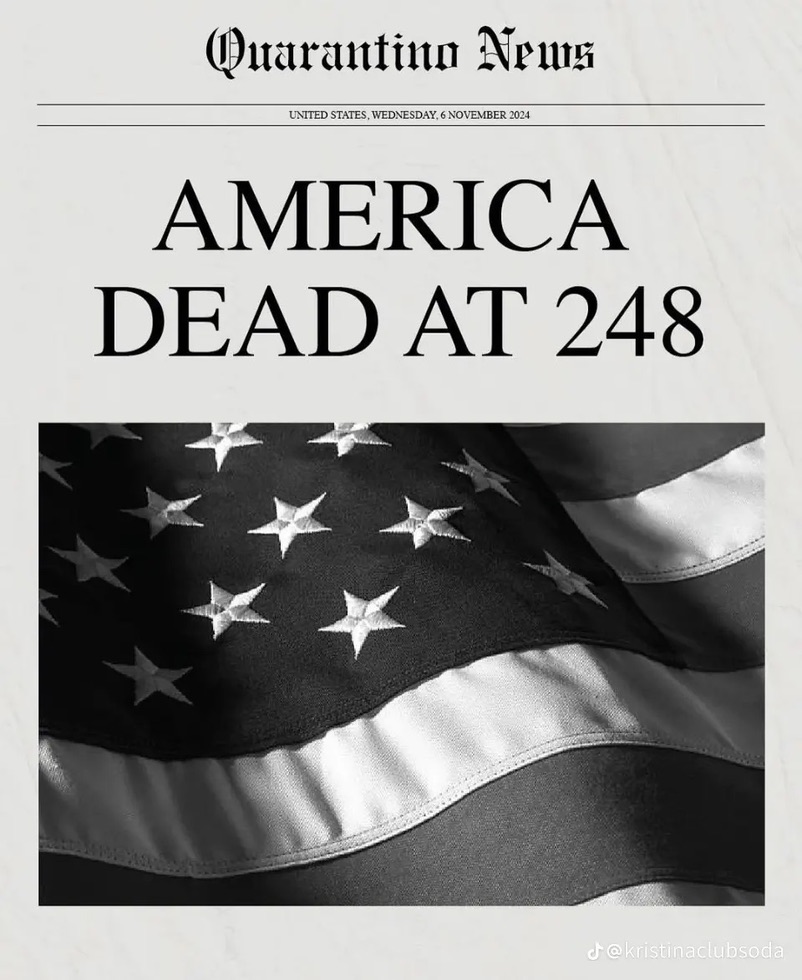
  • The Death of America.

    The Death of America.

    We can disagree and still love each other unless your disagreement is rooted in my oppression and denial of my humanity and right to exist

    James Baldwin

    I have a theory: men are jealous of a women’s ability to create life. Destruction is noted in callous behavior in their younger years — the throwing of their toy cars, the hitting, slapping, touching, killing. He cries toward a female god, of women in witchcraft, or how she wishes to be in doctor offices and law firms and science labs or behind podiums. Before the patriarchy, animals became their first target [they were unable to talk back, only, more feasibly, scream]: killing, maiming, dissecting, selling, raping, until they derived some pleasure: Female orangutangs in prostitution circles for years, the control over breeding season as they mix chihuahua’s and Doberman’s, the statistical link of animal cruelty and serial killers, until they searched for something which held the equivalency of their human life — this time they wanted the power of knowing they could kill something akin to them, the struggle from which their pleasure could derive. [The, ‘I may not be able to create life, but I can dictate yours’ mentality, which has developed in the coming centuries.] 

    Of course, they needed inspiration… they became prophets, scribes, poets, a gender foundational to intelligence. Education was turned to the legal, the social, the economically integral as head of house, the political as ‘leaders’. Religion was constructed, forced upon the crippling bones of an empire, barely held together by screeching voices and murderous intentions — was it then, as the blood filled the space before them, that death was all their hands could proctor? Movies made them hero’s, books made them murderous, war was strictly ordered by them; the atomic bomb, chemical warfare, gas chambers, torture shaped by bronze statues and state guillotines, Greek myths depicting disease and loose heads — for man, it was easier to cut off the hand before one held it.  

    Did they look upon mothers with scorn, as they damned Eve for the thirst of want — crucified her mouth, tied ribbon around the throat, held hands over the eyes, until she was no longer a God, but a womb facing death. Was it the purity they could no longer garner themselves — the body composed in the blood of their mother — that woman then, needed to be punished? What to make of the virgin Mary, betrothed at 12, a mother — a creator — discarded for the man, the sacred son, the one who developed a voice from the calcium of her bones, damned for the flesh of her womb, given to a son which must caress the hand of the holy. 

    They have become refined in their methods of torture. Playful tones, sly hands meant to caress, and shirts for toddlers demanding their feet cemented to a future kitchen. Donned in white, with rings burned into fingers caked of dish soap, forced to walk in circles around his chair, city sidewalks, a grasping hand of an uncle. We become news stories, death upon death, martyred, served, punished, praised by few, dedicated by housewife, chopped up, blended, denied, sold, brain dead, raped, buried by the river, prostitutes, riddled in childbirth… [at the hand of pastors, fathers, boyfriends, [or most of all, never found] 

    Men constitute 99.3% of those arrested for child pornography offenses

    Men constitute 99% of those arreseted for mass shootings

    Men constitute 96% of those arrested for incest

    Men constitute 95% of those arrested for serious domestic abuse

    Men constitue 91% of those arrested for familicide

    A desperate attempt to know God, to prove their righteousness [power], through honor killings, acid attacks, megachurches, abortion bans, mass shootings, church in schools, until they become their own metaphorical god. A needed advantage after the knowing barrier of her ability to create and God’s ability to nurture life — he must by nature, assume a religious opposition by death, severing the cord from a womb — until God becomes a father, and soon, believe a man might just be God after all. 

    —-

    I suppose now it would be crucial to scream. March in streets, hands clenched and held, and as the photographs are taken of blotchy faces and burning lips, we can pose alongside a replica in our history books. I suppose. As it spans centuries, until the history books cannot keep up, loaded in black-and-white stills, lengthy in the next protest and country and overruling of their rights to hold their body as their own. I suppose. 

    Yell fire, I suppose. Die from sepsis, I suppose. Become a doctor, only to be called a nurse, I suppose. Drug yourself on valium and amphetamines, become the wife he has always wanted, I suppose. Die on magazine covers with a hand over each breast, I suppose. Be a black woman, toyed by the medical industry, noted that you do not carry any pain within your body, I suppose. Have your land stolen and your body sterilized as a Native American woman, I suppose. 

    Become a women destined to fall down the stairs, train tracks, suitcases, i suppose. Sacrifice my womb, hold its bloody, beating body apart from mine, apart from this flesh which can make a voice loud enough to drown out mine. How much would my skin be worth then? I suppose, not enough.  

    Be a woman, I suppose


    “Once upon a time there was a wicked witch and her name was

    Lilith

    Eve

    Hagar

    Jezebel

    Delilah

    Pandora

    Jahi

    Tamar

    and there was a wicked witch and she was also called a goddess and her names was

    Kali

    Fatima

    Artemis

    Hera

    Isis

    Mary

    Ishtar

    and there was a wicked witch and she was also called queen and her name was

    Bathsheba

    Vashti

    Cleopatra

    Helen

    Salomé

    Elizabeth

    Clyemnestra

    Medea

    and there was a wicked witch and she was also called witch and her name was

    Joan

    Circe

    Morgan le Fay

    Tiamat

    Maria Leonza

    Medusa

    and they had this in common: that they were feared, hated, desired, and worshiped”

    Andrea Dworkin, Woman Hating: A Radical Look at Sexuality (1974)


    To:

    Josseli Barnnica, Amber Thurman, Candi Miller, Nevaeh Crain, Kyleigh Thurman, Kiersten Hogan, Elizabeth Weller, Mylissa Farmer, Amanda Zurawski, Jaci Statton, Kristen Anaya, Cristina Nuñez, Kylie Beaton, Samantha Casiano.


    “Look at that face, would anyone vote for that, can you imagine that that as the face of our next president”

    Trump

    “Are you going up the escalator? Yea. Im going to be dating her in ten years” (She was eight)

    Trump

    “I don’t even wait. And when you’re a star, they let you do it. You can do anything. Grab them by the pussy. [You] can do anything. “

    Trump

    “[Stern] Let me give you a hypothetical. Melania is in a horrible car accident, her body is fine except for the fact that her left arm is paralyzed. [Trump] ‘How do the breast look?’ [Sterne] ‘The breast are okay.’ [Trump] Okay, well that is important.”

    Trump

    [Trump on his one-year-old daughter] “She’s a really breautiful baby. She’s got Marla’s legs. We don’t know whether or not she got this part yet [Trump then points to the breast], but time will tell”

    Trump

    “If Ivanka were not my daughter perhaps I’d be dating her.”

    Trump

    “I’ll tell you the funniest is that i’ll go backstage before a show, and everyone is getting dressed and ready and everything else. And I’m allowed to go in because I’m the owner of the pagent. And therfore I am inspecting it. ‘Is everyone ok?’ You lnow they’re standing there with no clothes.[laughs] ‘Is everybody ok?’ [laughs]”

    Trump


    By now, I wish to make this article clear. A week later, I speak on the devastation of hearing the election results — of watching another qualified, strong woman be devalued, picked apart, slut shamed, and cast aside, not only for simply being a woman, but also being a black woman in the United States.

    There was a loud distaste from my corner of the house growing up — a burning, sobbing, moment of a young girl burdened by a skin, made from the women of another. In trying to find my identity i cried for black women, people of color all around the world, of those homeless, the millions in the foster care system, those apart of the LGBTQ+ community, the disabled, the starving, the veterans sold the American dream and riddled in PTSD, I suppose you must understand where I am coming from here. 

    Within those foundation years of a women’s life, which may seem to be all, but more specifically I am speaking upon those brutal teenage years, the years filled with boxes on a bedside table as you shape it around your waist and keep it filled with rubber bands. As your mind must be shaped by the advancement of others, of the sexual escapades you must be aware of to protect yourself, of the foods you must watch and the hobbies you need to just become, interesting. It is in those blistering school lights, first period, or the moment to breath at lunch, where you see the pre-occupied space, you must take up, squished alongside every other woman who has come before you. Sold alongside the American dream, fear must linger, like a father in the room beside you. You must dream of love, think too deeply of your madness and write about it [not intelligently, your progression could only be marked by the fanatical, you don’t know the ‘real’ world like a man], and by men’s desire of the feminine presentation, don’t think of politics, economics, physics, technology, law, finance, or the mind at all.  

    Instead, you should understand the man [the heroine, the one always wielding a sword, the leader, the one strong enough to kill you] and as the voting statics have announcing young men to be the most influential toward Trump’s campaign, this must simmer here: “Trump embodied an aggressive, testosterone-driven masculinity that many conservative evangelicals had already come to equate with a God given authority to lead”. It was this unfortunate mentality, man derived consequential connection between Trump and God, and unsurprising to a very similar group of people, he becomes their savior (from his increased tariffs? I am still trying to come up with their correlation here…) 

    Recently, Trump’s cabinet has been ‘formed’ for his next term in office — this reads like an episode from Family Guy, so please laugh with me.

    Elon Musk becomes the “Department of Government Efficiency”; Manipulates the stock market in order to further enrich himself on a regular basis; took on $13 billion in debt to purchase Twitter [how is this financially reasonable?]; He reinstated thousands of accounts belonging to prominent neo-Nazis, white nationalists, misogynists, anti-immigrant and transphobic figures; i feel like this one is self-explanatory…

    Matt Gaetz as “Attorney General” — accused of child sex trafficking, statutory rape, illicit drug use, underage sexual abuse, illegal drug use, sharing inappropriate images and videos on the House floor, misusing state identification records, converting campaign funds for personal use, and accepting impermissible gifts; invited alt-right Holocaust denier Charles C. Johnson to attend Donald Trump’s State of the Union address. Johnson previously raised money for the neo-Nazi website The Daily Stormer; Gaetz’s office acknowledged that he spent $28,000 on speech-writing services, which is prohibited by House rules; Gaetz organized a “storming” of a Sensitive Compartmented Information Facility on Capitol Hill by about two dozen Republican congressmen; tweeted “The mob wants to destroy America. We need PATRIOTS who will defend her” after Kyle Rittenhouse killed two people in protest — he then offered him a congressional internship.

    Tulsi Gabbard — “Director of National Intelligence” — raised on the teachings of the Science of Identity Foundation [criticized for their condemnation of homosexuality and hostility toward Islam have been heavily criticized.]; Successfully led opposition and protests to a state bill that would have legalized same-sex civil unions; She has no qualifications as an intelligence professional — a role which would oversee 18 intelligence agencies and over 70,000 people; an apologist for both the Syrian dictator Bashar al-Assad and Russia’s Vladimir Putin 

    Pete Hegseth as “Secretary of Defense” — Fox News TV Host, never held a political role, is to assume the position of leading over a million troops in the United States; persuaded Trump to pardon three American soldiers accused or convicted of war crimes related to the shooting of non-combatants in Iraq; [his issue with education, speaking upon Harvard]: “that as conservatives and patriots, if we love this country, we can’t keep sending our kids and elevating them to universities that are poisoning their mind.”; Hegseth also criticized the US military slogan “our diversity is our strength”, calling it the “dumbest phrase on planet Earth”.; accused of committing sexual assault in a hotel room after speaking at a California Federation of Republican Women event in Monterey, California 

    Kristi Noem as “Homeland Security Secretary” — shot her pet dog to show she is willing to do anything ‘difficult, messy and ugly’ in politics; Noem co-sponsored legislation that would federally ban abortion; Noem used pandemic relief funds to promote tourism during a surge in cases in the state — She used $819,000 of those funds to have the state’s Department of Tourism run a 30-second Fox News commercial she narrated during the 2020 Republican National Convention; In 2019, Noem signed a bill into law abolishing South Dakota’s permit requirement to carry a concealed handgun; Noem opposes same-sex marriage. 

    Robert F. Kennedy Jr. as “US Health Secretary” – Not only would he be in charge of a multi-trillion-dollar budget, he has aired out two decades worth of false claims about vaccines [America, I hope you like Measels]; made the damaging claims that vaccines were linked to autism [I really cannot explain this for the millionth time]; The stock prices of vaccine makers like Moderna, Pfizer and Merck fell after Trump announced his pick. [I just had to add this in as I laughed when I read it]; He later tweeted, “psychedelics, peptides, stem cells, raw milk, hyperbaric therapies, chelating compounds, ivermectin, hydroxychloroquine, vitamins, clean foods, sunshine, exercise, nutraceuticals and anything else that advances human health and can’t be patented”.[I have seen this pattern before, if you find yourself aware at this stage, go eat a pint of Ben and Jerry’s]; “Kennedy has described his position as advocating for medical freedom and raising concerns about government overreach in public health matter” [Are we beginning to see how hypocritical this is?] I would add on his drug felony, but apparently 34 means nothing, so I will let you make that very decisive decision. 

    Unsurprising, If he appointed Casey Anthony to Director and Child and Family Services, I would not be shocked.

    Quickly, there are a few points I wish to just leave here, on some text-filled paper, maybe to remember or for you to question: 

    A Few Constitutional freedoms revoked by Project 2025: 

    1. “Unitary executive theory” — entire federal bureaucracy will be placed under direct presidential control. The 922-page document proceeded to list the FBI as a “bloated, arrogant, increasingly lawless organization.” The proposal also extends to “declassif[ying] government records”  
    1. The closing of the Department of Education, an idea Trump has endorsed. Established in 1979, the program “oversees funding for public schools, administers student loans and runs programs to help low-income students” while also “enforc[ing] civil rights laws that prevents race or sex-based discrimination in federally funded schools.” 
    1. After being mentioned over 200 times in the document, abortion should be centered around data collection and “maintain a biblically based, social science-reinforced definition of marriage and family”. 
    1. Deportation is another main point of the document, where they have spoken to the mass deportation, eleven million in total, (a feat which would cost over 88 billion a year, even though the undocumented immigrants pay over 96 million in taxes in 2022 alone). The inhuman and ethical conditions which families are already subjected to, when Trump devised his wall in 2016, feature children in cages too young to list the names of their parents.  
    1. Climate — they propose to “slash federal money for research and investment in renewable energy and calls for the next president to “stop the war on oil and natural gas”. This eventually develops into the tariffs, which Trump extensively touches on with his campaign, yet people still seem unclear of what Tariffs mean… 

    I am just going to leave this here: “It proposes to eliminate a long list of terms from all laws and federal regulations, including “sexual orientation”, “gender equality”, “abortion” and “reproductive rights”. Following this idea of white America, it also wishes to “end diversity, equity and inclusion programs in schools and government departments” 


    Do men know of this rage or only the violence which they suppose, follows? 

    From my history, I know listing facts, statistics, articles leads me no listening ears — a severed connection of human interaction once again follows the history of American politics — and so I should write a monologue I suppose, yet I fear, all that I have learned, seen, felt, heard, will simply not matter. I can interject of the hope I had for the people [that is what matters right?] But hope was never a sought object, it was already commodified, ran through for the possibility of economic prosperity and teeth-clenching lies.  

    The United States of America has become a playground. Run by those who lack integrity and prize loyalty over ability, until it is left to crumble on the backs of millions of people. While I am sure my words lack eloquence, I do wish to make clear the rage I have felt and I am sure everyone around the world felt, so it feels necessary to end with: 

    “To the young people who are watching, it is okay to feel sad and disappointed, but please know it is going to be okay. On the campaign, I would often say, when we fight, we win. But here is the thing, sometimes the fight takes a while. That doesn’t mean we won’t win. That doesn’t mean we won’t win. The important thing is, don’t ever give up. Don’t ever give up. Don’t ever stop trying to make the world a better place” 

    Kamala Harris 


    “We have worked to hard and fought too long to see out daughters grow up in a world with fewer rights than our mothers”

    1900 – Women Gained Property and Wage Rights

    1910 – Women Could Wear Paints

    1920 – White Women Could Vote

    1963 – Women Gainted Equal Pay Right (Still Questionable)

    1965 – Black Women Could Vote

    1969 – Women were Allowed to Initate Dicorce from their Hisbands

    1972 – Women Could Get Birth Control, Without A Man

    1973 – Roe V. Wade

    1974 – Women Could Buy A Home, Without A Man

    1975 – Women Could Open a Bank Account Under Their Name

    1988 – Women Could Own Their Own Buisness, Without A Man

    1994 – Women Gained Legal Protection Against Domestic Violence

    2022 – Roe V. Wade Overturned


    Book recomendations, as reading is always political:

    I Who Have Never Known Men, Jacqeline Harpman

    A Girl’s Story, Anne Ernaux

    The Woman Destroyed, Simon De Beauvoir

    Doppelganger, Naomi Klein

    A Woman, Sibilla Aleramo

    Your Silence Will Not Protect You, Audre Lorde

    Study for Obedience, Sarah Bernstein

    Biography of X, Catherine Lacey

    Still Born, Guadalupe Nettel

    Recollection of my Non-Existence, Rebecca Solnil

    Reading Lolita in Tehran, Azar Nafisi

    The Days of Abandonment, Elena Ferante

    Of Cattle and Men, Ana Paula Maia

    A Woman is no Man, Etaf Rum

    Assembly, Natasha Brown

    Death in her Hands, Ottessa Moshfegh

    Enter Ghost, Isabella Hammad

    Sex and Lies, Leila Slimani

    Drive Your Plow Over The Bones of the Dead, Olga Tokarczuk

    Mutual Aid: Building Solidarity During this Crisis, Dean Spade

    Let This Radicalize You, Kelly Hayes & Mariame Kaba

    Men Who Hate Women, Laura Bates

    The Fire Next Time, James Baldwin

    Hood Feminism, Mikki Kendall

    Women, Race & Class, Angele Y. Davis

    Men Explain Things to Me, Rebecca Solnit

    Invisible Women: Data Biased in a World Designed for Men, Caroline Criado Perez

    A Room of One’s Own, Virginia Woolf

    We Should All Be Feminist, Chimamanda Ngozi Adichie

    Freedom As A Constant Struggle, Angela Davis

    Woman Hating: A Radical Look at Sexuality, Andrea Dworkin

    Hood Feminism, Mikki Kendall

    On Women, Susan Sontag

    On Women On The Ground: Essays By Arab Women Reporting From The Arab World

    Becoming Abolitionsit, Police, Protests, and The Pursuit of Freedom, Derecka Purnell

    Dear America: Notes of an Undocumented Citizen, Jose Antonio Vargas

    Go Tell It On The Mountain, James Baldwin

    Nervous Conditions, Tsitsi Dangarembga

    Jesus and John Wayne, Kristin Kobes Du Mez

    Poverty By America, Matthew Desmond

    One Nation Under Guns, Dominic Erdozain

    The Heat Will Kill You First, Jeff Goodell

    Caste, Isabel Wilkerson


    To Women who live in:

    El Savador, Malta, Phillipines, San Marino, Andorra, Eygpt, Haiti, Iraq, Mauritiania, Senegal, Dominican Republic, Nicaragua, Republic of the Congo, Suriname and Alabama, American Somoa, Arkansas, Idaho, Indiana, Kentucky, Louisiana, Mississippi, Missouri, North Mariana Islands, Oklahoma, South Dakota, Tennessee, Texas, West Virgina, Florida, Georgia, Iowa, South Carolina, Nebraska, North Carolina, Guam, Arizona, Utah

    Look to:

    Vitamin C (2-4 times a day), Mugwort, Dong Quai, Black Cohosh, Mothetwort, Damiana, Tansy, Anjelica Root, Queen Anne’s Lace, and Thuja.

    Websites:

    https://www.theguardian.com/us-news/ng-interactive/2024/jul/29/abortion-laws-bans-by-state

    https://www.insidehighered.com/news/government/politics-elections/2024/07/11/how-project-2025-could-radically-reshape-higher-ed

    https://www.theatlantic.com/newsletters/archive/2024/11/tulsi-gabbard-nomination-security/680649/

    https://en.wikipedia.org/wiki/Kristi_Noem

    https://www.bbc.co.uk/news/articles/c977njnvq2do

    https://www.bbc.co.uk/news/articles/c79zxzj90nno

    https://www.bbc.co.uk/news/articles/c4gx3kkz8z3o


  • Social Class and Justice demonstrated in Bessie Smith’s ‘Washwoman’s Blues’: How Jazz Followed the Lower Class During the Harlem Renaissance.

    Social Class and Justice demonstrated in Bessie Smith’s ‘Washwoman’s Blues’: How Jazz Followed the Lower Class During the Harlem Renaissance.

    “The jazz man must lose his identity even as he finds it.”

    Paul Gilroy, The Black Atlantic:

    Modernity and Double Consciousness

    A rupture, a cultural fracture, and a vocal disruption of the white voice, jazz embodies the subjectivity and integral expression of the black body. Drawn from the blues, the genre found movement in New Orleans, centred in Congo Square, as the slaves gravitated toward their own markets, grounds of dance, and the necessity — a moment to sing. Decades later, the migration from southern plantations to northern cities, facilitated the Harlem Renaissance[1], whose emergence in intellect, the arts, and political scholarship, shaped black culture, and most importantly the black voice as it encounters modernity and its afflictions.

    “There is little social protest in the blues… There is complaint, but protest is stifled… The oppressive weight of prejudice is so constricting that it is not surprising to find little protest in the blues.[2]” Charter’s study is hardly surprising as criticism became intrinsic to black expression, yet it draws upon Agamben’s, Bare Life[3], and in this context Fred Moten’s, Aunt Hester’s Scream, of the black voice being commodified, stifled, unwilling, or impossible. Mutilated, their ‘protest’ of speech signals the lack of conveyance the black voice carry’s as Charter’s denotation of ‘complaint,’ summarizes societal treatment, ridding their identity of repression and rather rife with indignation, instead. Paul Oliver slew of targeted language adds to such harmful notions: “That the number of protest blues is small is in part the result of the […] acceptance of the stereotypes that have been cut for him[4].”

    Posited as “The Empress of Blues,” Bessie Smith tonally situates her blues on“racism and econimic injustice — crime, incarceration, alcoholism, homelessness, and the seemingly insurmountable impoverishment of the black community.[5]” Mirroring vocal disruption a century prior[6], Smith’s presentation of ‘Washwoman’s Blues’ consciously protests the ill treatment of black women who were cornered to domestic servitude:

    Lord, I do more work than forty-‘leven Gold Dust Twins

    Got Myself a achin’ from my head down to my shins

    Sorry I do washin’ just to make my livelihood

    Oh, the washwoman’s life, it ain’t a bit of good

    Fraught with brash vocals, the emotion emulated parallels the physical suffering shown in domestic labour, whose inflection of ‘achin’ suggest the desire for further opportunities, less economic stratification, or simply a protest of hard, unforgiving labour in the domestic – an assertion continued by Davis[7] as ‘slavery reincarnated’. A later emphasis on ‘Gold Dust Twins’ constructs the racialized connotation embedded in domestic labour, as this washing product featured two male twins in black face, or in earlier advertisements of African children depicted with loose tongues and expressive eyes, captioned with ‘Do your work’ and ‘Roosevelt scoured Africa.’ Such ‘beastialization’ portrays a primitive, animalistic nature of the black self and allows Smith to intentionally protest domestic positions through jazz – as the art form littered in bodily movement can became rife in moral interpretations, once the voice has the position to carry past words and to hand and feet. It was also simply imperative that Smith facilitated repetition alongside a cleaning product littered cupboards across America – connectivity had its foundation in commonplace articles.

    Touching upon Smith’s third stanza, social injustice shadows a satirizing introduction of ‘Sorry’ – an apology abundant in her servitude status marked by gender, race, and clear economic stratification, but also tone which surrounds a clear verbal attack on her inability to escape, a possible snark ‘complaint’ to outline frustration, anger, and resentment toward a women’s designated duty, or as it can be more clearly stated, a protest

    “Brooks moves from an analysis of the langauge in the lyrics of “Washwoman’s Blues,” which he regards as anachronistic and “inauthentic,” to a much too literal and thus rather shallow reading of the content, which he thinks is violated by the instrumental[8]

    ‘Much to literal’ ‘shallow’ and ‘inauthentic’ provide a hypocritical insight into Brook’s conditions surrounding music, declaring Smith’s emotional encounter with racialized injustice as ineffectual. A rather deflating argument, the defining characteristic of jazz, as a genre, perpetuate “[An] assertion within and against the group.” Jazz, “springs from a contest in which the artist challenges all the rest; […] represents a definition of his identity: as individual, as a member of the collectivity and as a link in the chain of tradition[9].” Smith’s utilization, expression, tone, and movement of her body and vocal assertions delivers, or rather, represent the intention of jazz: the recognition of the black self and its voice. As Moten, Glissant, Gilroy, Hartman, and at present, Smith, situate the black construction of the self, their protest was outlined in expressions through autobiographical recognition (the acceptance of the I), a recognition of the body past a commodity, and rejection of class and economic discourse, until the fluidity of jazz situated an evolutionary space for the black voice to be heard.


    [1] Countee Cullen, W.E.B Du Bois, Claude McKay, Billie Holiday, Ella Fitzgerald

    [2] The Poetry of the Blues, 1963

    [3] “the loss of this distinction obscures the fact that in a political context, the word ‘life’ refers more or less exclusively to the biological dimension or zoē and implies no guarantees about the quality of the life lived”

    [4] The Meaning of the Blues

    [5] Blues Legacies and Black Feminism, Angela Davis

    [6] The scream of the slave was notified as a clear disruption in the racialized treatment that was enacted by slaveowners. It was the only moment for the black voice to be heard, which was in reaction to pain.

    [7] “…”

    [9] The Black Atlantic: Modernity and Double Consciousness, Paul Gilroy

  • Notes On 1-2

    1. Money and Sex. One women uses it for reclaiming her bodily autonomy, the man pressures, coerces, starts and finshes, as transactional weapons. They both fund the pleasure circle, presently who could stop it? That who funds it or one who pockets the cash?

    In any type of introduction to this question, empathetical and/or moral justification would need to be lessened or void. Addressing the objective of Money and Sex, transactional commodification of the body would be the only present source of argument, a battling of skin to skin, a questioning of whose is worth more. As a woman, my alliance and biases are prone and left to mutilate broad phrases, yet to keep it simple, can both sides of the interaction be held at equal ground, where the availability to run, stop, or finish is equitable. If no balance can be dectected, than sexual pleasure has to be transactional, leaving deficency of equal gain, i.e ejaculation, money, emotional gratification. If one is to continue on this example, bodily autonomy for the women can only be captured if she presently overrides the opposing pleasure. If the man is not to ejaculate nor have any reactive pleasure, she is to be presumed to have won in the exchange, only if physical pleasure or profit is to occur for her. In this case, as the man initates the pleasure and only insertion can be guarenteed by his urges, the occasion in which the women functions as higher ground in the exchange, could only be executed with the man’s desire – a production that leaves consent to mirror his desire to ‘take’ and her necessary reaction to flee. As the beginning follows the man’s initation of desire, equality of ground in sexual interaction can only be percieved as wanted if consent is held by the woman, and from there a baseline of equitable interaction is driven from circumstance they both partake in. If the women was to be labeled as a prostitute by action or interaction, than her consent is already taken from her by the man when monetary exchange is present, leaving the women to presumably address her bodily atonomy not as an assertion of herself but as means of survival. Her skin, not worth less, but reconstructed for personal survival no longer continues the assertion of money v sex, but rather seen as customary means of survival which must co-exist in the flesh.

    “[…] it is ultimately futile to attempt to disrupt one system without simultaneously disrupting others.” The woman in this situation will fail to undo her subbordination without acknowledgement and further dismantelting of class explotation spurred by gender hierarchies, financial instability by lack of family privilege and/or stable upbringings, etc. To address the man, one would attack his desires, his wealth, his place in relation to her, the ultimate pleasure he wishes to encounter, and, so his continual relation with sex correlates with the unconscious assertion of his ‘self.’ The man, in cases of desire where penetration is seeked, ‘taking’ in a necessary function, a metaphysical proclamation which posits him into the realm of masculinity, and further contributed to the opposing nature of the women which is forced, by correlation, to exist in the realm of ‘giving.’ Sex displays such proclaimed actions, must the breast, the vagina, the asshole, be diminshed to ‘hole’ for her, and ‘pleasure’ for him. Not to be too clincal any further, if one is to wish for an answer, where the possibility of stopping this ‘pleasure circle’ is necessary to disrupt the transactional relationship between money and sex, acceptance of what each person is to lose must be held at similar ground, even when acknowledgement toward oppressive systems favour one more feverently, and it is only then can the hierarchies and instiutions which subvert one as less equal by gender, class, or race, be forced into direct addressment and further action toward a deficiency which leaves one inequal from their counterpart.The man would have to assume the position of his masculinity to not co-exist with ‘take,’ and the women’s feminine existence can not (by social conditions) be seen as inequal nor impartial to the man’s physical assertion to his ‘self’ on grounds of overpowering and lose of assertion.

    2. Money and Sex. One women uses it for reclaiming her bodily autonomy, the man pressures, coerces, starts and finshes, as transactional weapons. They both fund the pleasure circle, presently who could stop it? That who funds it or one who pockets the cash?

    In any type of introduction to this question, empathetical and/or moral justification would need to be lessened or void. Addressing the objective of Money and Sex, transactional commodification of the body would be the only present source of argument, a battling of skin to skin, a questioning of whose is worth more. As a woman, my alliance and biases are prone and left to mutilate broad phrases, yet to keep it simple, can both sides of the interaction be held at equal ground, where the availability to run, stop, or finish is equitable. If no balance can be dectected, than sexual pleasure has to be transactional, leaving deficency of equal gain, i.e ejaculation, money, emotional gratification. If one is to continue on this example, bodily autonomy for the women can only be captured if she presently overrides the opposing pleasure. If the man is not to ejaculate nor have any reactive pleasure, she is to be presumed to have won in the exchange, only if physical pleasure or profit is to occur for her. In this case, as the man initates the pleasure and only insertion can be guarenteed by his urges, the occasion in which the women functions as higher ground in the exchange, could only be executed with the man’s desire – a production that leaves consent to mirror his desire to ‘take’ and her necessary reaction to flee. As the beginning follows the man’s initation of desire, equality of ground in sexual interaction can only be percieved as wanted if consent is held by the woman, and from there a baseline of equitable interaction is driven from circumstance they both partake in. If the women was to be labeled as a prostitute by action or interaction, than her consent is already taken from her by the man when monetary exchange is present, leaving the women to presumably address her bodily atonomy not as an assertion of herself but as means of survival. Her skin, not worth less, but reconstructed for personal survival no longer continues the assertion of money v sex, but rather seen as customary means of survival which must co-exist in the flesh.

    “[…] it is ultimately futile to attempt to disrupt one system without simultaneously disrupting others.” The woman in this situation will fail to undo her subbordination without acknowledgement and further dismantelting of class explotation spurred by gender hierarchies, financial instability by lack of family privilege and/or stable upbringings, etc. To address the man, one would attack his desires, his wealth, his place in relation to her, the ultimate pleasure he wishes to encounter, and, so his continual relation with sex correlates with the unconscious assertion of his ‘self.’ The man, in cases of desire where penetration is seeked, ‘taking’ in a necessary function, a metaphysical proclamation which posits him into the realm of masculinity, and further contributed to the opposing nature of the women which is forced, by correlation, to exist in the realm of ‘giving.’ Sex displays such proclaimed actions, must the breast, the vagina, the asshole, be diminshed to ‘hole’ for her, and ‘pleasure’ for him. Not to be too clincal any further, if one is to wish for an answer, where the possibility of stopping this ‘pleasure circle’ is necessary to disrupt the transactional relationship between money and sex, acceptance of what each person is to lose must be held at similar ground, even when acknowledgement toward oppressive systems favour one more feverently, and it is only then can the hierarchies and instiutions which subvert one as less equal by gender, class, or race, be forced into direct addressment and further action toward a deficiency which leaves one inequal from their counterpart.The man would have to assume the position of his masculinity to not co-exist with ‘take,’ and the women’s feminine existence can not (by social conditions) be seen as inequal nor impartial to the man’s physical assertion to his ‘self’ on grounds of overpowering and lose of assertion.

  • The Necessary Pages: August [PDF] edition And Deserted Drafts. [And a Some Connections between Texts.]

    The Necessary Pages: August [PDF] edition And Deserted Drafts. [And a Some Connections between Texts.]

    “… separating, purifying, demarcating, and punishing transgressions.”

    One of her most influential works, Butler’s theoretical perception of gender and the body is captivating by the single use of cultural inscription. A guide between the works of Sontag and Fellows / Razack seen much later, Butler’s approach must be led by two confounding questions: “Is there a political shape to “women,” as it were, that precedes and prefigures the political elaboration of their interests and epistemic point of view?” and “What circumscribes that site as “the female body?”

    So, how does culture, inscript a body to formulate decisive language, practices, or rules which one should adhere to by their presentation? There is, of course, no statistical measure of the body’s personification of itself nor could a graph be formed highlighting an achievable number according to one’s gender presentation; gender is then, “neither true nor false, neither real nor apparent, neither original nor derived.” Yet, more specifically, Butler’s conclusion provides a context of cultural inscription of gender, which becomes necessary to the function of these comprehensive questions:

    “Gender is a performance with clearly punitive consequences”

    The categories of ‘performance’ and ‘consequences’ are carefully divided into the internal and external environment of the body. We develop into a gender performance before conception, bound by limiting colors or designs on t-shirts, held down by feminine activities and masculine sports, forced to separate on opposite sides of the classroom as we slowly begin to view the other as ‘different.’ Regulatory, seasonal, each second, the body’s conception of itself must remain transfixed on the authoritarian power of external reciprocation of acceptance, of the binary which holds long hair to baggy clothes to crossed legs to whip cream on cold drinks meaningful, or rather necessary. To be more concise, Butler develops the “three dimensions of significant corporeality: anatomical sex, gender identity, and gender performance” which begin to fashion the principles of their theory.

    Rather, gender’s movement alongside identity becomes metaphysical, and in the case of performance, it more specifically becomes an illusion. Their work surrounding the ‘Other’, or the Cartesian / Foucault dualistic construction of the soul, or rather systematically, the inscription and transgression onto the body, outlines its illusive significance on gender identity. A ‘disembodied consciousness’ Butler signifies,  a clear separation between the structuralist framework of mind/body and culture/society. Unshockingly, analysis of the skin develops alongside cultural coherence. As mentioned later on, Susan Sontag’s, Illness as a Metaphor, addresses the ill-defined metaphors that shape the sick through the expression of Cancer and Tuberculosis. Butler, follows Sontag’s approach in her work, arriving at the AIDS movement, defining the skin as, “[a] systemically signified by taboos and anticipated transgression.” Bodily fluids become the ‘transgressions,’ and the the cultural inscription derives from the existing hegemonic order, which creates the anti-, the homophobia, toward the ‘Other.’ Butler sums it up as,

    male homosexuality would, within such a hegemonic point of view, constitute a site of danger and pollution, prior to and regardless of the cultural presence of AIDS.”

    So, what is Butler’s conclusion? While, one may have to read into some lines or redefine some new vocabulary, she makes it simple to the readers who have made it that far. It reads as such, “In other words, acts, and gestures, articulated and enacted desires created the illusion of an interior and organizing gender core, an illusion discursively maintained for the purpose of the regulation of sexuality within the obligatory frame of reproductive heterosexuality.” While it might seem redundant, the message aligns with many other theorists and intersectional works in literature, highlighting even some present ideas of Fellows and Razacks, whose theory known as ‘The Race to Innocence’ is mentioned later in this article. Gender is a regulator for people who follow it. A facet of feelings that cater toward feminine and masculine binaries internally, and of course, externally. There is no right or wrong assimilation of presentation toward physical appearance, attire, walks, language, and expression — it is all a performance anyway. Made up of fluid traits, internal gratification can be made from external perception.

    While I could carry on about Butler and her revolutionary theories, I will wrap it up with one more quote that furthers the significance of her work:

    “Gender is an identity tenuously constituted in time, instituted in an exterior space through a stylized repetition of acts.”

    The Race to Innocence is a 19-page document confronting the hierarchal relationships between women when oppression is a point of conversation. Fellows and Razack, who developed their theory in 1998, express the notion of ‘competing marginalities,’ a facet of victimization, complicity, and erasure that emerges from the fear of our own eradication as women. Numerous talking points envelop the framework, layered yet exceptionally examined, so to be concise and literal when creating a specific narrative of my own, here is what Fellows and Razack developed in my own words:

    1. Communication. If they feel they are not validated in the damaging action, if their ideology is not listened to as thoroughly, there will be no shift in targeting other institutions that undermine women. The only equality that will then be reached is one where she feels adequately listened to.
    2. One can use their subordination as a means for further domination if equality for themselves can be garnered. They wish to secure their own places in the margin with fear over risk of erasure, but it develops into an unproductive, systemic pattern.
    3. Although, one may believe their claims are advancing any assertion for justice by addressing institutional subordination or oppression, distinguishing the self as separate, by claiming oneself as an antithesis, leads to further injustice for all.
    4. Questioning past intellectual inquiry, we can begin to ask, “Why do we feel consistently innocent of one another’s oppression.” Multifariouness can be furthered when innocence is addressed.
    5. Identity is only a contrived idea of difference, contrasting with its own root of ‘same,’ when speaking upon groups of subordination. The ‘baseline’ of race, gender, sexuality, language, etc. lack the same continuance of voice, and often face oppression from their own broad group of identification on the basis, that they no longer fit into the baseline. One is to hold the condition of ‘norm,’ a product that embodies the ability to not have to actively produce or sustain the domination.

    The work is furthered, enveloped in historical social orders and Foucault’s examinations of the bourgeois in the nineteenth century, to produce the possible chain of events from prostitution 200 years prior to the social order of the working class. Fellows and Razacks’s procurement of ‘The Race to Innocence’ is necessarily repetitive, and whose broad statements maintain the conditions of social repression unapologetically: “We are able in this way to maintain our innocence and to consider that the systems that oppress us are unconnected from the ones in which we are privileged.”

    Having read the theoretical document a few years back, my interest developed alongside new waves of feministic ventures and mind-numbing old literature whose chosen words for women needed staggering introductions of ill-defined sexual connotations, its approach was a way to work through intersections of race, class, gender, identity, and historical analysis leaving the devaluation of women from a patriarchy, to possibly, a matriarchal evolution whose intersections must first address race. Movements geared toward women are recent, confined to a mere century, whose typical allegiance aligns not with the women, but with the whiteness. Suffrage movements, charts, comparisons, and wages of the man who comes first, but the white women who follow — I spent many moments of my time trying to articulate ‘white feminism’ and its allegiance to race. Sitting in drafts discarded by the tens, the examination of Fellows and Razack’s work led me to my intersectional roots, with titles such as, ‘The Worst of White Feminism and The Glorification of the Sex Industry,’ and drawn-out notes on consent in a televised sex industry1, the transactional space of money and sex2, and what freedoms the women obtains when she is advertised for her bodily autonomy yet utilized for sexual exchange.

    More importantly, the foundation of intersection within race aligns with Butler’s personification of the ‘Other’ from a social ontological perspective. As there will be differing definitions, Fellows and Razack begin to define theirs as:

    “The containment of the Other is a making of the dominant self. To exclude Others from the membership in the human community, that is, to name, classify, and contain the Other through a number of representational and material practices, assures the material basis for domination while enabling the members of the dominant group to define themselves.”

    To mention more names, I had recently picked up The Second Sex by Simon De Beauvoir in a charity shop, with only limited time to read the introduction. Unsurprisingly, her words related to hierarchal relations women encounter, so quickly I wish to share a becoming of the ‘Other’ in the context of man v women:

    He is the Subject, he is the Absolute — she is the Other”

    I could have quoted her passage on Levi-Strauss, or Benda and his Rapport d’Uriel, but what else was this marginalization of the ‘Other’ than verbal manipulation, or by linguistic default, or even the confidence to assign labels? Beauvoir held it simply, man did become the Subject by the peculiar situation of not having to defend male identity — they were simply It. The sex that is women, through hormones or reproductive organs, must clarify the binarism and even defend the title of ‘Other,’ to be seen as an opposite — outlined more specifically when Simone offers a historical analysis of religion, culture, servitude, etc. being overshadowed by a possible weakness, a fault, which concludes that: “No subject will readily volunteer to become the object, the inessential.” And so, the dominant group becomes everything the ‘Other,’ or the ‘weaker’ is not, and at once the label is born.

    Social order drove notions of respectability from feudalism to liberal democracies. History held domination, the assertion of membership in a culture and of personal identity to a systemic hierarchy, leaving the individual to either suffer under the conditions of exploitation or earn distinction in ‘respectability.’ Fellows and Razack are more polished with such words in their work, but what I wanted to end this deconstruction on was the last three pages of the work. Towards the end, their words which mirror the broad questions at the beginning of the work, are more refined and somehow entirely dependent on the last section to to reconstruct this theoretical argument from a historical glance. The quote goes as such:

    “…However, is only made possible by her complicity in maintaining class, gender, and racial hierarchies that resulted in the economic and sexual exploitation of other women”

    While, I could have factored in racial regression, skin and domestic workers, or sexual exploitation and the distinction of the middle-class family, the central argument reconstructed, wisely might I add, to an intersectional perspective while also maintaining a socio-economic and political standpoint was brilliant. They were broad, yet decisive in what it meant to be a woman yet still be subordinate by race, queerness, or economic stature. Unsurprisingly, the mention of ‘complicity’ above, never strayed from the central meaning of the text, which contributes to an understanding of intersectionality, entirely.

    “Everyone who is born holds dual citizenship, in the kingdom of the well and in the kingdom of the sick.”

    Sontag’s descriptions never falter and her statement above captures the refined movement of her text. A common generalization, a homage to her later metaphors and discrepancies society hones toward TB and Cancer, she moves to particulars, developing such comparisons between the ‘sick’ and the ‘well,’ a necessary skill that matures Sontag’s theory: victim-blaming is central to sickness and the language used, the metaphors expressed in medicine or society, even void conversations, re-define those suffering with sickness until their experience becomes navigated by a domination of metaphorical ignorance…

    First, the subjects of deepest dread (corruption, decay, pollution, anomie, weakness) are identified with the disease. The disease itself becomes a metaphor. Then, in the name of the disease (that is, using it as a metaphor), that horror is imposed on other things”

    The patient suffering from Tuberculosis is, “more beautiful and more soulful,” the person dying of Cancer is “robbed of all capacities of self-transcendence, humiliated by fear and agony.” In an elaborate fashion, Sontag doesn’t need specific dialogue or an outline of the theoretical structure toward beliefs, her metaphors are pointedly bold, willing the text to become theoretical by not only analysis but her own confidence. She knew medicine not because of academic knowledge, but become she knew disease; she knew literature, and therefore she knew suffering. Sontag’s brazen claims were not lacking, nor did they shy away from broad assertions; she saw a metaphor in romanticism or a comparison to the soul and knew that language was an appropriate response, to what Judith Butler comes to define as cultural inscription.

    “Health becomes banal, even vulgar”

    Pursuing language surrounding Cancer, Sontag’s perception shocked me with her brilliant comparisons contrived between the patient and terminology used in warfare — a rich analysis of the ruination the disease causes upon the body and the speech we have developed as ‘controlling metaphors:”

    “Thus, cancer cells do not simply multiply they are invasive. Cancer cells ‘colonize’ from the original tumor to far sites in the body, first setting up tiny outposts… Chemotherapy is chemical warfare, using poisons. Treatments aim to ‘kill’ cancer cells… There is everything but the body count”

    It only makes sense for phrases like “the war on cancer” to be coined, that it was a problem which needed to be defeated, a solution solved through associations (American Cancer Society) or by the media as it develops a sense of ‘literalness and authority” toward society. Cancer becomes the “Other,” a “mutation” on a tumor, or an “alien-like” sci-fi tale, which causes an “atrophy or blockage of bodily functions.” It was different than TB and its consumption. It did not inspire romantics and their poems, or idealized beliefs surrounding health when one is skinny enough to cough up blood. It was destruction, past the centering of the soul (like TB), toward the body itself as a target. It became an “Other” by default, on its refusal to consume energy and target the self.

    Not only inventive in her work, I wanted to touch on her sharp comparisons between TB and Cancer. From the first chapter, Sontag made sure to outline Cancer’s position as an outliner in medicine. “Ill-omened, abominable, repugnant to the senses,” etc. A notable polarity to TB, connections between spiritualizing a redemptive death (moral corruption!) or boldened by moral and psychological judgments, the commentary that follows Tuberculosis has differed each century. You were mysterious, wealthy, romantic, healthy, a dropout and a wanderer, one who is creative and sad, attractive, held the distinction for breeding, passionate and strangely sexual, the list can continue filled with the conditioning of the illness on society. I have found that TB’s reputation was shaped from a cultural standpoint, in the same condition Botox, health treatments, laser hair removal, sex toys, coffee, cigarettes, and close relationships with your mother: It is what society made it at that time. It is reconstructed on the revision of health, sex, relationships, and gender which are inscripted and redefined by each decade, until like TB, an accurate depiction is simply not possible. It moves with human nature until you have forgotten one is suffering at all.

    Naturally, I wanted to write more. I suppose anything theoretical holds the right content to spur the desire for my own words, yet as I have not left the idea of this draft yet, the title is all I can afford. It only makes sense to include existentialism into the mix: Romance As A Disease: Sontag’s ‘Illness As A Metaphor’ and Albert Camus, the Stranger, Reconstructs Romanticism Through Tuberculosis (And Cancer.)

    Digested quite briefly here, I do wish to end with a necessary message Sontag discreetly writes within the work, which not only articulates the premise of her text, but holds a social truth of language and fear of the unknown.

    “Psychological theories of illness are a powerful means of placing the blame on the ill”

  • Space, Gender and Chastity: Domestic Space in The Rape of the Lock.

    Space, Gender and Chastity: Domestic Space in The Rape of the Lock.

    Literature 1550-1740, Term 2.

    Judith Butler in Gender Trouble (1989) develops the relationship between gender and space through a cultural discourse. An unprecedented work, Butler’s aim shifts the reflection of gender to the corporeal – the body, and by relation, the space in which the physical and mental are shaped by social intrusion. When addressing Alexander Pope’s, The Rape of the Lock, domestic space becomes a cultural and social inscription which is repressive toward women and an unexplored political playground roaming with the women’s plight toward sexual purity. Domestic space shapes the repressive nature spurred by class and patriarchal objectives until chastity defines the characteristics of a women.  

    Re-worked alongside theory, domestic space leans into dichotomies that allows for cultural inscription, a feat best represented by the Oxford Dictionary as they characterized the space to exist as, “The apartheid system dichotomized physical space into masculine and feminine categories, marginalizing the feminine1.” It is practical to notice the dualism, which must be addressed, where women’s domestic space caters to expansion, possibility, and subversive positions which warrants the growth of children, partners, and their developing passions, leaving the mother, daughter, or wife to cater excruciatingly to a force- fed oppression: “Women were relegated to the inferior physical and social space of the homelands where they were expected to farm, raise children, and care for the sick and elderly2.” In replicating the domestic space in The Rape of the Lock, Pope’s execution becomes fluid and satirical, relegating Beauty as a willingly, yet violent adornment alongside the female body, whose vain rituals profess an innocence not yet known to the woman.   

    Revisiting Butler, her suggestions of ‘cultural inscription’ and the body follows Pope’s domestic space of marriage and class, a notion summed up as,  

    “Space is never neutral but always discursively constructed, ideologically marked, and shaped by the dominant power structures and forms of knowledge… space is both created and articulated through cultural discourse, including gender discourse. Thus, we cannot grasp space outside a socially meditated perspective.3” 

    Pope drives the perception of wealth and space satirically in one excerpt, denoting the jewels and objects adorning the main character, Belinda, as a foolish desire the wealthy place on insignificant items. Class is seen as: 

      “Whether the Nymph shall break Diana’s law, / Or some frail China jar receive a Flaw, / Or stain her Honour, or her new Brocade, / Forget her Pray’rs, or miss a Masquerade, /Or lose her Heart, or Necklace, at a Ball;/ Or whether Heav’n has doom’d that Shock must fall.4” 

    Represented by ‘frail China,’ or her ‘new Brocade,’ the objects surrounding the female character shapes both a metaphysical and domestic space aligned with conforming to beauty practices upheld from a ‘socially meditated perspective,’ whose yearning for marriage is a presentation of ‘her Honour.’ In mock-epic fashion, Belinda’s description of wealth pervades human protection, as the Sylphs surround the embellished and objectifiable lady, leaving Pope to pursue the permeation of the body through the adornment of wealth and established performativity of gender roles: “Form a strong Line about the Silver Bound, / And guard the wide Circumference around.” (ii.121-122) The fixation on the ‘Necklace’ and a ‘Heart’ situate the body and the material in the same category of space – domestic, as Belinda unconsciously indulges the prospect of her situated repression – a decision by Pope, which posits her outside a space of volition and feeds into the class-act of marriage and wealth. The ‘circumference’ of Sylphs surrounding Belinda introduces the skin as a mode of space, a quality capable of permeation and personal condemnation, whose association to gender discourse, brings about the plights of the domestic space, as a limit to the female self:  

    “What constitutes the limit of the body is never merely material, but that of the surface, the skin, is systemically signified by taboos and anticipated transgressions indeed, the boundaries of the body become, within her analysis, the limits of the social per se5”  

    Now, the existence of space from the self to the social creates a distinction of physical limitations; performativity rest upon the beauty of her skin, its likeness to grace and wonders distinctive of innocence until the body performs its own objectivity – she enacts her own gender discourse through a desired cultural inclusion.  

    The significance of the domestic space is rendered to the adequacy of the female body, the forced objective beauty that is: “Th’ inferior Priestess, at her Altar’s side, / Trembling, begins the sacred Rites of Pride.” (i.127-28) Pope’s verbal control toward terms like ‘sacred’ and the aforementioned ‘pride’ by extension must exist in the domestic space of femininity – exemplifying the required attention the body must hold for the women. It is a space worthy of adoration and touch, where ‘rites’ signify the opportunity the woman holds, leaving the ‘trembling’ as Pope’s chosen dichotomy in the sentence: does the sacred nature of feminine rituals driven by excitement of reenactment or nervous acceptance toward her guarded purity and vanity she must act upon? 

    Ending physical permeation of the female body, one last signification of the domestic space is the internalization of the female body and young girls. Introducing Braidotti, Lois McNay states simply, “The internalization of representation of the female body by women is fundamental to the formation of the feminine identity.6” The formation is drawn clearly in Pope’s text, compared quickly alongside Belinda’s evolving vanity, and one which characterizes the female body as less, due to the directive nature one must adopt: “’Tis these that early taint the Female Soul, / Instruct the eyes of young Coquettes to roll, / Teach Infant Cheeks a bidden Blush to know, / And little Hearts to flutter at a Beau.” (i.87-90) Pope’s reference to ‘taint’ corresponds with his mock-epic attitude, drawing upon the absurdity of social adherence, the forceful nature of desire, seduction, and innocence that must be catered to, even when innocence is all the young body holds. The domestic space is manipulated, so much so that the submission must be unnatural – formulated for social coherence and the uplifting of gender roles, and in Butler’s simplest words, performative, until the body is lacking in space completely. 

    Hovering in the realm of the metaphysical, the metaphorical ‘rape’ of Belinda exposes the manipulation of the domestic space and repression of the female body by means of chastity. When positioning the ‘natural’ alongside the female body in Pope’s mock-epic, it becomes “…a device central to the legitimation of certain strategies of oppression,” until it lacks the signification held toward beauty and ornamental jewels of the self – a disruption to the desirable objectification of a ‘body [as] a site of conquest.7”. Belinda’s honed acceptance must follow and indulge toward repression, of self and sexual identity, until she foster’s the decoration of her own virginity, as Pope writes, “Fair Tresses Man’s Imperial insnare, / And Beauty draws us with a single Hair.(ii. 27-28)” The dichotomy rest in Belinda’s internalized and furthered materialized objectification of her beauty – a cultural process spurred by a patriarchal body, while also characterizing the male self to egregious behaviors akin to ‘rape’ and ‘insnare.’ The permeation of this dichotomy rest internally for Belinda, and it is only until the ‘rape’ of her lock is orchestrated by the Baron, does the domestic space wither: “So long my Honour, Name, and Praise shall live!” (iii.170) From her rage-filled declarations, the representation of the female body loses touch with feminine objectification when it eventually becomes ‘conquered,’ or when the honor and name have been stripped of pure, virgin innocence. The woman assembled through mock-epic fight scenes permeate a physical domestic space, where skin contends with its own internal and external oppressors and moral plights induce the voice of women such as Clarissa, Thalestris, and Belinda. 

    Quickly, Foucault’s revaluation of women and their bodies produces a hierarchy of their repression, noted as, “…individuals as docile bodies has the effects of pushing women back into the position of passivity and silence8.” The construction of metaphysical conceptions like honor, pride, and vanity develops what domestic space is and its significance to the female self; It was a rite of passage and a representation of women’s suppression, generational to “her Mother’s hairs/ Which long she wore, and now Belinda wears.” (v. 95-6) Pope references these facets of identity in multiples, contriving, “He spoke, and speaking, in proud Triumph spread / The long-contended Honours of her Head.” (iv.139-140) The hair as a metaphor for rape, or seizing, delineates ‘docile bodies’ enacting ‘passivity’ genealogically, until the unitary movement of the body, the objectified female self and the space in between becomes “a construction, a product of the effects of power.9” This ‘construction,’ lies within the critical nature of man described by Pope, as the female self internalized honor and pride and vanity on man’s decisive rule, yet it was used against them for their sexual identity and objectifiable pleasure.  

    Domestic space is arguably a metaphysical conception, overarchingly dependent on the women’s existence and played by Pope to represent the potential reversal of power between men and women. Canto V redefines the significance of domestic space, as women “killed him with a frown / She smil’d to see the doughty Hero slain” (v.68-9), or the echoing of Belinda’s rage-filled desires, “Restore the Lock! She cries; and all around / Restore the Lock! the Vaulted Roofs rebound.” (v.103-04) The female body, in the domestic space, warrants voice past the expression of honor or virtue but rather violence shed from lack thereof, and rather utilizes the metaphysical to create what can be termed a new ‘domestic space.’ Foucault redefines this shift as a“discourse [which] transmits and produces power; it reinforces it, but also undermines and exposes it, renders it fragile and makes it possible to thwart it.10” Pope’s decision to ‘thwart’ the systematic power over women, to alter the significance of the domestic space, is delivered by Clarissa, whose moral address is noted as such: “Think not, when Women’s transient Breath is fled, / That all her Vanities at once are dead” (i.51-52). Sequentially, the women’s consciousness and further assertions toward their vain plights recognizes space as its own body, capable of change and fluid movements must death alter the current inferiority of the female body, and rather renders the domestic space in favour of their own, personal space. Naturally, the power is seized from men the moment Belinda’s lock of hair tumbles into space, or what Pope denotes as “the shinning Sphere!” (v.143-44). 

    The figurative “domestic space,” the female body encounters welcomes a navigation not only through the construction of gender and sexual identity, but its interaction with metaphysical space and personal identity. Through Alexander Pope’s, The Rape of the Lock, and philosophers such as Judith Butler and Michel Foucault, the significance of space can be critically analysed through cultural inscription, and as a result, the spatial and social begin to develop the performativity of gender past the dichotomy of a domestic space. It is through these articulations that the female self is positioned past the theoretical to the present, capable body, much like Pope’s Belinda.  

    Bibliography: 

    A Dictionary of Geography. ‘Domestic Space,’ oxfordreference.com <https://www.oxfordreference.com/display/10.1093/oi/authority.20110803095725760

    Butler, Judith. 1990. ‘Bodily Inscriptions, Performative Subversions’ in Gender Trouble. Routledge 

    Jagger, Gill. 2008. ‘Judith Butler: Sexual Politics, Social Change and the Power of the Performative.” Routledge 

    McNay, Lois. 1992. ‘Foucault and Feminism: Power, Gender, and the Self.’ Polity Press 

    Pope, Alexander. 2007. The Rape of the Lock. (Vintage) 

    Wrede, Theda. 2015. ‘Theorizing Space and Gender in the 21st Century.’ Rocky Mountain Modern Language Association 

  • The Flexibility of The Body.

    The Flexibility of The Body.

    It’s past seven. I have broken my sobriety twice, if the first time didn’t count enough, and the cider beside me reeks of berries. I can only stomach fruits these days. My body burns, terribly so, each eye hums till the tulips double in sight and each finger becomes diminished by the slight intoxication I gave way to; my shoulder’s ache past relative relief and so in the intolerable heat of fermented cider, the shirt must come off. I am a woman once more. The breasts lean forward, the stretchmarks are abhorrent as they are lovely, and when I fall upon the corner of the shower, I can only find adoration in the body I can call my own. There is much I could say, defiantly, upon every marker of humanity and history and achievements and abilities, yet in a state where the alcohol has marked my singular body as a conscious being capable of love and generosity, each sip pushes me to the conclusion toward this feminine mind and artistic hands and moveable body. In some short, painfully illiterate way, here is everything I once felt about my co-existence of a woman, with a kissable mouth and rough skin.

    i. I cared willingly, fervently, and when religion struck upon my mind, I prayed, in an odd stance and with sweaty hands, about all I could not heal. It was painful in such a small body, poised to know the ruinous emotions and overwhelming fixation of love, yet not act upon them. My body was theirs unknowingly, and rather irresponsibly, and by natural law, I enacted my own child-like persecution, where I dreamed one could read my mind and such unnecessary devotion would be met with consistent understanding; I homed confusion. Still, my sacrifice meant something to me, in tiny jersey’s and shoeless feet, and from this I had come to know of such strange intimacies we pursue so willingly. I was tender as every nine-year-old is, and in big ways, I never knew how to say ‘Thank you’ at birthday parties and on Christmas days, but in some small ways, I knew of you, which meant I still knew how you felt eight years later (and the way you made your breakfast each morning). If I think about this matter at all, it does little harm to know I have never been in love at all, but simply by the condition that I do love, and therefore it must exist.

    From this, as a woman, fundamentally, the simple notion of love seems relatively simple for all the emphasis I put on making sure it was known; most people already know the love you feel for them, its awkward escapades and horrifying experiences are congratulatory. You love well enough, I should say, if doubts toward the softness of your hands ever claimed such tender inabilities, look in your medicine cabinet quietly, you will find all the remedies you salvaged just to save yourself once more.

    ii. We believe we are crazy, sometimes excitingly, as if the blood on our teeth was as clean as water. War-like screams, collapsing chest and mascara tears, all we know coincides with all we’ve felt. It feels structural, as if each cell holds its own grief, some lingering territorial part of longing, until each atom lacks in further development. I could uphold every name given to me, should you question if I have cried harrowingly, devastatingly; it is similar to cell division sometimes, while others fail to beat out by odd laughter. Completely, it is simple, all of this is simple, we cry, scream, puncture, scrape, melt, sing, must we remember how they felt. We wish to know of the devastation, and if we are smart, remember what brought us to strikingly still.

    [the window knows only the cold, the beating of wind upon its frame. I wonder if the heat will melt its body this summer.]

    Girlhood. (!!!)

    pajama parties. makeup and the use of our faces as dummies. princess dresses and our mom’s high heels. press on nails till our fingers bleed and glue that sticks to the sofa. the fear the first time we shaved; the liberation which follows; the begging of people’s hands upon hairless legs. our dad’s oversized shirts as nightgowns. hot, burning, blurring showers. rosy cheeks near the ocean and hopeful eyes in the forest. fashion shows and the swapping of clothes. showers of compliments in the bathrooms at bars; lipstick stains on each mirror as we walk out. the hugs, the touching shoulders, the grabbing hands to pull you into stores. mirrored grief and lack of apologies. selfies and videos and moments all hung upon the wall cased in spotlights. code names of the fruit we ate that morning to the boy we desperately look for. calendars, post-it notes, to-do lists, weekly chores and monthly meetings. the cheeky feeling of the hand over our mouth as we spill our secrets. matching outfits. spilled nail polish, wine, tears, dipping sauces, car keys, ice cream, white pants. the obsession of virginity and the relief that followed. journals and photo albums and burned letters. the synced nausea and white underwear that follow the cramps, panadol, hot water bottles, muscle relaxers, and the eventual fetal position. the anger turned to sadness we held toward our moms; they were girls once too; they could have still been girls now. telling everyone the price of our new shirt we got on sale. flowers, in excessive, in every color, on some continuous loop which holds the remnants of heartache away. our intelligence and the dreams that follow. holding love between the skin on our fingers, knowing it was enough, in some way, in some light.

    [Pause, once more, the shirt is coming back on. I digress.]

    GMT 21:00, Apartment 1, City Center

    (the difference in name is by want and honed acceptance.

    the mind has always been more flexible than the body)

    ME

    Is it pleasureable? You know,

    (pause, some sort of exasperated sign)

    was any of it pleasureable?

    MYSELF

    Were you happy? I am failing to understand the question. Were you happy with the outcome. Was this what you wanted?

    ME

    (confused in the manner of her question, she can only lean upon the frame of the bed)

    That is not really a question. I am happy all the time, you know that very well. I don’t see how any of that matters when it is pleasure I am seeking to understand. I don’t think where this has any place in our conversation. It is unknowing, like some spineless creature with no care of those around them. You can’t want if sacrifice has to exist.

    MYSELF

    (always smiling knowingly, she knows herself so well)

    What do you want? Think slowly, like some spineless creature, as you call it, and if they had no care in the world, what would they want?

    ME

    (her pause is predicatable and depressive. rather inconsolable in the possibility of the question)

    I would think of them as greedy, selfish probably, with to much attention to themselves. Maybe sinful to some people, I wouldn’t know who to hand my desires over to. Its some overflowing laundry basket, and quite frankly, I don’t have the time to seperate all the colors and whites. What’s the point anyway, if they are my wants, they could live in the same soapy water, for all I care.

    (pause. she is conflicted ones more. her body turns

    away from the speaker, a clear line to the city outside.)

    Should I care?

    MYSELF

    You could. I am in no position to point out such cares for you. Ultimately, your desires will slowly die with you, along with each passion and secret dream you have written about in your journal, and while you think you are doing some justice to the world, maybe even to yourself, you are too big to fit back into the box of self-repression as a term of endearment. You are older, not as malleable as a child, yet not old enough to simmer in lost opportunities, and while you think your life is over because everyone else has moved on, you still have to fend for yourself. How are you going to do that? You could care, unabashedly about everything and everyone, but what do you want?

    ME

    (she paces, clear on what she wants, but one more question must be answered)

    What about my mother? What did she want? Could you tell me?

    MYSELF

    (She should have known such a question would appear.

    All she can do is smile kindly)

    Such questions hold irrelavance, my dear. If you can do my the favor of answering the question, I fear my time is limited. All I wish is to hear all that you have wanted. Could you give me something so little?

    ME

    If I must. I want to be nice.

    MYSELF

    (astonished, she interupts seemingly frustrated)

    That can’t be…

    ME

    (Interjects)

    And weirdly strong, like you look at me and you wouldn’t know all that I have went through. And I want to love myself, annoyingly might I add, that I make myself blush when I look in the mirror. Oh, and maybe a little greedy, where I am the first to take a shower, or eat, and maybe I leave the dishes in the sink overnight, because who else is going to do them or really who cares? I wouldn’t really know what to do with myself. [pause] I think I would be happy then, brilliant even, and even when time did sculpt my face and make me knarly per se, I would know who I was. I would enjoy all the time in the world with myself. Who wouldn’t want to be someone so radiant?

    MYSELF

    Then, everything will be pleasureable. Or, by the way you’re looking at me, I am guessing you want to know if you feel the pleasure, am I right?

    [slight nod]

    Well, that I don’t know. Maybe you have always felt pleasure and never knew it. Maybe it has never left you like you thought it did.

    [a quiet smile]

    You know, you never left yourself? You were always here. What is to say about those desires to not wash dishes tonight? I don’t think that was spontaneous, nor do I think you have even recently felt like that. You, the person in front of me, has continually smiled and dreamed of momentous events and found ways to feed all the clothes you currently own. You were never not whole. You were you.

    (They both stare at each other. ME can only nod, gently, before she begins to look for her stuff, gathering her phone and keys upon the bed, as she stands up to head to the door)

    MYSELF

    Oh, and before I forget, when you asked me what you mom wanted, she was very short with her answer. She just wanted you.

    [The cold has gotten to me. I must leave quietly, tonight.]